Trust has quietly become the most valuable currency in artificial intelligence.
People are willing to experiment with AI. They are willing to let it assist, recommend, summarize, and create. What they are not willing to do is surrender control. Every inaccurate answer, unexplained decision, or confusing interaction chips away at confidence, reminding organizations that technological breakthroughs alone are not enough.
This is precisely where Christian Kuhn has built his life’s work.
As Head of UX Center of Competence at Optimizer, Christian has dedicated more than twenty years to understanding how humans interact with technology and, more importantly, why they sometimes choose not to. Long before generative AI entered mainstream conversations, he was exploring conversational interfaces, machine learning applications, wearables, voice technologies, and immersive digital experiences. Those early lessons taught him something that remains true today: innovation succeeds only when it aligns with human needs, behaviors, and expectations.
Today, Christian is recognized internationally for helping organizations bridge the gap between AI capability and human experience. Through his Human-AI Experience Design (HAX) framework, educational programs, and industry thought leadership, he continues to advocate for a future where transparency, user agency, and thoughtful design are treated as strategic priorities rather than afterthoughts.
His work serves as a reminder that the greatest challenge facing artificial intelligence may not be building smarter systems, but building systems people can confidently trust.
Inspired by his commitment to putting humans at the center of AI innovation, we engaged Christian Kuhn in a fascinating conversation about design, trust, and the future of human-AI collaboration.
Here are the excerpts from the interview:
Christian, over the last 20 years, you’ve worked on award-winning products, taught globally, and helped organizations rethink human-centered design. What experiences from your earlier career laid the foundation for your current work in AI-driven UX?
Two things shaped everything that followed. The first was learning, painfully, that what users say and what users do are often very different cases, and that gap is the entire job. The second was watching how often beautifully designed products failed because they ignored the users needs, their requirements and behaviours. I came into UX through Human-machine-interaction and usability engineering, and stayed because of my fascination for the user psychology and behaviour design. It was the work of Fogg, Thaler, Norman and Nielsen, the Irrational Labs school of thinking and many more. Already over 10 years ago, I worked on conversational interfaces like machine learning-driven chatbots in the medical sector or Alexa apps for the financial sector. We build many MVP demos using wearables, VR, AR, Vision AI, Voice AI, and other input methods. We learned a lot these days. And often that the given technology was not ready for the end consumer market.
By the time generative AI hit consumer products, the underlying problem felt familiar. We kept building powerful systems and assuming users would understand them. The vocabulary changed to agents, models, prompts but the mistake didn’t. Everything I do now sits on that single observation: providing capability without matching users needs and wants, doesn’t ship.
In one of your articles on The Great AI Product Interface Regression, you describe modern AI products as a “return to the command line.” What do you think today’s AI interfaces are fundamentally getting wrong?
A blank text box is not a product. It’s a confession that the product team doesn’t do proper user research first. We shipped the most capable systems in the history of computing wearing a sugarcoated interface of a 1970s terminal, and then we blamed the user for “not prompting well.” That is the regression. The pattern works for power users. The rest of the world has to learn invocation syntax to get any value out of the machine. Good interaction design has always offered affordances, signals about what the system can do and how to ask. A prompt field gives you none of that. Until AI products learn to suggest, scaffold, point, recover, and meet people where their intent already is, we will keep selling typewriters and calling them intelligence. The fix is not better prompting tutorials and prompt collections. The fix is to stop making people prompt. That is the argument of the article, and a year on, with many conversations in the field, I’m only more convinced.
There’s a race to build more powerful AI systems, but much less attention on how humans actually experience them. Why do you believe human-centered AI design is becoming one of the defining challenges of this era?
Because capability without legibility doesn’t compound, it confuses. Every previous wave of software was deterministic: same input, same output. AI is probabilistic. It learns, drifts, hallucinates, surprises. That changes the contract between user and product in a fundamental way. Trust now has to be designed, not assumed. Failure has to be expected, not hidden.
Agency has to be granted, not abstracted away. The companies winning the capability race are spending billions on training and almost nothing on the surface where humans actually meet the model. That gap is where adoption goes to die, and where most of the “AI hype fatigue” we keep hearing about actually comes from. People aren’t tired of AI. They are tired of products that demand work from them without giving them control. Whoever closes that gap, and a few teams are starting to, owns the next decade of product. It is the most consequential UX problem we have ever had.
You developed the 6 Principles of HAX (Human AI Experience Design) framework after years of fieldwork across industries like healthcare, pharma, fintech, and logistics. What patterns or frustrations pushed you to formalize these principles?
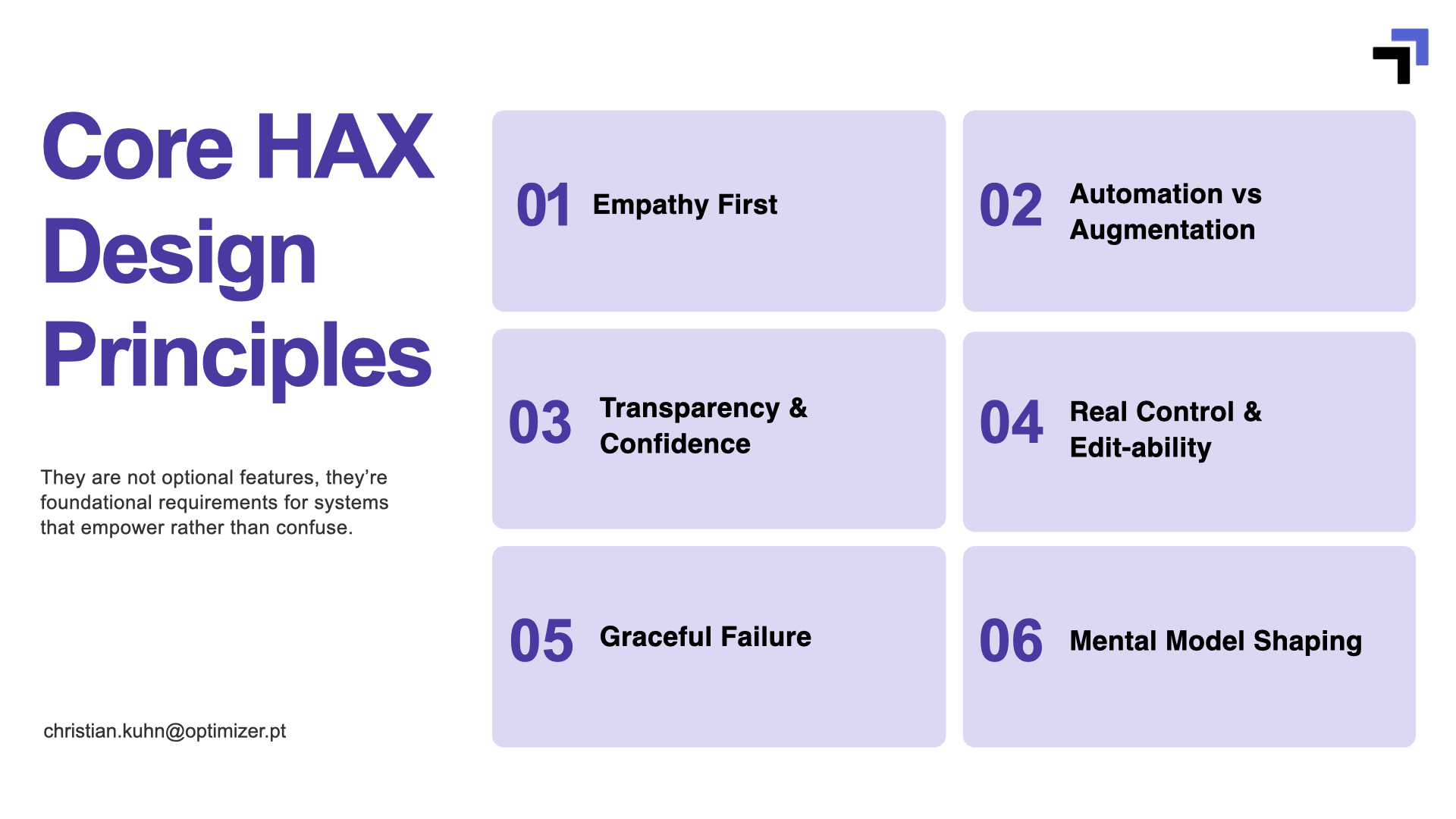
Let me be precise about what I did and didn’t do. I curated the six HAX principles. I did not invent them. The substance comes from Microsoft’s HAX Toolkit, Google’s People + AI Guidebook, Apple’s Human Interface Guidelines for ML, the GitHub Copilot guidelines, the Shape of AI catalogue, AIverse.design, and the academic human-AI interaction literature (30+ papers). The field already had the answers. They were scattered. The frustration that pushed me to integrate them was practical. Every project-team I sat with was asking the same questions in different vocabularies. Should we automate or augment? How transparent is transparent enough? How do we handle a wrong answer without breaking trust? I distilled the answers into six principles a team can apply on Monday morning: Empathy First, Automation vs. Augmentation, Transparency & Confidence, Real Control & Editability, Graceful Failure, Mental Model Shaping. They are working as an Audit tool in the same way as guidelines to follow. On the diagnostic side we are also using the 7 Sins of AI Product Design. Common Dark-patterns framed as Sins, to make it more fun and diggestable, by Irrational labs in a Webinar in 2024.
Every Sin is violating at least two of the 6 HAX Principles. So it works well in combination for entertaining Workshops and knowledge sharing. Bring your App to a confession!
Many companies are obsessed with replacing human effort entirely. Why do you think the distinction between automation and augmentation is so critical in AI product design?
Because it answers the only question that matters: should the user feel served or empowered? Automate the things people don’t want to do, the repetitive, the dangerous, the unscalable, the work they don’t have the skill for. Augment everything else, especially the work people take pride in. Grammarly is the canonical case for me. It sits beside the writer, offers alternatives, lets you accept, reject, retry. The author keeps the pen. Compare that to products that strip the choice and produce a “done” output the user now has to reverse-engineer. That is not productivity. That is the Tyranny sin, agency removed in the name of efficiency. Most Users do not want that. They appreciate Co-Creation and agency in the working relationship with any AI product.
Traditional software breaks in predictable ways. AI behaves differently. How should designers rethink failure states in AI-driven experiences?
The first move is to stop calling them edge cases. In AI, unhappy paths are core flows. The model will be wrong, vague, biased, slow, or simply odd and daily, by design. So we engineer for visible, recoverable failure from day one. The research is striking: users rate AI quality higher when they can see and correct a mistake than when the system silently muddles through.
Replit’s AI agent is a good example: when it can’t complete a step, it tells you what it tried, what failed, and asks for help. Scale the response to the stakes. A wrong autocomplete is a dismiss. A wrong medical summary is a full rerouting flow. Humanize the apology. Never hide the error. And structure the feedback channel so the model can learn from the correction, not just the user. Graceful failure is not a polish-phase concern. In AI-first products, the experience is the product. The teams that internalise this ship better systems and earn forgiveness when they don’t.
You’ve said that users still don’t truly understand how AI works — meaning designers are effectively shaping their mental models. That’s an enormous responsibility. How do you approach it?
Carefully, and constantly. Most users will never read a model card. Their understanding of the system comes from the interface — what it asks, what it answers, what it apologises for. So every microcopy choice is teaching. Dropping someone into a blank chat with no idea what the assistant does is one of the most common failures I see in the field. The antidotes are concrete and well-evidenced: prompt examples (Figma, OpenAI), interactive walkthroughs (ClickUp), references to past behaviour (Headspace), subtle placeholders (“Photos, People, Places…” in Apple Photos). Three rules I keep coming back to. Communicate the algorithmic nature of the system honestly. Anthropomorphic personality is fine, but never let it outrun the user’s understanding of the limits. Frame every explanation around user benefit, not technical capability. And teach progressively, onboard for the first use, then keep teaching across the lifecycle as the user’s mental model deepens. Mental model shaping is not a feature. It is the whole onboarding, and the whole retention strategy.
Your HAX principles connect to the Iceberg UX Model — where the visible UI is only the surface. What are the deeper layers organizations often overlook when building AI products?
The UI is what we used to design. In an AI-first product it’s the tip of the iceberg. Beneath it sit the layers that actually drive the experience: the reward function the system is optimising for (and whether that aligns with the user’s goal), the training data (whose voices are in it, whose are missing), the reasoning and tool-use behaviour, the memory and personalisation strategy, the failure-and-recovery handling, and the feedback loops by which the model learns from real users. Most product teams still treat those as engineering concerns. They are design concerns. Bias is also an UX problem. Confidence calibration is a UX problem. Even latency is a UX problem. A confidently wrong answer in 200ms erodes trust faster than a hedged answer in two seconds. Users are trained for years to expect lightning fast responses from software. Waiting 30+ seconds for an AI output is breaking the expectations. On the other side users are reporting that they are not trusting the AI output if it is delivered “too fast”, which the user interpreted as unreflected or not thoughtful enough. If designers do not have a seat at those tables, the surface they later style is already broken. The org chart is where most AI products fail before a single screen is mocked.
More than 1,000 professionals worldwide have participated in your talks, webinars, workshops and online courses. What excites you most about teaching AI-driven UX today?
Two things. The leverage and the hunger. The leverage is the audience: I teach designers, researchers, product owners and increasingly the engineers building these systems. People who will ship to millions next quarter. Five years ago I’d open a workshop with “why does this matter?”. Now people walk in with the bruises of a feature that flopped, a chatbot that got reported, a Copilot rollout that nobody used. They want frameworks they can apply on the next sprint, not slides for a conference deck. Because I teach worldwide, I get direct feedback from different economical and cultural areas. Doesn’t matter if it’s Brasil, Portugal, Germany, Denmark or Greece. The challenges (Problems) are the same. Teaching has also kept me honest. You cannot hide vague thinking from a room of experienced practitioners. Every cohort sharpens the language and surfaces new patterns I then carry back into the articles, talks and books I’m writing. That feedback loop is the most rewarding part of my work right now. I am hungry for that kind of reward.
When people look back on your work years from now, what do you hope they’ll say Christian Kuhn contributed to the future of human centered AI experience design?
That I helped move human-centered AI experience design from a side conversation into a discipline. I did not invent the six principles! Microsoft, Google, Apple, and a generation of researchers wrote that playbook long before I taught it. What I want to be credited for is the integration: the framing that lets a working product team carry the field’s best thinking into a real roadmap on a Monday morning, in language a CEO will fund and a developer will implement.
Beyond that, I hope the people I taught built products their own users would defend. That is the only legacy that counts. Frameworks are scaffolding. The product on someone’s phone is the verdict.