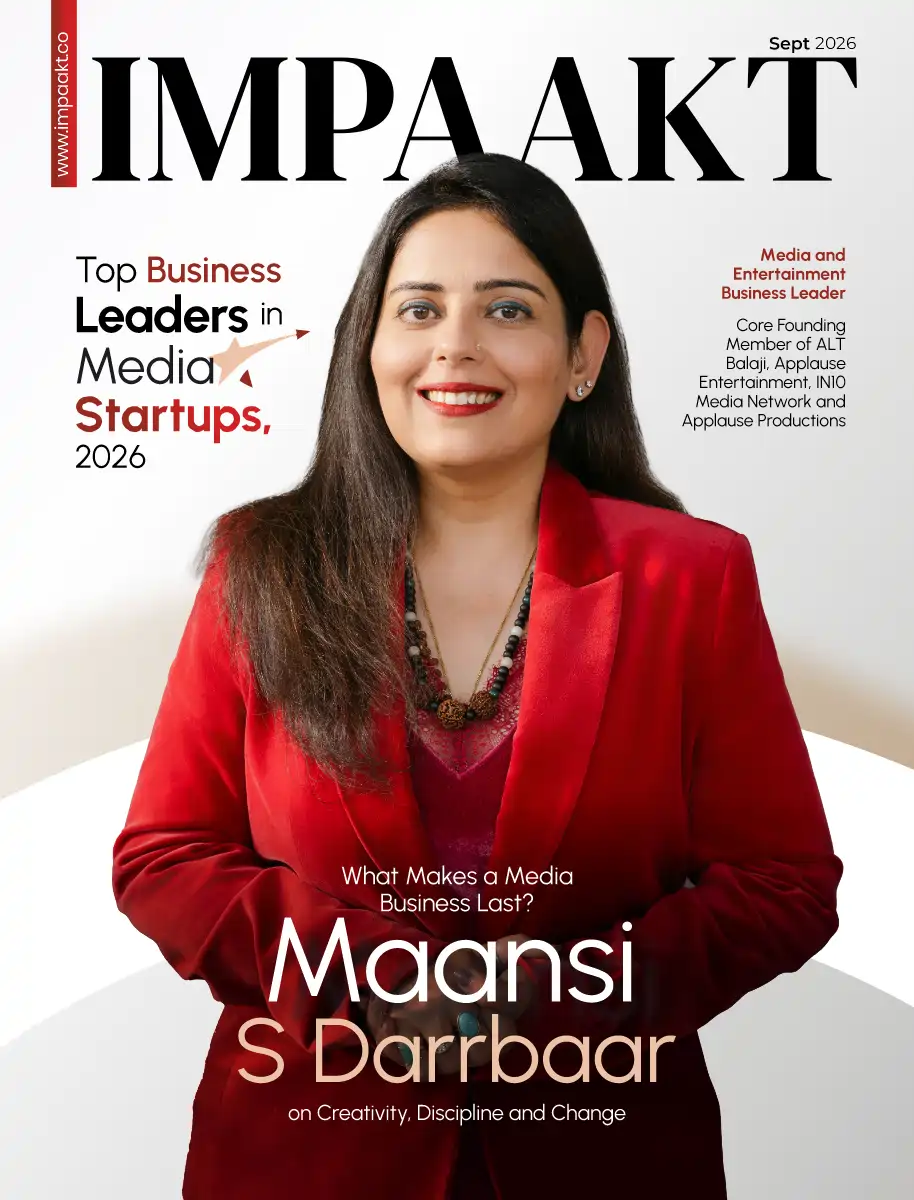
Every year we pick a leader whose work tells us where an industry is actually headed, not where it claims to be headed. For 2026, that industry is AI driven UX design, and the choice was not difficult once we started asking people a simple question: do you trust the AI tools you use every day? Most said no, not fully. That one answer, more than any benchmark or funding round, is what this edition is really about.
AI has stopped being a novelty. It drafts, predicts, recommends, and increasingly makes decisions before a human even sees them. But capability was never the hard problem. The hard problem is convincing a person, mid task, stressed, skeptical, to hand over control to a system whose reasoning they cannot see. Get that wrong once, and users do not forgive the model, they abandon it.
This is the exact terrain Christian Kuhn has spent two decades mapping. As Head of UX Center of Competence at Optimizer, he was studying voice interfaces, wearables, and machine learning applications long before generative AI made headlines, and what he learned then still holds now: technology only works when it respects how people actually think, not how engineers wish they thought. His Human-AI Experience Design framework treats transparency and user agency as design requirements, not features bolted on later. In our cover conversation, Kuhn makes an argument that deserves wider circulation, that the next real advantage in AI will not come from smarter models but from systems people are willing to believe.
That idea alone earns him our Leader of the Year. It also sets up a bigger truth this edition keeps returning to, that trust cannot be manufactured through messaging, only earned through design choices made when nobody outside the product team is watching.
Beyond our cover feature, this edition carries a set of stories we are genuinely proud to run, builders and designers whose work rarely makes headlines but is quietly resetting expectations for what an AI experience should feel like. Their industries differ, their methods differ, but the instinct underneath is identical, put the human ahead of the interface, every time.
If there is one thread running through this entire issue, it is this: the organizations that win the AI decade will not be the ones with the most powerful models. They will be the ones whose users actually believe what the model tells them. That is a design problem before it is a technology problem, and increasingly, it is the only one that matters.