How Women Leaders Shaped Drug Safety Standards and Protected Global Health
In the complex machinery of healthcare, regulatory agencies operate as the gatekeepers; the final line of defense between promising pharmaceutical innovations and the millions who will eventually use them. These institutions wield enormous power: approving drugs, setting safety standards, enforcing compliance, and sometimes, standing between corporate pressure and public welfare. The decisions made within these walls ripple across populations, determining which treatments reach patients and under what conditions.
For decades, women have held critical positions within these regulatory bodies, often during moments of crisis or transformation. Their leadership has not only shaped drug safety standards but fundamentally altered how we think about pharmaceutical oversight, risk assessment, and the relationship between innovation and protection. This case study examines three pioneering women whose regulatory leadership protected public health and transformed the systems designed to safeguard it.
The Pharmacologist Who Said No: Frances Oldham Kelsey
In 1960, Dr. Frances Oldham Kelsey joined the U.S. Food and Drug Administration as a medical officer. Born in British Columbia and educated at McGill University and the University of Chicago, where she earned both M.Sc. and Ph.D. degrees in pharmacology plus an M.D., Kelsey brought rigorous scientific training to her new role. Her first major assignment seemed routine: reviewing a new drug application for thalidomide, a sedative already approved and marketed in 46 countries under various names, including Contergan in West Germany and Distaval in the UK.
The pharmaceutical company, William S. Merrell, expected quick approval. After all, thalidomide was already being prescribed to millions of pregnant women across Europe to alleviate morning sickness. The application was comprehensive, backed by international sales data and clinical reports. But Kelsey wasn’t convinced.
She identified critical gaps in the safety data. The studies provided insufficient evidence about the drug’s effects during pregnancy. The testing protocols were inadequate. When the company pressured her for approval, she held firm. When they submitted additional data, she found it unconvincing. For months, she refused to approve thalidomide for the U.S. market, withstanding mounting pressure from the pharmaceutical company and even some colleagues who questioned her caution.
By late 1961, reports from Europe began revealing a horrifying pattern: thousands of babies were being born with severe birth defects—phocomelia, a condition causing malformed or absent limbs. The connection to thalidomide became undeniable. In West Germany alone, approximately 5,000 to 7,000 children were affected. Worldwide, the estimates reached 10,000 to 20,000 cases. In the United States, thanks to Kelsey’s refusal to approve the drug, only 17 cases were reported—instances where American women had obtained the drug abroad or through clinical trials.
Kelsey’s stand became a watershed moment. In 1962, President John F. Kennedy awarded her the President’s Award for Distinguished Federal Civilian Service—only the second woman to receive it. More significantly, the thalidomide tragedy catalyzed legislative reform. Congress passed the Kefauver-Harris Amendment in 1962, fundamentally transforming pharmaceutical regulation by requiring companies to prove both safety and efficacy before approval, mandating informed consent for clinical trials, and giving FDA greater authority over drug testing and advertising.
Kelsey continued at the FDA for 45 years, eventually establishing and leading the investigational drug branch. She shaped policies on informed consent and worked to ensure that the lessons of thalidomide were embedded in regulatory practice. Her legacy wasn’t just preventing a tragedy—it was building systems to prevent future ones.
Breaking the Glass Ceiling: Jane E. Henney
In 1998, Dr. Jane E. Henney made history as the first woman appointed Commissioner of the FDA. Her appointment represented not just a symbolic milestone but a recognition that regulatory leadership required diverse perspectives and collaborative approaches to increasingly complex challenges.
Henney brought impressive credentials: a medical degree from Indiana University, clinical oncology training, and experience both in academia and industry. Before joining FDA, she served as vice president of health sciences at the University of New Mexico and held positions at the National Cancer Institute. Her background in cancer treatment gave her direct insight into the tension between innovation urgency and safety rigor—a balance that defines regulatory decision-making.
Her tenure from 1999 to 2001 coincided with critical debates about drug safety, particularly regarding several high-profile drugs and the FDA’s approval processes. Henney emphasized transparency, evidence-based decision-making, and the need to modernize FDA’s approach to emerging biotechnologies. While her tenure was relatively brief, she established precedents for female leadership at the highest levels of pharmaceutical regulation and demonstrated that women could navigate the political, scientific, and corporate pressures inherent in the role.
Modernizing an Institution: Margaret Hamburg
When Dr. Margaret Hamburg became the 21st Commissioner of the FDA in 2009, she inherited an agency facing unprecedented challenges. The pharmaceutical landscape had evolved dramatically—biologics, personalized medicine, and digital health technologies were creating regulatory questions that traditional frameworks struggled to address. Public health threats were globalizing. Budget constraints and staffing limitations hampered the agency’s ability to fulfill its expanding mandate.
Hamburg’s background uniquely prepared her for this complexity. The daughter of psychiatrist Beatrix Hamburg and epidemiologist David Hamburg, she grew up immersed in public health thinking. She earned her M.D. from Harvard Medical School and completed residency training in internal medicine at Weill Cornell Medical Center. Before becoming FDA Commissioner, she served as New York City’s Health Commissioner from 1991 to 1997 under Mayor David Dinkins, where she confronted tuberculosis outbreaks and worked to modernize the city’s public health infrastructure. She also held leadership positions at the Nuclear Threat Initiative, bringing expertise in bioterrorism preparedness.
Hamburg’s six-year tenure from 2009 to 2015 focused on institutional modernization. She championed the FDA Safety and Innovation Act, which reformed the drug approval process and enhanced safety monitoring. She expanded the FDA’s international presence, recognizing that global supply chains required global oversight. Under her leadership, the FDA approved a record number of novel drugs while simultaneously strengthening post-market surveillance systems.
One of Hamburg’s most significant contributions was advancing precision medicine regulation. She understood that treatments targeting specific genetic profiles required different regulatory frameworks than traditional blockbuster drugs. She invested in building FDA’s scientific capacity to evaluate complex biologics and biosimilars. She also prioritized transparency, making more FDA data publicly accessible and engaging stakeholders in policy development.
Hamburg faced her share of controversies. The FDA’s handling of certain drug safety issues drew criticism. Budget constraints limited the agency’s ability to implement all her proposed reforms. But her leadership demonstrated that regulatory modernization and public health protection weren’t opposing goals—they were complementary. The systems she built and the precedents she established continue shaping FDA operations today.
The Leadership Pattern: What These Women Share
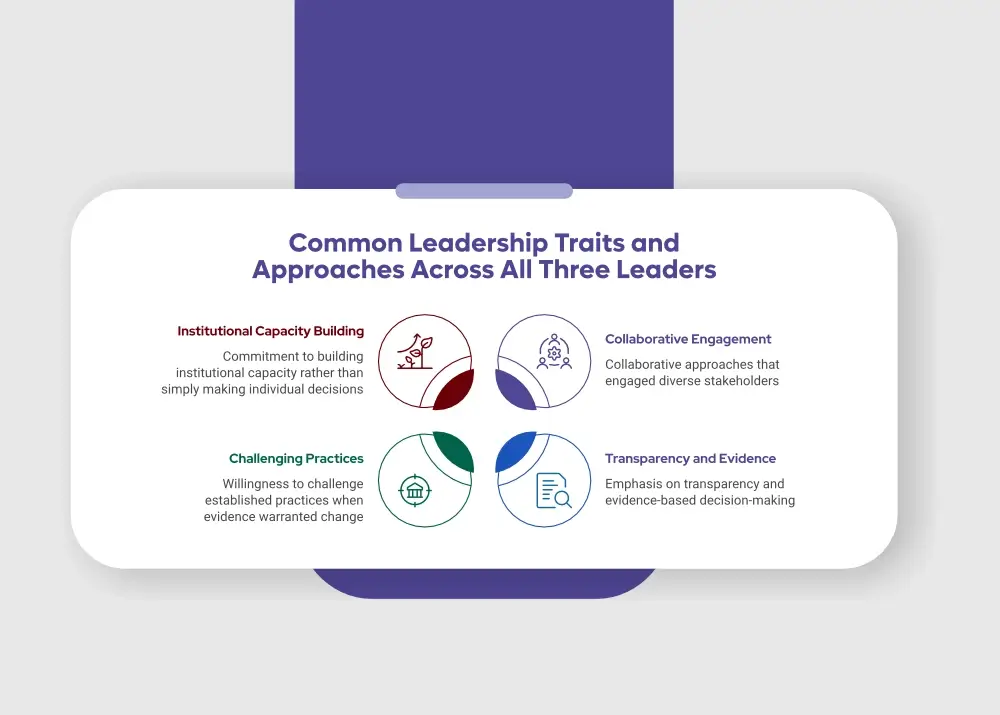
Common leadership traits and approaches across all three leaders:
- Collaborative approaches that engaged diverse stakeholders
- Emphasis on transparency and evidence-based decision-making
- Willingness to challenge established practices when evidence warranted change
- Commitment to building institutional capacity rather than simply making individual decisions
Examining these three women’s careers reveals consistent patterns. All brought rigorous scientific training to regulatory roles. All faced pressure—from pharmaceutical companies, from political actors, from public opinion—to make decisions that prioritized speed or economic considerations over safety. All withstood that pressure by anchoring their decisions in evidence and principle.
Their leadership styles shared common elements: collaborative approaches that engaged diverse stakeholders, emphasis on transparency and evidence-based decision-making, willingness to challenge established practices when evidence warranted change, and commitment to building institutional capacity rather than simply making individual decisions.
Perhaps most significantly, all three understood that regulatory leadership isn’t about blocking innovation—it’s about ensuring innovation serves public health. Kelsey’s refusal to approve thalidomide didn’t stop pharmaceutical development; it improved testing standards and ultimately accelerated the development of safer drugs. Henney and Hamburg’s modernization efforts didn’t weaken the FDA; they strengthened its ability to evaluate emerging technologies effectively.
Lessons for Contemporary Healthcare Leadership
The experiences of Kelsey, Henney, and Hamburg offer insights beyond regulatory agencies. In an era where healthcare faces constant pressure to move faster, cut costs, and embrace disruption, their examples remind us that protection and progress aren’t opposing forces.
Effective healthcare leadership requires scientific rigor, ethical courage, institutional thinking, and stakeholder engagement. These women didn’t just make good decisions in their roles—they changed the roles themselves, building systems and setting precedents that continue protecting public health decades later.
As healthcare grows more complex—with artificial intelligence, gene therapies, and global supply chains creating new regulatory challenges—the leadership model these women exemplified becomes more relevant, not less. Their legacy isn’t just the specific policies they implemented or the tragedies they prevented. It’s the demonstration that healthcare leadership at its best combines scientific excellence with institutional courage, and that the most important innovations aren’t always new drugs—sometimes they’re new systems for ensuring those drugs actually help the people they’re meant to serve.