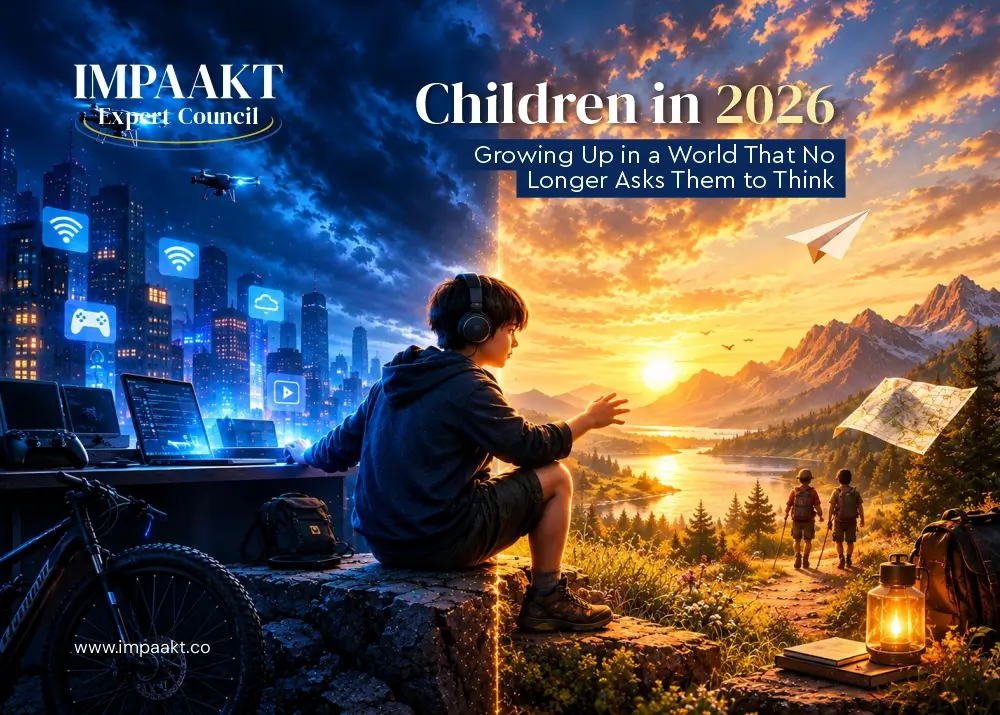
Standfirst
Children today live in a world of instant answers, automated decisions, and digital convenience. Technology has removed many of the everyday challenges that once shaped resilience, creativity, and independent thinking. This article explores what childhood looks like in 2026 and what it means for the future of human development.
A Childhood Without Friction
Children in 2026 live in a world that feels almost frictionless. Answers appear instantly. Directions are spoken aloud. Entertainment is endless. Decisions are suggested before they are even needed. Technology has become a constant companion, helpful in many ways but quietly intrusive. It fills the spaces where problem-solving, patience, and independent thinking used to grow.
For those of us who grew up in the eighties or nineties, childhood looked very different. We learned by doing, not by being directed. We navigated life using paper maps, road signs, and common sense. We got lost and figured it out. We made mistakes and learned from them.
We did not have a machine telling us the next step.
We were the next step.
Children in 2026 are not weaker or less capable. They are developing in an environment that removes many of the challenges that once shaped resilience, creativity, and practical intelligence. The consequences are subtle at first but profound over time.
The World Used to Ask Children to Think
In the eighties and nineties, childhood demanded real world thinking.
If you wanted to go somewhere, you used a paper map.
If you wanted to call someone, you memorised their number.
If you wanted to fix something, you experimented.
If you wanted to find something, you looked.
If you wanted to know something, you asked a human being.
Today, a device does all of that.
Children do not need to remember routes because GPS does.
They do not need to read maps because apps do.
They do not need to ask for help because search engines do.
They do not need to plan because algorithms do.
They do not need to tolerate uncertainty because technology removes it.
The machine thinks.
The child follows.
This is not laziness. It is conditioning. When a tool does the thinking, the child does not get the chance.
The Lost Art of Struggle
Struggle used to be part of growing up, not harmful struggle but developmental struggle. The kind that teaches patience, resilience, and emotional regulation.
Children used to wait for things.
They tolerated boredom.
They solved problems without instant answers.
They learned through trial and error.
They made mistakes and corrected them.
They relied on memory, not search engines.
These experiences built character. They built grit. They built the ability to sit with discomfort and still move forward.
Today’s children live in a world where waiting is optional, boredom is avoidable, and answers are instant. The result is a generation that is highly stimulated but underdeveloped in areas requiring slow thinking, perseverance, and self-direction.
They are capable but guided.
Smart but not always self-reliant.
Connected but not always grounded.
Technology Removes Friction and Growth
Children in 2026 live in a world designed to eliminate friction. But friction is where growth happens.
When a child gets lost and finds their way, they build confidence.
When a child struggles with a problem and solves it, they build resilience.
When a child waits, they build patience.
When a child is bored, they build creativity.
When a child makes a decision, they build identity.
Technology removes these moments.
It removes the need to think ahead.
It removes the need to remember.
It removes the need to tolerate uncertainty.
It removes the need to ask for help.
It removes the need to fail and try again.
Children are growing up with fewer opportunities to develop the skills that once came naturally through everyday life.
The Emotional Consequences
Technology does not just change how children think. It changes how they feel.
Lower frustration tolerance
When everything is designed to be easy, anything difficult feels overwhelming.
Higher anxiety
Constant guidance creates dependence. Without the device, children feel lost both literally and emotionally.
Difficulty with uncertainty
Children expect clarity and speed because that is what technology gives them.
Reduced confidence in independent decisions
If a machine always tells you the next step, you do not learn how to choose your own.
These emotional shifts shape how children handle relationships, school, conflict, and adulthood.
The Social Consequences
In the eighties and nineties, children interacted with the world to get things done. They asked strangers for directions. They spoke to shopkeepers. They navigated public spaces using social cues.
Today, many children can go through an entire day without speaking to anyone outside their immediate circle. Technology has replaced human interaction with digital convenience.
This leads to fewer opportunities to build confidence, reduced social problem solving, less exposure to diverse people, and weaker community connection.
Children are connected online but disconnected in real life.
The Cognitive Consequences
Heavy reliance on technology reduces practice in critical thinking, memory, spatial reasoning, planning, sequencing, risk assessment, and creativity.
These skills do not disappear, but they develop differently and sometimes more slowly.
A child who grows up with GPS learns how to follow instructions.
A child who grows up with maps learns how to think.
Children in 2026 Are Not Broken. They Are Under Challenged
Children today are not less intelligent. In many ways, they are more advanced. They navigate digital systems effortlessly. They learn fast. They adapt quickly.
But they are developing in a world that removes many of the challenges that once shaped resilience, independence, and practical intelligence.
They are capable but guided.
Smart but not always self reliant.
Connected but not always grounded.
So What Do We Do
We do not need to reject technology. We need to balance it.
Children need both digital skills and real world skills.
They need to know how to use GPS and how to read a map.
How to search online and how to think independently.
How to follow instructions and how to make decisions.
How to use technology and how to function without it.
The goal is not to recreate the eighties or nineties.
The goal is to give children the full range of human experience.
A Final Thought
Children in 2026 are growing up in a world that thinks for them. It guides them, directs them, entertains them, and answers every question before they have had time to wonder. Childhood is not meant to be a guided tour. It is meant to be an exploration.
If we want this generation to grow into resilient, capable, thoughtful adults, we must give them opportunities to struggle, to solve, to navigate, and to think. Technology is a tool, not a replacement for human development.
Reintroducing Healthy Friction: Practical Ways to Build Real-World Thinking
If we want children to grow into resilient and capable adults, we must intentionally reintroduce the kinds of experiences that build slow thinking, patience, and independence. This does not mean rejecting technology. It means creating balanced environments where children practise both digital competence and real-world problem-solving.
Children benefit from moments of boredom where creativity can emerge. They grow through small tasks that require effort and patience. They strengthen spatial reasoning when navigating with a map rather than a device. They build memory when they practise recalling information instead of relying on instant search. They develop persistence when they engage in activities with uncertain outcomes. They build identity and confidence when they make meaningful decisions for themselves.
These experiences do not need to be dramatic or time-consuming. They simply need to be real. When children face manageable challenges, they build confidence, autonomy, and emotional resilience, skills that no device can replace.
References
Carr, N. (2020) The Shallows: What the Internet Is Doing to Our Brains. New York: W. W. Norton and Company.
Department for Science, Innovation and Technology (DSIT) (2026) Understanding the Impact of Smartphones and Social Media on Children and Young People: Executive Summary. London: HM Government.
Early Years Screen Time Advisory Group (2026) Screen Use by Children Aged Under Five: Independent Report. London: Department for Education and Department of Health and Social Care.
JAMA Pediatrics (2026) ‘Digital Media Use and Child Health and Development: A Systematic Review and Meta Analysis.’ JAMA Pediatrics, 180(4), pp. 312–324.
Turkle, S. (2017) Reclaiming Conversation: The Power of Talk in a Digital Age. New York: Penguin Books.
Twenge, J. M. (2024) Generations: The Real Differences Between Gen Z, Millennials, Gen X, Boomers, and Silents — and What They Mean for America’s Future. New York: Atria Books.
UK Parliament (2026) POSTnote 778: The Impacts of Screen and AI Use on Children and Young People. London: Parliamentary Office of Science and Technology.