Corporate training has always faced a fundamental paradox: every employee learns differently, yet training programs are designed for everyone to learn the same way. An entry-level analyst sits through the same compliance module as a senior manager. A visual learner clicks through the same text-heavy slides as someone who absorbs information through hands-on practice. The result? Billions spent on training that employees forget within weeks, skills gaps that widen instead of close, and L&D teams perpetually fighting for budget to solve problems their current approach can never fix.
The global corporate training market is undergoing a seismic shift. At the center of this transformation is artificial intelligence—not as a futuristic concept, but as a proven solution already delivering measurable results for companies willing to embrace it.
The Economics of Ineffective Training
Before exploring solutions, consider the cost of the problem. Traditional corporate training operates on a broadcast model: create content once, deliver it to everyone, hope something sticks. Employees trained through traditional methods retain very less of what they learn.
This isn’t just inefficient—it’s economically unsustainable. Companies pour resources into training programs that don’t measurably improve performance, don’t address individual skill gaps, and don’t adapt to how different employees actually learn.
AI: From Theory to Transformation
AI-powered personalized learning flips the entire model. Instead of forcing employees to adapt to training, training adapts to employees. Machine learning algorithms analyze individual performance data, learning preferences, skill gaps, and career trajectories to create customized learning paths. The system continuously adjusts based on how quickly someone masters concepts, where they struggle, and what learning formats work best for them.
The AI in Learning and Development market, valued at $9.3 billion in 2024, is projected to reach $97 billion by 2034, representing a 26.4% CAGR. (Source: Market.us, 2025) This explosive growth isn’t driven by hype—it’s driven by results.
Real Companies, Real Results
Bank of America: Scaling Personalization Across 200,000 Employees
Bank of America’s “The Academy” represents one of the most comprehensive implementations of AI-powered training in the corporate world. With over 200,000 employees globally, the bank needed a training solution that could scale without sacrificing personalization.
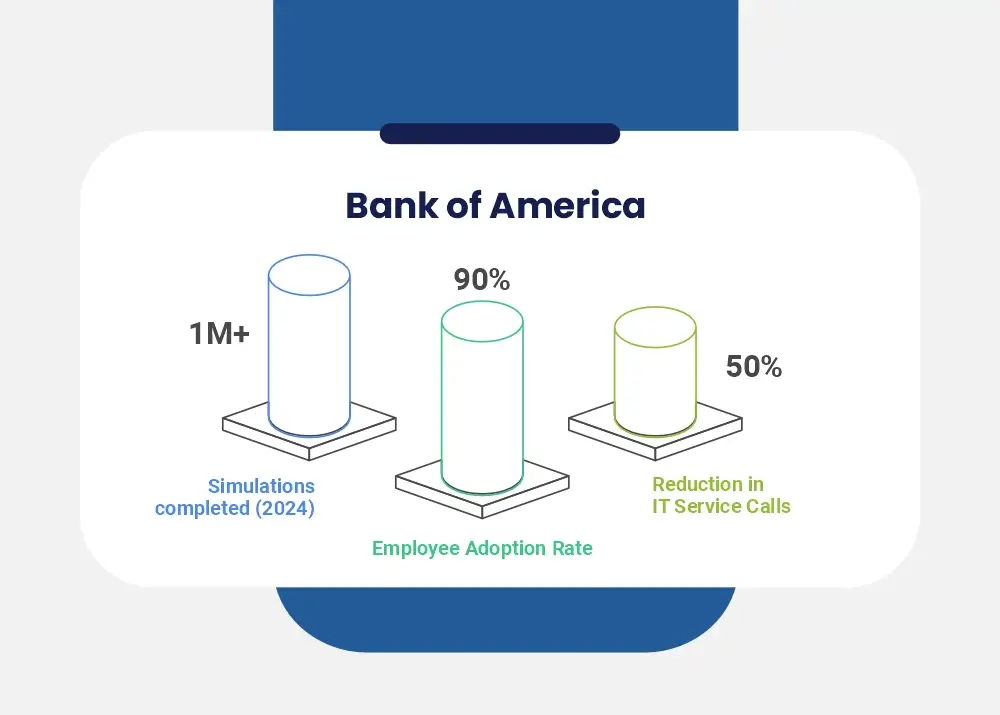
The results speak for themselves. By 2024, employees had completed over 1 million simulations through the platform. More importantly, the bank documented a significant improvement in communication skills among trained employees and a decent productivity gains from AI-assisted coding tools.
The bank’s AI assistant “Erica for Employees” achieved 90%+ adoption among staff, with a 50%+ reduction in IT service desk calls as employees found answers through the AI system instead. In 2024 alone, the bank’s AI tools processed 23 million interactions through askMERRILL and askPRIVATE BANK platforms.
Perhaps most telling: The Academy delivers consistent, personalized learning experiences that traditional classroom-based programs could never match at this scale.
Walmart: VR and AI Converge for Frontline Training
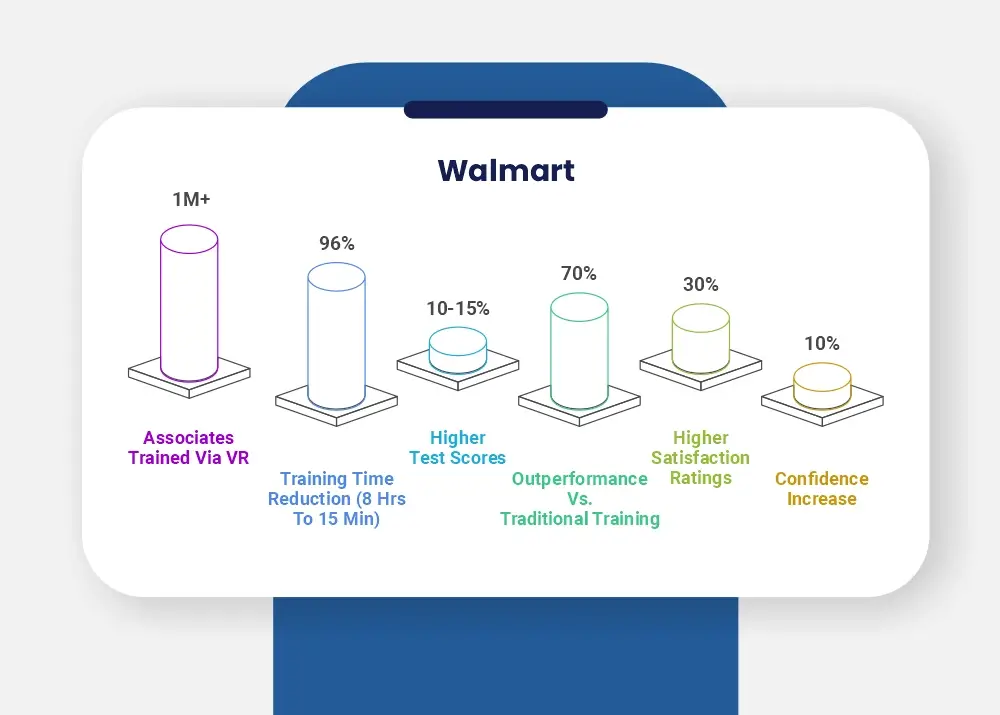
While Walmart’s use of virtual reality training is well-documented, the integration of AI into these programs amplifies their effectiveness. The retail giant deployed a massive number of VR headsets across its locations, creating a training infrastructure that serves over 1 million associates.
The combination of VR’s immersive environment with AI’s adaptive learning produced remarkable results. Associates who completed VR training scored 10-15% higher on content tests than those trained through traditional methods. Trainees reported 30% higher satisfaction ratings compared to traditional training, and VR-trained associates outperformed non-VR learners on post-training skills assessments 70% of the time.
Most dramatically, Walmart reduced training time by 96%—from 8 hours of in-person instruction to just 15 minutes of VR training—for its Pickup Tower rollout, without sacrificing training effectiveness. Associates also reported 10% higher confidence in handling customer inquiries and operational tasks.
The Technology Stack Behind the Transformation
Understanding what makes AI-powered personalized learning work requires looking beyond surface-level implementations. The technology relies on several interconnected components:
Machine Learning Algorithms lead the market, accounting for 36.6% of the AI in L&D technology category in 2024 (Source: Market.us, 2025). These algorithms analyze vast datasets on employee performance, learning patterns, and outcomes to identify which approaches work for different learners.
Personalized Learning Paths emerged as the leading application in 2024, capturing 38.4% of the market (Source: Market.us, 2025). This reflects the core value proposition: training that adapts to individual needs rather than forcing everyone through identical content.
Cloud-Based Deployment dominated with 48.6% market share in 2024, driven by its scalability and accessibility (Source: Market.us, 2025). Cloud infrastructure allows companies to deploy personalized learning at scale without massive upfront hardware investments.
Enterprise Adoption represented 53.3% of the market in 2024, reflecting how corporate training and upskilling initiatives are driving AI adoption (Source: Market.us, 2025).
Implementation Realities: Beyond the Hype
While the results are compelling, successful implementation requires more than purchasing an AI platform. Companies planning AI-powered personalized learning initiatives should consider several factors:
Start with Clear Business Problems: The most successful implementations tie directly to measurable business challenges. Bank of America focused on scaling training while maintaining quality. Walmart needed to reduce training time without sacrificing effectiveness.
Invest in Data Infrastructure: AI systems require substantial data to personalize effectively. Companies need robust systems for tracking employee performance, learning patterns, and outcomes. The 21% of platforms that had integrated AI-driven personalization tools by 2024 represent early adopters with the infrastructure to support these systems. (Source: Market Reports World, 2025)
Manage Change Carefully: Moving from traditional training to AI-powered personalization requires cultural change. Employees need to trust that the AI is helping them, not surveilling them. Managers need to understand how personalized learning fits into broader talent development strategies.
Budget Realistically: While AI can reduce long-term training costs, initial implementation requires investment. Companies now allocate roughly 18% of L&D spend to platform modernization, with procurement cycles averaging 5.6 months (Source: Market Reports World, 2025).
The Road Ahead
The trajectory is clear. AI adoption in corporate learning has been rising and a lot of companies planned AI pilots for learning in 2025. These aren’t experiments—they’re strategic investments in workforce capability.
The corporate e-learning market is projected to grow from $24.67 billion in 2025 to $51.41 billion by 2034 at a 13% CAGR (Source: Market Reports World, 2025). Within this broader market, AI-powered solutions are growing significantly outpacing traditional approaches.
Conclusion: The Competitive Imperative
The evidence is overwhelming. But the real story isn’t about numbers. It’s about companies that train its employees with individualized attention, retailers that prepare associates for Black Friday without disrupting store operations, and technology firms that keep pace with rapid skill evolution.
The question for corporate leaders isn’t whether to adopt AI-powered personalized learning. It’s whether they can afford not to—and how quickly they can implement it before their competitors do.