In a sector driven by speed, Dario Amodei built his company around a question that slows people down: what if something goes wrong? Not the minor, correctable kind of wrong. The kind that cannot be undone. That single question — treated as a technical problem, and not a philosophical footnote — became the founding philosophy of Anthropic, and the reason the company has grown into one of the most consequential AI organisations on the planet.
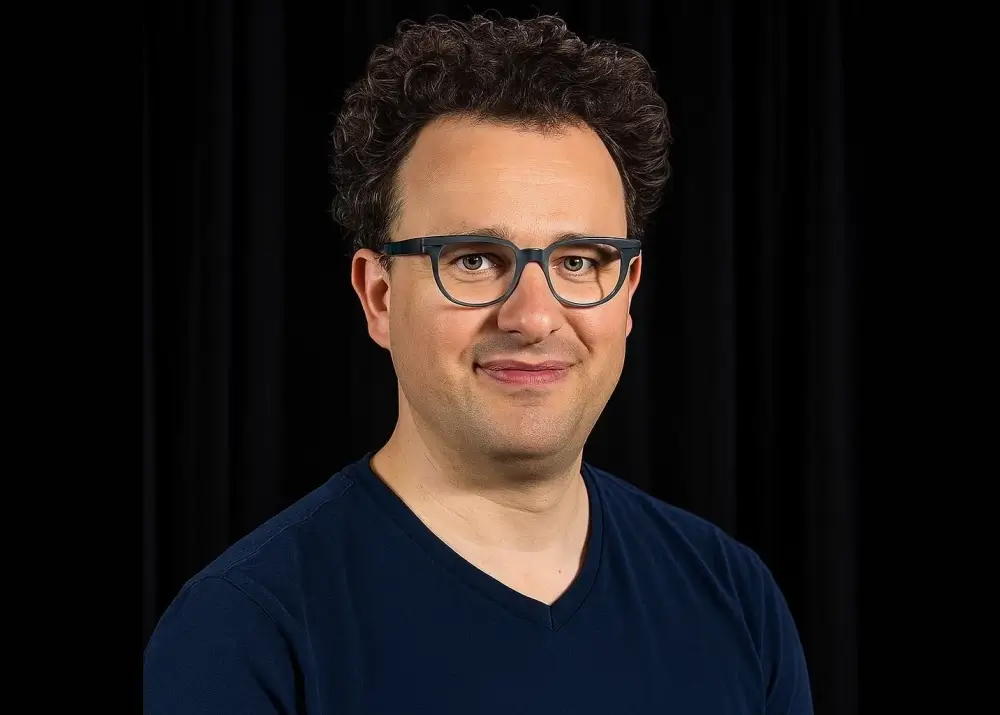
As of February 2026, Anthropic’s valuation stands at $380 billion. Its annualised revenue hit $19 billion by March 2026 — growing from $1 billion in December 2024 in just fifteen months. Eight of the Fortune 10 are now Claude customers. And the man at the centre of it, wearing a blue shawl-collar sweater and thick-rimmed glasses, describes himself not as a tech entrepreneur but as a scientist who needed a bigger laboratory.
Physics, Loss, and a Long Road to AI
Dario Amodei was born in San Francisco in 1983. His father, Riccardo Amodei, was an Italian leather craftsman; his mother, Elena Engel, was a Jewish-American project manager. He grew up in the Mission District, where his early obsessions were mathematics and physics — not the internet. When the dot-com boom erupted around him in his high school years, it barely registered. ‘Writing some website had no interest to me whatsoever,’ he has said. ‘I was interested in discovering fundamental scientific truth.’
His academic path reflected that. He studied physics at both Caltech and Stanford, then completed a PhD in biophysics at Princeton University, followed by postdoctoral research in computational methods at Stanford. He came to AI not through entrepreneurship but through science — drawn by the structural similarities between modelling neural circuits and training large neural networks.
There was something else driving him, too. His father died of cancer — an illness that, within four years of his death, became 95% curable through a scientific breakthrough that arrived too late. The grief of that near-miss never left him. The idea that accelerating scientific progress could save lives — that the gap between 50% fatal and 95% curable was, in part, a gap in the speed of discovery — became a quiet motivating force behind everything that followed.
The Man Who Built GPT-2 and GPT-3
In 2014, Amodei joined Baidu’s AI division, working alongside Andrew Ng, where he contributed to Deep Speech 2 — a speech recognition system MIT Technology Review named one of its top ten breakthroughs of 2016. From there, he moved to Google Brain as a Senior Research Scientist before joining OpenAI in 2016. At OpenAI, he rose to become Vice President of Research, leading the development of two models that redefined what AI could do: GPT-2 and GPT-3. He is also a co-inventor of reinforcement learning from human feedback — the technique now considered foundational to how modern AI models are aligned with human intent.
He was, in short, one of the people who built the AI revolution from the inside. And then he left.
The Exit That Launched an Industry
In 2021, Amodei and his sister Daniela — along with several other senior OpenAI colleagues — departed the organisation over concerns about the direction of AI development. Specifically, they believed that scaling AI models without proportional investment in safety research was a mistake that would prove costly, and possibly catastrophic, as systems grew more powerful. They founded Anthropic in February 2021 with a clear mandate: build AI that is steerable, interpretable, and safe.
The company secured $124 million in early funding — including backing from former Google CEO Eric Schmidt, who later said he invested in the person more than the concept. ‘At this level, you have essentially no data,’ Schmidt noted. ‘You have to decide based on the people. And Dario is a brilliant scientist.’ That bet has since appreciated at a velocity few could have predicted.
Constitutional AI and the Claude Difference
Anthropic’s flagship innovation — Constitutional AI — is not a product feature. It is a methodology. Rather than relying on external moderation after the fact, Amodei’s team embedded a set of guiding principles directly into the training process, instructing the model to evaluate and revise its own outputs against a defined constitution. The approach drew from documents such as the UN Declaration of Human Rights. The result is Claude — a family of large language models now in its fourth generation, distinguished in enterprise settings for reliability, transparency, and reduced harmful outputs.
By October 2025, Anthropic had over 300,000 business customers. The number of companies spending more than $1 million annually on Claude grew from a dozen to over 500 in two years. Claude Code — the company’s AI coding assistant — generated $2.5 billion in annualised revenue by February 2026. Amazon has invested $8 billion in Anthropic; Google has invested $3 billion. Microsoft began integrating Anthropic’s models into Office 365 Copilot in September 2025, extending Claude’s reach to over 100 million potential users. Anthropic’s technology now powers Amazon’s Alexa+, bringing it into millions of households.
The Line He Will Not Cross
February 2026 offered the clearest window into Amodei’s character as a leader. The U.S. Department of Defense requested that Anthropic remove contractual restrictions that prohibited the use of Claude for mass domestic surveillance and fully autonomous weapons. Amodei refused. The Pentagon responded by designating Anthropic a ‘supply chain risk’ and directing U.S. agencies to stop using Claude. The move drew widespread condemnation — legal scholars, civil liberties organisations, and industry groups filed amicus briefs supporting Anthropic’s position.
Amodei did not back down. It was not the first time he had taken a difficult public stand. In 2023, he testified before the U.S. Senate judiciary panel, warning of the dangers of unregulated AI including its potential use in weaponry. In 2025, he challenged a proposed ten-year AI regulation moratorium in the pages of the New York Times. He has predicted publicly that AI could eliminate 50% of entry-level white-collar jobs — a forecast that made headlines for its directness and generated significant industry debate. He is not, he has been at pains to point out, a pessimist. ‘I get really angry when someone calls me a doomer,’ he has said. ‘One of my main reasons for focusing on risks is that they are the only thing standing between us and what I see as a fundamentally positive future.’
The Scientist’s Vision
Amodei’s 2024 essay ‘Machines of Loving Grace’ laid out that positive future in striking detail: AI accelerating the pace of medical discovery, compressing decades of scientific progress into years, extending healthy human lifespans, and helping lift billions out of poverty. It was a vision grounded not in Silicon Valley optimism but in a physicist’s understanding of what accelerating capability curves actually mean when applied to hard problems. His January 2026 follow-up essay, ‘The Adolescence of Technology,’ returned to the risks — not to contradict the optimism, but to describe the five categories of AI risk he believes must be managed before that future can be safely reached.
Time named him one of the world’s 100 most influential people in 2025 and designated him one of the ‘Architects of AI’ for its Person of the Year. Forbes estimated his net worth at $7 billion as of February 2026. Anthropic is targeting a Nasdaq listing as early as October 2026, with Goldman Sachs and JPMorgan as lead banks, at an anticipated valuation between $400 billion and $500 billion.
None of that was the goal when Amodei walked out of OpenAI in 2021 with a small team, a safety-first philosophy, and a conviction that the industry needed a different kind of company. It turned out the industry agreed — even if it took a few years to say so out loud.
The scientist who said no has built one of the most valuable technology companies in the world by refusing to compromise on the one thing he cared about most. In an industry that rewards speed above almost everything else, that is not a small thing. That is the whole story.