Adaptability is designed, not improvised
Micro and small businesses often feel change first. A customer segment shifts its expectations. A supplier becomes unreliable. A valued employee needs a new role. A technology changes how people compare, buy, or work. For micro and small business leaders, these changes rarely arrive with extra time, extra staff, or a formal strategy department.
That is why adaptability cannot depend on instinct alone. The World Bank estimates that SMEs represent around 90 percent of businesses globally and more than half of global employment, so the ability of small organizations to adjust is not a small-business issue; it is an economic resilience issue (World Bank Group). The 2023 SME outlook from the Organisation for Economic Co-operation and Development (OECD) also points to the environment leaders are navigating: inflation, geopolitical tension, supply-chain disruption, labor shortages, cybersecurity risk, and fast digital and green transitions (OECD).
In my first IMPAAKT article, “When Purpose Isn’t Enough,” I argued that purpose alone does not create execution. The same is true for adaptability. A purpose-driven organization still needs structure, routines, and decision discipline. Without adaptability, agility becomes constant reaction.
Dynamic capabilities in practical language
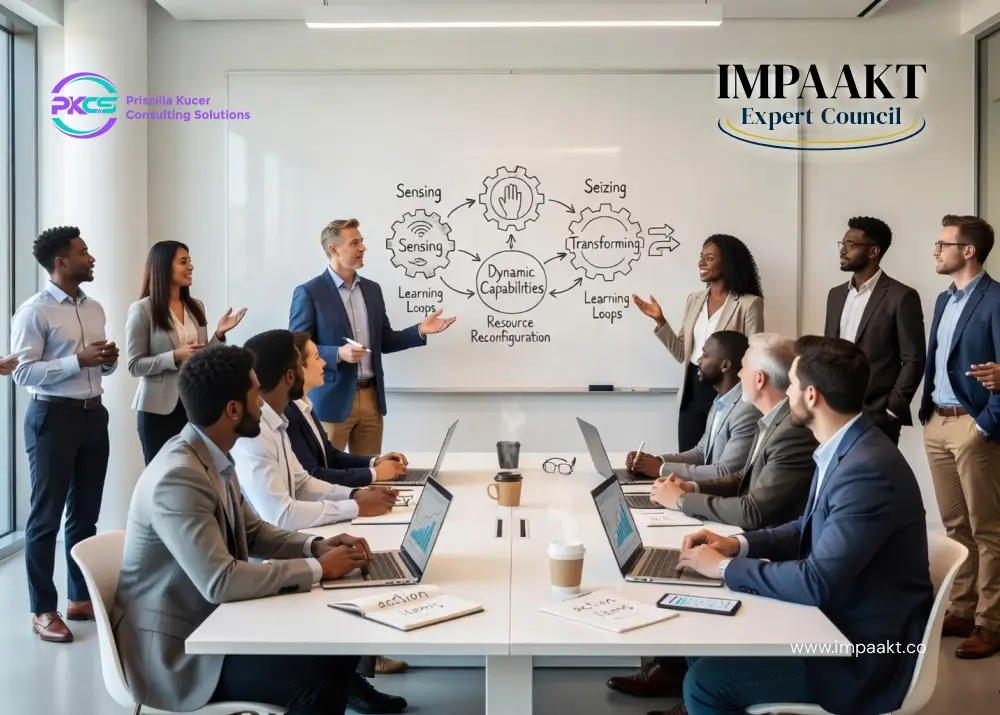
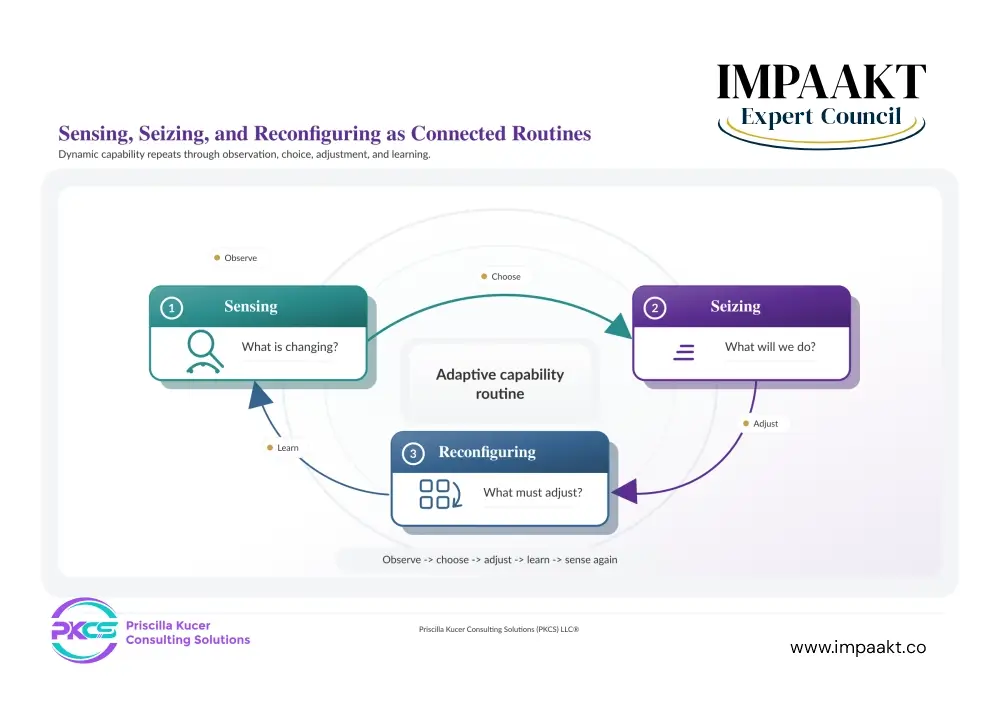
Dynamic capability research gives leaders a useful way to think about adaptation. David Teece describes dynamic capabilities as the organization’s ability to sense opportunities and threats, seize them through decisions and investments, and reconfigure assets as conditions change (Teece). In plain language, adaptable organizations repeatedly ask three key questions: What is changing? What will we do about it? What must we adjust to make the decision work?
Recent SME research supports this practical view. A study of 509 Spanish SMEs found that dynamic capability dimensions such as sensing, learning, integrating, and coordinating do not contribute equally to performance, and that market orientation strengthens the link between sensing, learning, and performance (Hernández-Linares, Kellermanns, and López-Fernández). Another study of 209 SMEs during COVID-19 found that dynamic capabilities positively affected performance before and during the pandemic, while leaders shifted from searching for new opportunities to getting products to market (Dejardin et al.). The lesson is straightforward: adaptability is not simply being flexible. It is knowing which capability to use at which moment.
Sensing, seizing, and reconfiguring as routines
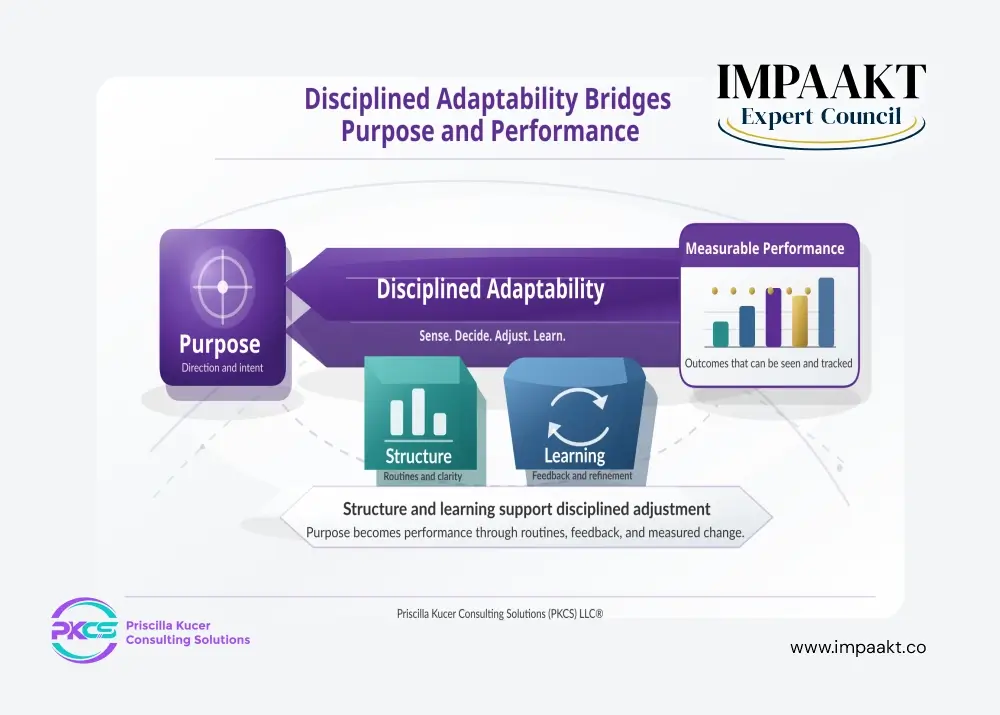
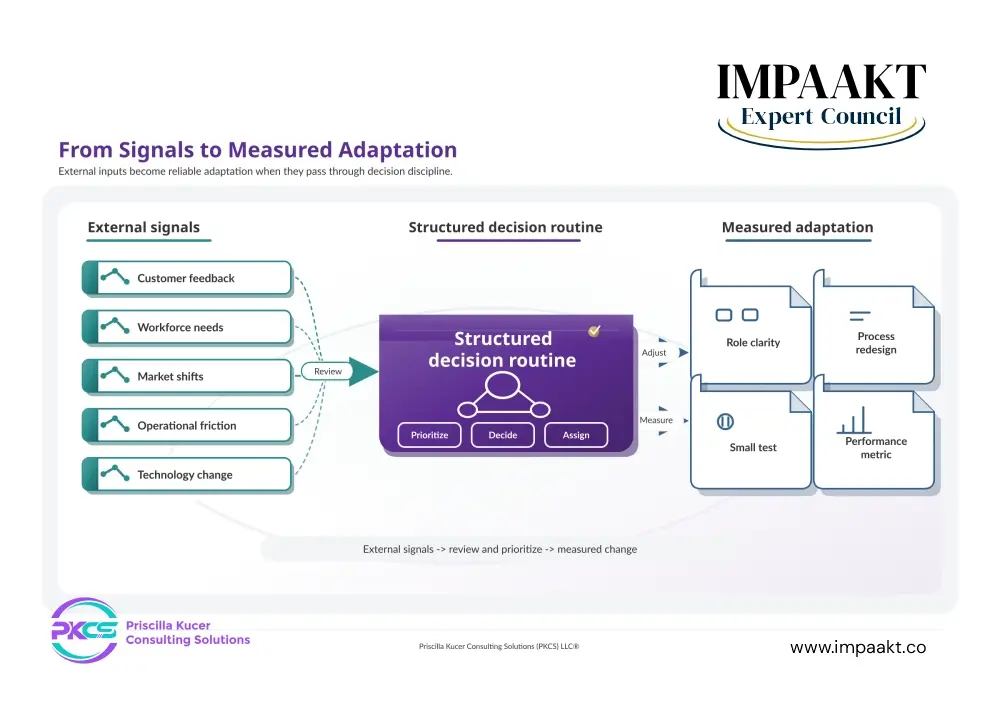
In my article, When Purpose Isn’t Enough, The Adaptive Strategy Cycle. Sensing starts with disciplined attention. Leaders can build a monthly signal review that gathers customer feedback, employee observations, sales patterns, workflow delays, competitor moves, and technology changes. This does not require complex analytics. It requires a habit of looking beyond the immediate perspective of the founder, business owner, or business leader.
Seizing turns signals into choices. A leader may notice a new customer need, but the capability is not complete until the team decides whether to test, pause, invest, partner, or exit. This is where many micro and small organizations lose momentum. They collect information, but do not convert it into accountable decisions.
Reconfiguring is the often-overlooked third step. If a new offer is approved, who owns it? What process changes? What skill gap must be closed? What work must stop so capacity becomes available? Research on SMEs in Poland during COVID-19 linked dynamic capabilities to value creation and value capture, including maintaining employee and production levels, cash flow, and revenue during lockdown conditions (Dyduch et al.). In practical terms, the decision is only real when the organization changes how work is organized.
Practical routines that keep agility grounded
Micro and small businesses can make dynamic capability real through three routines.
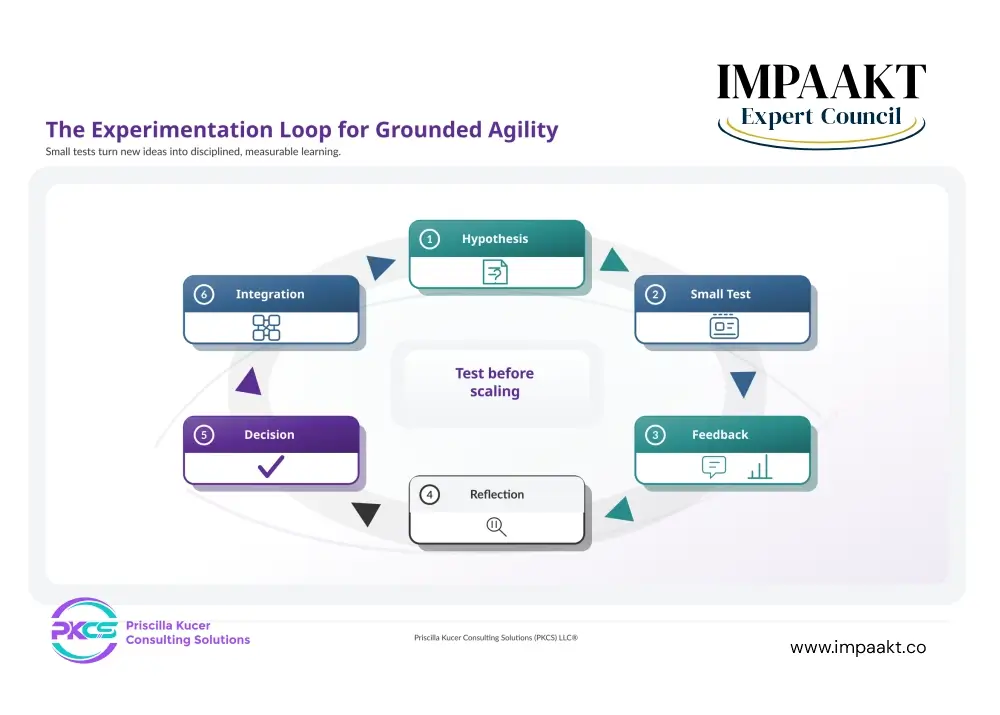
First, use experimentation cycles. Micro and small businesses tend to overlook this routine because of their focus on making fast money. Before scaling a new service, market channel, or internal process, define a small test: the hypothesis, the target customer or team, the time frame, the success measure, and the decision rule. This keeps innovation from becoming guesswork. Recent research on 194 Chilean manufacturing SMEs found that absorptive capacity and open innovation practices improve SME performance when they are connected through innovation strategy (Carrasco-Carvajal et al.). The practical translation is to learn from outside information, but filter it through strategy before acting.
Second, build feedback loops. Feedback should come from customers, employees, and performance data. Across OECD countries, social media use had become mainstream by 2021, with uptake by over 60 percent of the total business population, and SME cloud-computing use doubled in less than six years; yet technical skills and knowledge gaps remained common barriers for small firms (OECD). More data does not automatically create learning. Leaders must decide what feedback matters, how often it is reviewed, and who is responsible for acting on it.
Third, practice structured reflection. A 30-minute monthly reflection can ask: What did we notice? What did we decide? What changed in the work? What did we learn? What will we stop, continue, or redesign? This is where organizational psychology matters. Reflection helps people make meaning from experience, reduce blame, and convert lessons into routines.
Agile without chaos
Adaptability becomes chaotic when every signal looks urgent, every idea becomes a priority, and every role keeps shifting. Structure protects agility. Decision rights, meeting rhythms, role clarity, and performance measures tell people where flexibility is welcome and where consistency is required.
This extends the systems view I introduced in “A Systems View of Micro and Small Business Growth.” Structure, skills, leadership behavior, and learning routines must adjust together. A new strategy without new skills creates frustration. New roles without leadership discipline create confusion. Learning without measurement creates activity without performance.
This systems logic is reinforced by research. A 2024 study of 1,047 Portuguese and Spanish SMEs found that knowledge-based dynamic capabilities relate to firm performance and that entrepreneurial orientation partially mediates that relationship (Hernández-Linares et al.). A 2023 study of 421 family SMEs found sequential links among absorptive capacity, strategic agility, sustainable competitive advantage, and sustainable business performance (Tufan and Mert). In 2025, research on 587 high-tech SMEs found that digital maturity influenced innovation performance through dynamic capabilities, underscoring that technology alone is not the capability; the organization’s ability to reconfigure around it is (Jie et al.s).
Conclusion: adaptability by design
For micro and small businesses, adaptability should not mean constant motion. It should mean disciplined adjustment. Leaders can sense changes without chasing every trend, seize opportunities without overextending the team, and reconfigure work without dismantling the organization’s foundation.
The practical invitation is to make adaptation visible. Name the signals. Test the idea. Review the feedback. Reflect on what changed. Reassign resources deliberately. Measure whether the adjustment improved performance. When leaders do this consistently, adaptability becomes more than resilience during disruption. It becomes a strategic capability for sustainable growth.