In boardrooms across the globe, purpose has become the language of leadership. Organizations articulate commitments to sustainability, inclusion, innovation, or customer impact. Yet despite compelling vision and mission statements, execution frequently falters. Teams remain unclear about priorities. Strategy drifts. Performance plateaus.
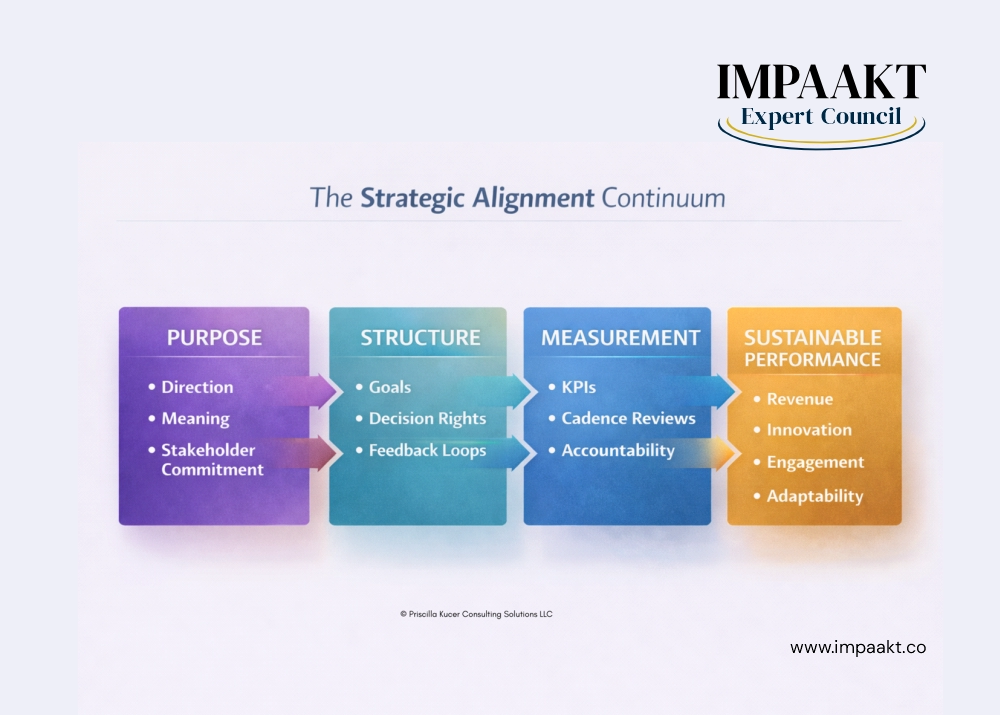
This is why it is important to realize that purpose inspires, but structure delivers!
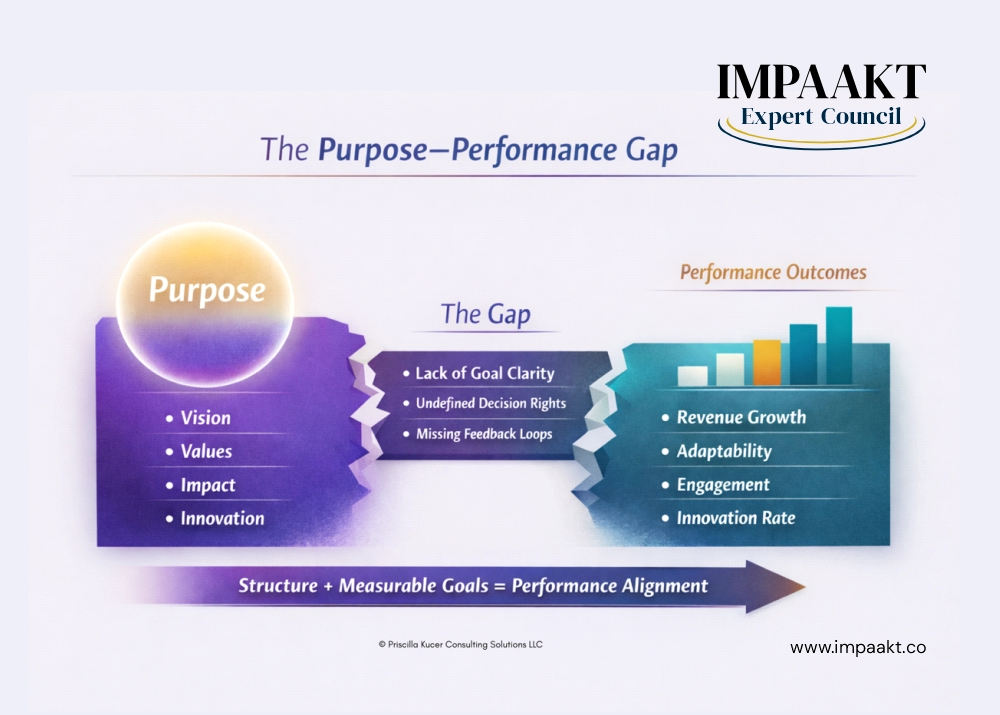
As an organizational psychologist working with founder-led and scaling micro and small businesses, I have observed a consistent pattern: strategy stalls when purpose is not translated into measurable goals, aligned systems, and adaptive routines. Research over the past five years confirms this gap between intention and execution.
The Execution Gap: Why Purpose Alone Fails
Purpose positively influences engagement and identification, but it does not automatically produce performance outcomes. A 2021 systematic review of psychological safety research found that clarity of roles and processes significantly moderates whether positive climate translates into innovation and performance (Newman et al.). In other words, culture without structure rarely sustains results.
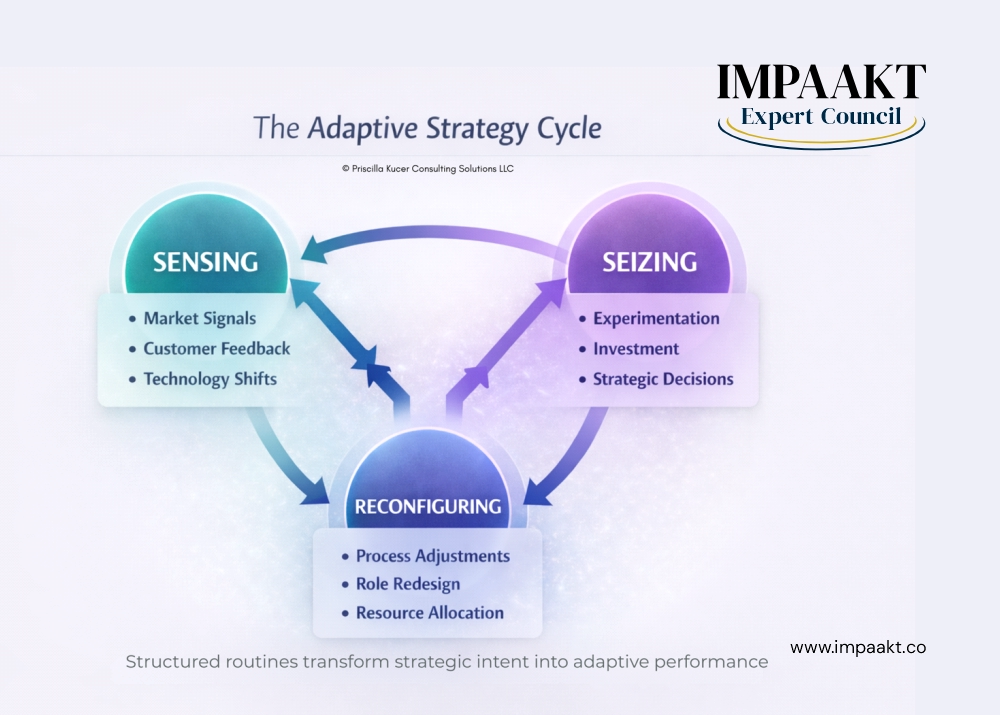
Similarly, studies in dynamic capability theory emphasize that organizations must operationalize strategic intent through routines that enable sensing, seizing, and reconfiguring in changing environments (Felin et al.). Businesses that fail to embed structured experimentation and feedback mechanisms struggle to convert aspiration into adaptability.
The implications are significant. According to Awad and Martín-Rojas’s 2024 study of small and medium enterprises (SMEs), organizational learning and innovation mediate the relationship between strategic orientation and resilience. Companies with formalized learning processes demonstrated significantly higher adaptive performance during market disruptions (Awad and Martín-Rojas.). These implications support that purpose creates direction, while structure creates momentum.
Goal Clarity: Converting Vision into Measurable Outcomes
Goal-Setting Theory continues to receive empirical validation across industries and cultures. A 2024 study in the Asia Pacific Journal of Management found that specific and challenging goals—when paired with structured feedback—significantly improve employee performance and adaptive behavior (Wei et al.). Goal specificity enhances prioritization and reduces strategic diffusion and confusion.
Billore et al. further demonstrate that feedback frequency strengthens self-regulation over time, supporting sustained performance rather than short-term spikes. Yet many companies stop at values statements. They communicate “innovation” but do not define innovation metrics. They articulate “customer centricity” without establishing feedback cadences or measurable outcomes. Without structured goal alignment, purpose becomes rhetorical.
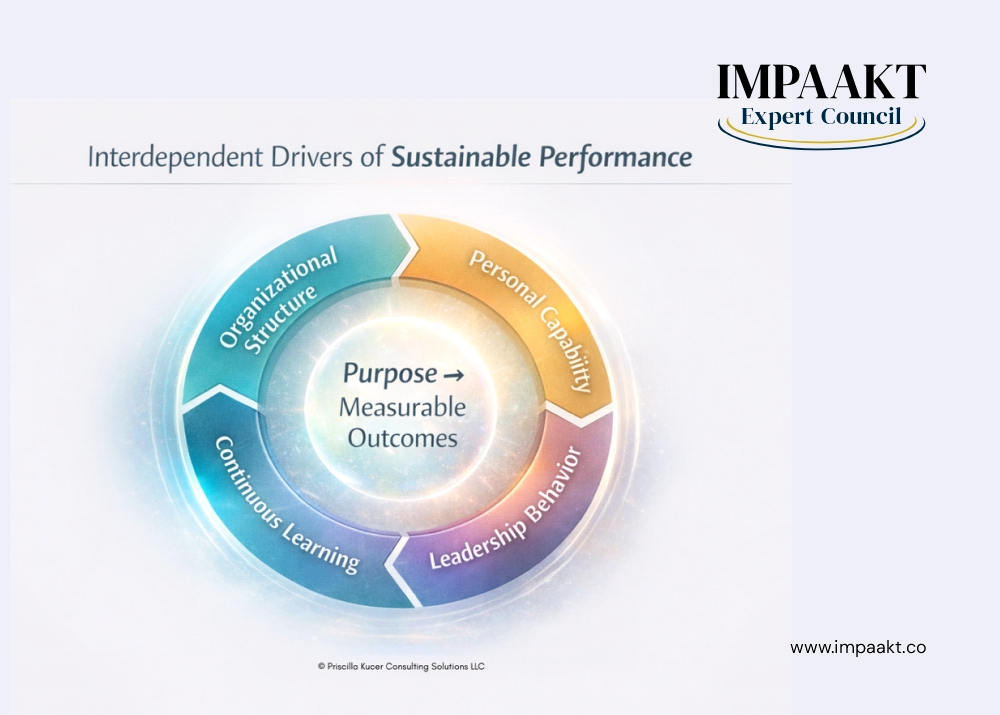
In my work, I often encourage leaders to view purpose as a central organizing force that must refract through four interdependent levers: organizational development, personal skills, leadership, and education. When these domains align, purpose and vision translate into disciplined execution rather than fragmented effort. This systems-based perspective—sometimes described as an integrated performance architecture—helps to ensure that purpose is not isolated from operational reality.
Dynamic Capabilities: Building Adaptive Structure
Dynamic Capability Theory provides further insight into why structure matters. Hernández-Linares et al. found a statistically significant relationship between dynamic capabilities and SME performance, particularly under conditions of environmental turbulence. Papadopoulos et al. similarly demonstrated that B2B high-tech SMEs with structured strategic agility processes maintained stronger performance during crisis conditions than those relying primarily on leadership intuition.
What distinguishes adaptive organizations is not inspirational rhetoric but disciplined routines. Such routines include:
- Defined decision rights and escalation pathways
- Time-bound experimentation cycles
- Structured after-action reviews
- Measurable KPIs linked to strategic objectives
- Regular reconfiguration discussions
In my practice, I frame these routines as forming a reinforcing cycle: structure supports people, capable people exercise leadership, leadership encourages learning, and learning refines structure. When one element is missing, execution weakens. When aligned, they create compounding performance gains that are sustainable.
Psychological Safety and Accountability: A Necessary Balance
Purpose-driven cultures often emphasize trust and inclusion—and rightly so. Wu and Li found that inclusive leadership positively predicts innovative behavior through psychological safety mechanisms. Employees who feel heard contribute more ideas. However, safety without accountability does not guarantee results.
Research on autonomy-supportive leadership shows that empowerment increases intrinsic motivation and engagement (Slemp et al.). Yet motivation requires direction. Clear expectations, measurable targets, and transparent evaluation mechanisms ensure that psychological safety translates into productive energy rather than ambiguity.
Recent well-being research further underscores the risk of unclear expectations. De Neve and Ward demonstrate that workplace wellbeing correlates strongly with firm performance, while ambiguity and chronic overload undermine both. Clarity reduces cognitive strain.
In globally distributed teams, cultural norms, time zones, and regulatory contexts vary. Therefore, role clarity and decision structure become even more critical. Transparent expectations foster cross-border collaboration and reduce friction.
A Practical Framework for Leaders
Closing the purpose–performance gap requires intentional alignment. Evidence-based practices that can close the gap include:
- Translate purpose into quarterly measurable outcomes.
Identify two to three strategic objectives directly linked to mission. - Install structured feedback loops.
Weekly or bi-weekly reviews aligned with goals improve self-regulation and adaptability (Billore et al.). - Clarify decision rights.
Explicit accountability reduces decision latency and prevents founder or executive bottlenecks. - Formalize learning capture.
After-action reviews strengthen organizational memory and dynamic capabilities (Felin et al.). - Balance empowerment with guardrails.
Encourage innovation within defined performance parameters.
When organizations integrate structure, personal capability development, leadership alignment, and education routines into a coherent system, purpose moves from inspiration to operational clarity. While labels for such systems vary across contexts, the underlying principle remains consistent: performance emerges from alignment across multiple interdependent domains.
A Global Leadership Imperative
The global business environment remains characterized by volatility, geopolitical shifts, technological acceleration, and evolving stakeholder expectations. Purpose-centered leadership is necessary to navigate ethical and societal demands. But purpose without disciplined structure creates fragility.
Dynamic capability research confirms that organizations embedding adaptive routines outperform reactive competitors (Hernández-Linares et al.). Contemporary Goal-Setting studies reaffirm that specificity and feedback remain among the strongest predictors of sustained performance (Wei et al.).
Across industries and regions, leaders who integrate vision with structure achieve more durable results than those who rely on inspiration alone.
Works Cited
Awad, Jeehan and Rodrigo Martín-Rojas. “Digital Transformation Influence on Organisational Resilience Through Organisational Learning and Innovation”. Journal of Innovation and Entrepreneurship, vol.13, no. 69, 2024, https://doi.org/10.1186/s13731-024-00405-4
Billore, Soniya, Tatiana Anisimova, and Demetris Vrontis. “Self-regulation and Goal-directed Behavior: A Systematic Literature Review, Public Policy Recommendations, and Research Agenda.” Journal of Business Research, vol. 156, 2023, pp. 1-19. https://doi.org/10.1016/j.jbusres.2022.113435
De Neve, Jan-Emmanuel, and George Ward. “Workplace Wellbeing and Firm Performance.” Wellbeing Research Centre Working Paper, University of Oxford, 2024. https://doi.org/10.5287/ora-bpkbjayvk
Felin, Teppo, Nicolai J. Foss, and Robert E. Ployhart. “Microfundations of Routines and Capabilities: Individuals, Processes, and Structure.” Journal of Management Studies, vol. 49, no. 8, 2012, pp. 1352-1374. https://doi.org/10.2139/ssrn.1988881
Hernández-Linares, Rafael, Franz W. Kellermanns, and María C. López-Fernández. “Dynamic Capabilities and SME Performance: The Moderating Effect of Market Orientation.” Journal of Small Business Management, vol. 59, no. 1, 2021, pp. 162–195. https://doi.org/10.1111/jsbm.12474
Newman, Alexander, Ross Donohue, and Nathan Eva. “Psychological Safety: A Systematic Review of the Literature.” Human Resource Management Review, vol. 27, no. 3, 2017. https://doi.org/10.1016/j.hrmr.2017.01.001
Papadopoulos, Thanos, Konstantinos N. Baltas, and Maria E. Balta. “The Role of Dynamic Capabilities and Strategic Agility in High-Tech SMEs during COVID-19.” Industrial Marketing Management, vol. 105, 2022, pp. 502–514. https//doi:10.1016/j.indmarman.2022.07.006
Slemp, Gavin R et al. “Leader autonomy support in the workplace: A meta-analytic review.” Motivation and Emotion, vol. 42, no. 5, 2018, pp. 706-724. https://doi:10.1007/s11031-018-9698-y
Wei, Feng, et al. “Negative Feedback Change and Employee Performance: A Goal-Setting Theory Perspective.” Asia Pacific Journal of Management, vol. 41, no. 4, 2023, pp. 2155–2178. https://doi.org/10.1007/s10490-023-09908-2
Wu, Guangpeng, and Ming Li. “Impact of Inclusive Leadership on Employees’ Innovative Behavior: A Relational Silence Approach.” Frontiers in Psychology, vol. 14, 2023, https://doi.org/10.3389/fpsyg.2023.1144791