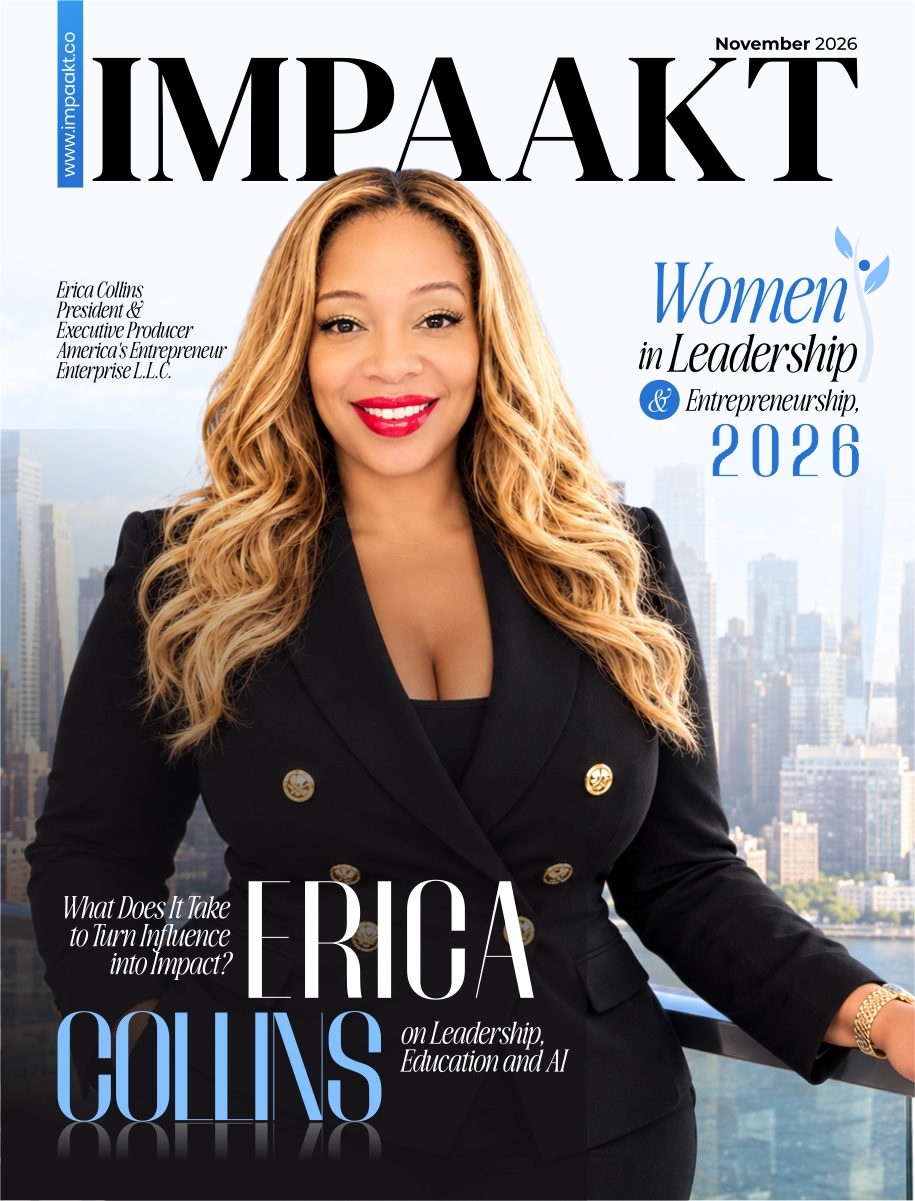
A career can be measured by the positions someone holds, the industries they enter, or the milestones they achieve. But there is another measure of leadership: what becomes possible for others because they chose to make a difference.
That idea runs through Erica Collins‘s journey. From her early work in broadcasting and journalism to her contributions across entrepreneurship, education, and emerging technologies, she has continued to explore how communication, knowledge, and innovation can create opportunities. Her career has crossed disciplines, but the underlying purpose has remained consistent: helping people find their voice, recognize their potential, and turn that potential into meaningful action.
Today, that purpose carries particular weight as women navigate changing business landscapes and the growing influence of artificial intelligence. Erica advocates for women to take ownership of their professional stories, develop the skills to lead through change, and claim a place in shaping emerging technologies. She sees leadership as an ongoing responsibility to learn, evolve, and make room for others to advance.
Inspired by her belief that lasting influence is measured by the opportunities it creates, we spoke with Erica Collins about her journey across industries, her vision for women’s leadership, and the legacy she hopes to help build.
Below are the excerpts from the interview:
Erica, your career has taken you through media, technology, entrepreneurship, and leadership education. When you look back at these different chapters, what has been the common thread connecting them, and how has it shaped the leader you are today?
When I look back at my journey, the common thread has always been communication, innovation, and the desire to create opportunities that make a difference. I have never viewed my career as a collection of unrelated chapters. I see it as an evolution of purpose.
My interest in broadcasting began early. The empowering and impactful representation of Oprah Winfrey shifted my childhood thoughts of becoming a lawyer or politician to broadcasting and media. Growing up in Cherry Hill, New Jersey, I participated as a student and local anchor, reporter in broadcasting cable networks throughout the state, as well as student and local news editor and reporter/writer for community newspapers and publications. In my youth, I developed an appreciation for storytelling in media and public speaking as president of my school. My education at George Washington University in Washington, D.C., combined with internships and professional experiences in media at George Michael Sports Machine,WRC- NBC News, WTTG-Fox News, Interactive Television Association/Association for Interactive Media, U.S. Chamber of Commerce Broadcast Studios and the U.S. House and Senate Radio/ TV Press galleries helped me understand how information influences people’s perceptions, decisions, and opportunities.
My continuing education and advanced certifications and degrees in multimedia, agentic ai and education at New York University, Walden University and Harvard University strengthened the threads of skills and tools for any industry.
Over time these amazing experiences, my interests expanded into entrepreneurship, technology, and education. I became increasingly interested in not just communicating ideas, but building platforms, developing people, and creating opportunities for others to succeed.
One lesson has stayed with me: you do not have to remain the person you were when you started. You can grow, learn, reinvent yourself, and bring the wisdom of every previous chapter into the next one.
For women in business, I want to emphasize that your experience both good and bad are assets, not limitations. The skills you developed in one industry may become your competitive advantage in another.
My leadership philosophy is rooted in being a lifelong learner, remaining adaptable, and understanding that success is not simply monetary or about reaching a destination. It is about what you contribute along the way and how you empower others.
Having worked in prominent media environments, you have seen how stories are selected, shaped, and presented to the public. What has that experience taught you about the relationship between visibility, credibility, and influence, particularly for women in leadership?
Media taught me that visibility matters, but visibility without credibility is not enough. You can attract attention and still fail to build trust. You can have an impressive title and still struggle to influence a decision. Real influence happens when people recognize the value of your perspective and trust what you bring to the conversation.
Women have historically faced challenges getting their expertise recognized, receiving equitable access to opportunities, and being represented in the rooms where decisions are made. That is why I encourage women to become intentional about telling their own stories. My online workshop/course “Professional You to Persona AI” is an introduction to Empowering Women in Leadership & Entrepreneurship through Media & AI Driven Engagement. https://linktr.ee/professorericacollins
Do not assume that your work will always speak for itself. Sometimes you must speak for your work.
That means articulating your accomplishments, documenting your results, sharing your expertise, and building relationships with people who understand your value. New technology tools can give you different perspectives beyond your perception and voice.
It also means recognizing that you do not need to imitate someone else’s personality to be influential. Authenticity and professionalism can coexist.
I also believe women must become more comfortable with strategic self-promotion. We sometimes celebrate our colleagues while minimizing our own accomplishments. We hesitate to discuss our expertise because we do not want to appear boastful.
There is a difference between arrogance and communicating your value.
My advice is simple: own your narrative, establish your credibility, and use your visibility to create opportunities for others. When women become more visible, we should not only ask how many followers we have. We should ask whose lives, businesses, and opportunities are changing because of our influence. For example, my career as a plus size model/beauty queen/actress encouraged the fashion and entertainment industries to notice the overlooked value and profitability in body positivity for the majority of women; my podcasts during covid highlighted the struggle of all businesses but the focus on minority business owners especially in the African American communities encouraged opportunities for more funding for minorities especially women and lead to my role as National Small Business Association Leadership Council; my articles of analysis in women in sports set a chain reaction focused on policies rather than social media arguments; my work with organizations empowered movement for change in civil, workers, women’s and human rights; my work in education and higher education set initiatives for girls and women in global leadership. Actionable influence becomes more impactful rather than just counting followers.
You have witnessed the evolution from traditional broadcasting to the digital information era and are now exploring advanced AI technologies. How has this transformation changed the way you think about who gets to shape conversations, build influence, and lead?
The transformation has been remarkable. Traditional broadcasting required access to specific platforms and distribution channels. Digital technology expanded the possibilities, allowing entrepreneurs, educators, creators, and independent voices to reach audiences directly.
Now, artificial intelligence is introducing another significant shift. We are moving into an environment where individuals and small businesses can access capabilities that once required substantial teams, specialized expertise, or considerable resources.
That creates exciting possibilities for women entrepreneurs, particularly those who have historically faced barriers to capital, visibility, and business infrastructure.
My exploration of AI, including advanced learning in applied AI, reflects my belief that leaders must understand emerging technologies rather than simply react to them. We need to ask not only what these tools can do, but who benefits from them, who is represented in their development, and who has a voice in determining how they are used.
Statistically, most original AI founders. CEOs and companies are dominated by a male demographic. This was very noticeable in the early creation of images until more ethnic groups and women started contributing, could you get a more realistic picture for example. Our contributions as women are essential to the development of AI, AGI, Robotics or if the innovation is rebranded as Super Intelligence (SI). Without our perspectives in all fields and facets, we do not exist in the systems and intelligence that is reshaping the future of society. Therefore, it is necessary to contribute and seek higher positions to lead in these emerging fields.
Technology can expand access, but access alone does not guarantee equity. Women must be involved in building, governing, implementing, and benefiting from these systems, intelligences and emerging technologies.
I want women to see themselves as more than consumers of innovation. We can be decision-makers, founders, strategists, educators, and architects of what comes next.
The future belongs to people who combine technological understanding with sound judgment, creativity, and a clear sense of purpose. We do not need to know everything before we begin. We need the curiosity to learn and the courage to participate.
AI is creating new possibilities for entrepreneurs, but it is also raising questions about trust, originality, and human judgment. What should women business owners understand about using AI strategically without losing the perspective and individuality that set them apart?
My message to women business owners is this: use AI as a strategic tool, not as a substitute for your thinking or visual real person and reality.
AI can help entrepreneurs research markets, organize ideas, draft communications, analyze information, improve workflows, and explore possibilities. For a small business owner managing multiple responsibilities, these capabilities can be valuable.
However, technology does not eliminate the need for judgment. AI-generated information can be inaccurate, incomplete, biased, or outdated. Business owners must protect confidential information, verify important claims, and consider the privacy and security implications of the tools they use.
Your experience, relationships, values, and understanding of your customers remain essential. Those are not inconveniences to automate away. They are part of your competitive advantage.
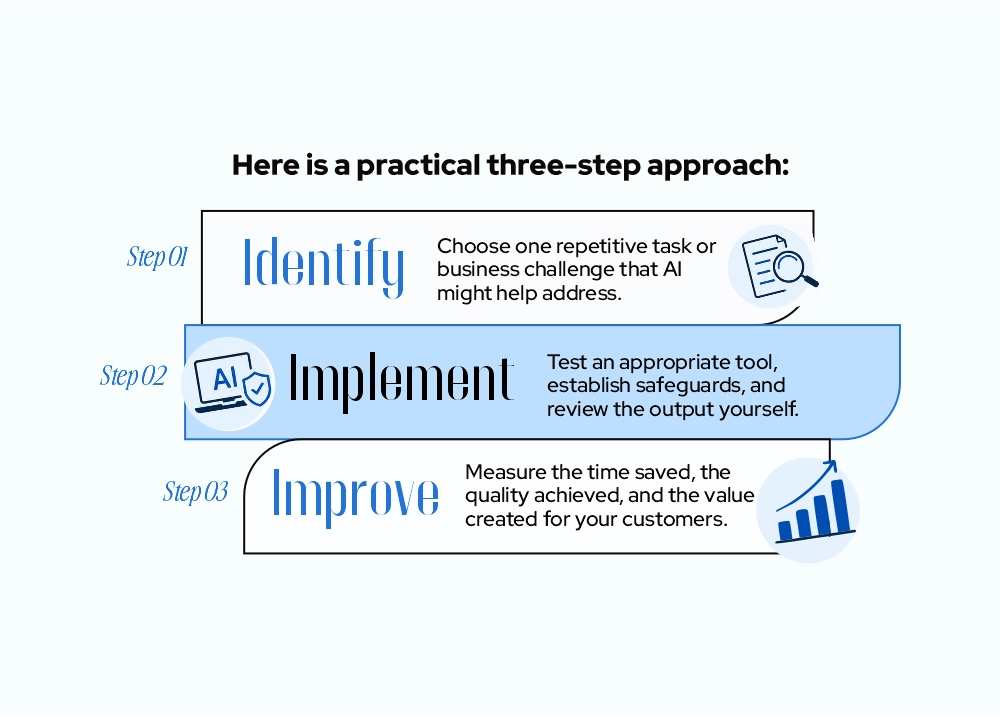
I encourage women to begin with a business problem rather than a technology trend. Ask yourself: What consumes too much of my time? Where am I losing opportunities? What process could become more efficient without compromising quality?
Then experiment with a tool, measure the results, and improve the process.
Remember, your individuality is not found in how many tasks you can complete. It is found in the insight, perspective, and value you bring to the work.
AI may help you move faster. Your judgment determines whether you are moving in the right direction.
Leadership advice often focuses on confidence, communication, and ambition. In your experience, what are some of the less visible capabilities that help women navigate complex environments, influence decisions, and grow into positions of authority?
Some of the most important leadership capabilities are the ones people do not immediately see: discernment, emotional intelligence, resilience, strategic patience, and the ability to recognize patterns before they become problems.
Leadership is not simply being the loudest voice in a room. It is knowing when to speak, when to listen, when to ask a better question, and when to make a difficult decision.
Women also need to understand the importance of boundaries. Being capable does not mean accepting every assignment, solving every problem, or making yourself endlessly available. If you consistently carry responsibilities that belong to an entire team, you may become indispensable to the workload without becoming appropriately positioned for advancement.
Learn to delegate. Negotiate. Document your contributions. Develop relationships with mentors, sponsors, and peers who will challenge you and advocate for your growth.
I also believe in creating space for vulnerability. Women are often expected to demonstrate strength while concealing uncertainty, exhaustion, or disappointment. But leadership does not require us to abandon our humanity.
You can be strong and ask for help. You can be ambitious and still need rest. You can be decisive and remain open to learning.
My advice is to develop the inner capabilities that allow you to lead consistently, especially when circumstances are difficult. Confidence may get you into the room, but judgment, integrity, and preparation help you make a meaningful contribution once you arrive.
Entrepreneurship rarely unfolds exactly as planned. When a business is growing, how can its founder recognize when to stay committed to the original vision and when to rethink the strategy entirely?
Entrepreneurship requires vision, but vision must be accompanied by the willingness to evaluate what is working.
I encourage founders to distinguish between their mission and their methods. Your mission may remain meaningful even when the strategy you originally designed is no longer effective.
Markets change. Customers change. Technology changes. Sometimes the business model that worked at one stage cannot support the next stage of growth.
The question is not whether you should ever change direction. The question is whether you are making that decision intentionally, using evidence rather than fear, pride, or pressure.
I recommend three steps.
First, return to the customer. Are you solving a problem people genuinely need addressed? What are customers telling you through their purchases, feedback, and behavior?
Second, evaluate the business fundamentals. Examine cash flow, profitability, operating costs, customer acquisition, and the sustainability of your growth. Revenue alone does not tell the entire story.
Third, test before making major commitments. Explore a new offer, pricing model, audience, or distribution channel on a manageable scale. Establish clear criteria for deciding whether to continue, modify, or discontinue the experiment.
Sometimes the breakthrough comes from persistence. Sometimes it comes from recognizing that the original approach has served its purpose.
There is no shame in adjusting your strategy. The real risk is becoming so attached to how you thought success would look that you fail to recognize the opportunity in front of you.
A successful entrepreneur is not someone who never changes course. It is someone who understands why the course must change.
Through your work in curriculum development, instruction, and university programs, you also contribute to how future leaders are prepared. What do you believe leadership education needs to teach differently to prepare women for a business environment increasingly shaped by AI and rapid change?
Leadership education must move beyond teaching people how organizations operated yesterday. We must prepare them to make thoughtful decisions in environments that are changing rapidly.
That requires a combination of technological literacy, critical thinking, financial understanding, ethical judgment, communication, and practical problem-solving.
AI education should not be limited to learning how to write prompts or operate a particular platform. Students need to understand how these systems work at a practical level, where their limitations lie, how bias can emerge, and why human accountability remains essential.
We also need to connect education more directly with entrepreneurship. Women should have opportunities to practice negotiating, interpreting financial statements, developing business models, presenting ideas, building professional networks, and evaluating emerging markets.
Equally important, leadership education should acknowledge the realities women may encounter, including unequal access to networks, funding, sponsorship, and decision-making authority.
We should not teach women merely how to adapt to every existing system. We should help them recognize when a system needs improvement and equip them to lead that improvement.
I believe in lifelong learning because no degree, title, or professional accomplishment can replace the need to remain curious.
The leaders who thrive will not necessarily be the ones who know the most on day one. They will be the ones who can learn, question assumptions, collaborate across disciplines, and apply knowledge responsibly.
Our responsibility as educators is to help people develop the judgment and courage to use what they learn to create meaningful results.
You have built a career across industries that are often treated as separate worlds. Has moving between these spaces ever required you to redefine yourself professionally, and what did that teach you about creating your own opportunities?
Absolutely. Moving across industries requires you to remain comfortable with learning, adaptation, and the possibility that other people may not immediately understand your direction. Also, one of my new hats or current role at New York Life helps women map a success plan in case something unexpected happens. Moving across industries requires financial planning and empowerment.
When you have experience in multiple fields, people may try to place you in one category. But a multidisciplinary career can be an advantage because it allows you to connect ideas that others may approach separately.
My experiences in media, entrepreneurship, technology, and education have reinforced the value of transferable skills. Communication supports business development. Technology can . expand educational access. Entrepreneurship can turn ideas into practical solutions. Leadership connects all of them.
I have learned that you do not always have to wait for an opportunity to be formally offered. Sometimes you must recognize a need, develop a solution, build the relationships, and demonstrate the value yourself.
That does not mean every opportunity will work. It means you must be willing to explore possibilities without requiring certainty at every stage.
For women considering a career transition, launching a business, or pursuing a new leadership role, I would say this: do not discount what you already know simply because you are entering unfamiliar territory.
Identify the skills you can transfer, determine what you need to learn, and build evidence that you can deliver results in the new environment.
You are allowed to evolve beyond the expectations people formed when they first met you. Your core being will always be your barometer and compass. Your professional identity can grow as your experience, interests, and ambitions grow.
The idea of legacy often comes up in conversations about leadership, but it can mean very different things to different people. Beyond professional recognition and milestones, what does building a meaningful legacy look like to you?
For me, legacy is about contributions, actionable influence that empowers generations and adaptability to innovation and progress for positive change. It is about what becomes possible for other people because you were willing to use your knowledge, experience, relationships, and opportunities to make a difference.
Awards and professional milestones can be meaningful. They may recognize years of work and dedication. But recognition is not the same thing as impact.
I think about whether the people I encounter feel better equipped to pursue their goals, whether the knowledge I share helps someone make a better decision, and whether the opportunities I help create can continue beyond my direct involvement.
Education is one expression of that legacy. Entrepreneurship is another. Media can introduce people to ideas and perspectives they might otherwise never encounter. Mentorship can help someone see a possibility they had not considered for themselves.
I also believe legacy includes the way we treat people when there is nothing immediate to gain.
We need more environments where women share knowledge, recommend one another for opportunities, discuss lessons learned honestly, and build relationships that extend beyond a single transaction.
I want women to understand that they do not have to wait until they have achieved a certain level of success to make a contribution. You can mentor someone while you are still learning. You can open a door while you are still building your own career.
Legacy is not something we create only at the end of our journey. We build it through the choices we make every day.
As women navigate a future shaped by entrepreneurship, digital influence, and AI, what is one belief about leadership that you would like to challenge, and what do you hope the next generation of women will feel empowered to do differently?
I want to challenge the belief that women must have everything figured out before they are qualified to lead.
Too often, women wait until they have another credential, another year of experience, or one more sign of approval before pursuing an opportunity they are already capable of exploring.
Preparation matters. Competence matters. Integrity matters. But perfection is not a prerequisite for progress.
The next generation of women must feel empowered to ask questions, negotiate confidently, experiment with new technologies, establish businesses, pursue leadership positions, and participate in decisions that shape their futures.
I also want them to recognize the importance of collaboration. We do not have to compete for the right to succeed. We can build businesses, share resources, exchange knowledge, and create opportunities that benefit entire communities.
As AI reshapes work and business, women should be at the table discussing how these technologies are developed, funded, implemented, and governed. We should not simply prepare ourselves for the future others create. We should participate in creating it.
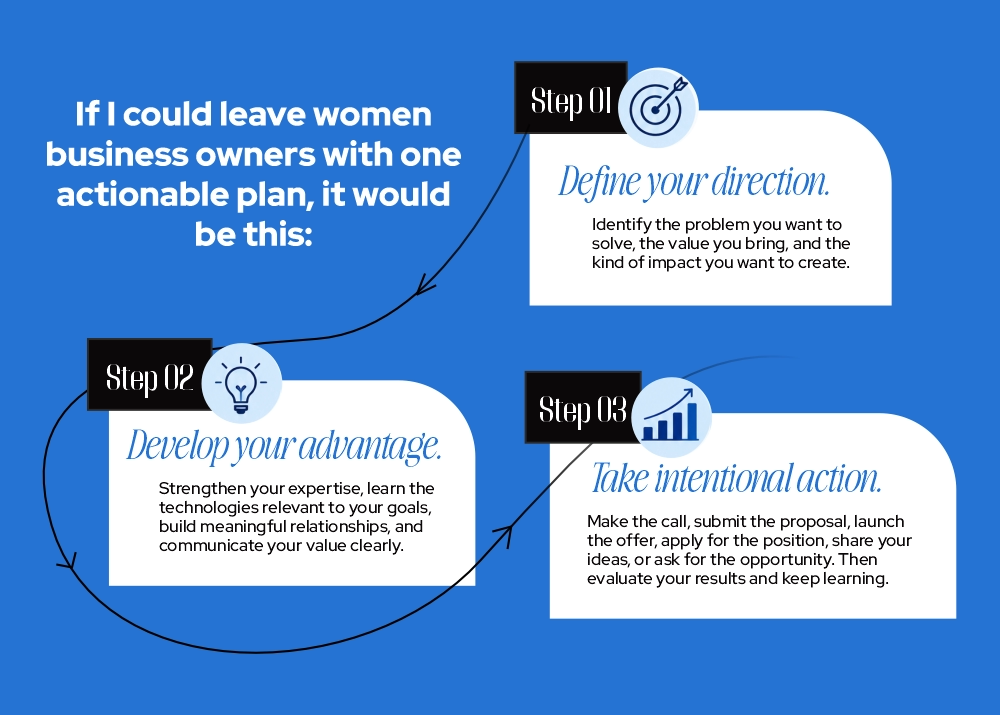
You do not need to see the entire staircase to take the next step.
I want women to give themselves permission to grow, to change their minds when the evidence calls for it, and to pursue success without sacrificing their individuality or humanity.
The future is not something we simply wait for. It is something we help build.
And I believe women belong at the center of that conversation.
For women ready to strengthen their leadership, grow their businesses, embrace emerging technologies, and expand their influence, Erica Collins’ work across media, entrepreneurship, financial empowerment, education, and innovation offers a platform for continued conversation.
Explore her professional work at ericacollins.com and connect with her on LinkedIn. For Financial planning and empowerment connect here https://www.linkedin.com/in/ericacollinsnyl
For event organizers, business associations, universities, and leadership programs, this interview also opens the door to conversations about women’s entrepreneurship, financial empowerment, strategic communication, AI literacy, professional reinvention, and building a legacy of impact.