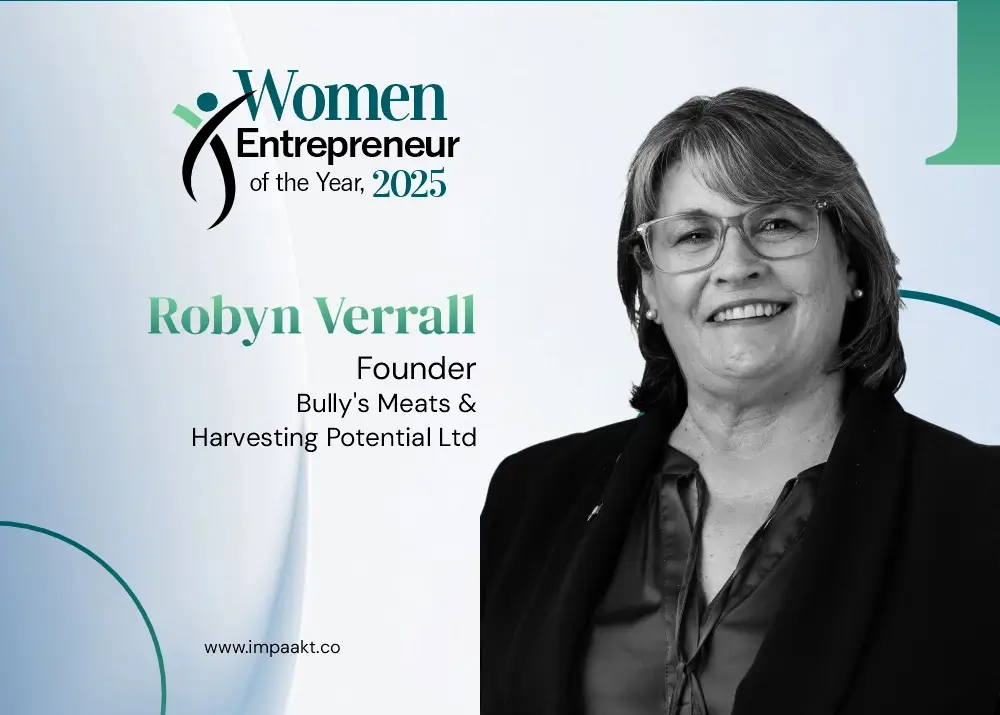
Agriculture has always been seen as a test of endurance; of weathering the droughts, the long days, and the quiet uncertainty of the land. But for Robyn Verrall, it became something more: a canvas to grow purpose, equality, and community from the ground up.
Her story doesn’t begin with business plans or boardrooms; it begins with courage — the kind that led her from a career in nursing to carving her place in Australia’s agribusiness landscape. What started as a leap of faith into her husband’s family farm evolved into Bully’s Meats, a business rooted in ethics, sustainability, and heart. Along the way, she turned challenges into change, transforming not just how food reaches homes, but how women find their voices in one of the world’s most traditional industries.
As the founder of Harvesting Potential Ltd, Robyn has redefined what leadership in agriculture can look like — inclusive, community-driven, and unapologetically human. Her work bridges profit with purpose, empowering women and First Nations communities while championing a more equitable and sustainable future for rural Australia.
From paddocks to policy, from family farms to global conversations, Robyn’s influence reaches far beyond her own fields. She’s not just running businesses; she’s rewriting what it means to lead with purpose in agriculture.
Inspired by her remarkable journey of resilience and reinvention, we sat down with Robyn to dig deeper into the lessons, the leadership, and the legacy she’s cultivating for the next generation.
Here are the excerpts from the interview:
Robyn, your career journey has moved from nursing to agribusiness leadership to women’s empowerment. Looking back, what inner calling or pivotal moment led you to step away from healthcare and embrace entrepreneurship in agriculture?
The simple answer here is “true love.” I only ever wanted to be a nurse from the age of 4—it really was a calling. During my training and career, I became a single mum and worked hard in this career. After being knocked back for internal promotions and needing better pay, I moved into medical sales, which are hard and time-consuming. During this period, I decided to organize my 20-year high school reunion, and with that, re-met up with my now husband. Chris and I were friends at school, but once we met prior to the reunion, we began dating, and I did the 600km round trip to visit and make the relationship work.
Once we married, it wasn’t too hard for a decision to step away from healthcare into farming. Not only was my chosen nursing field (operating rooms) too far away to work, but I had also lost the passion many years before, so I carved or dug out a career in farming, getting affordable meat into homes of South Australia and beyond. It was a huge leap in a traditional farming family business, but one that was embraced by my husband and his parents at that time. I took the leap, learned all I could, and as I say, my husband would have forgotten more things about farming than he could teach me. He makes it safe to ask and never belittles any question. With him allowing me to step forward and step in, it became easy to step up to embrace all that is agriculture today.
What sparked the idea for Bully’s Meats—and how did you go from an idea in a regional town to export across continents? Was there ever a moment when you wondered if it would actually work?
I wanted to bring a value-add to the farm and saw there were animals that couldn’t be sold, and the farmer was paid less or nothing for these animals, so I decided to turn them into business so that the farm became more sustainable and more robust. It was also the best way I could earn my own income and be able to travel back to the city 300km to see family, friends, and spend time with my daughter.
I had some Chinese friends who had some of our meat, and I was asked by them to export it to China. This then became a logistical study to get the right qualifications, get an export number from the government, and then find a service kill abattoir who would work with us to get our boxed beef to the world, all the while ensuring our lamb business was growing nationally and still turning a profit.
It took months. The lies by industry along the way were mind-boggling. The requirements for export were legislated, so I had to work each step along the way just to enable us to be able to sell. By the time I did all of that, the people who said they would help didn’t, so we had to then go about finding our own customers. From the day I realized that every step was difficult and the country of importing requirements was mandated, I honestly thought we would never do it. By the time we did, I was ready to say stop. We got into China at the time there was a country ban on Australian abattoirs and meat. We managed to get paid at that time, and when we went back to look at the costs vs. profit, we stopped this side of our business to ensure we could continue being financially viable and bringing high-quality meat back to a national business.
Life on the farm—and in business—is never without challenges. Can you share one moment where things didn’t go as planned but ended up teaching you something invaluable about leadership or resilience?
I think farming, leadership, and resilience need to go hand in hand. Climate is our biggest challenge, and one of the things that hits hard is drought. As livestock producers and planting paddocks only to grow fodder to make hay bales feed our animals, getting no rain is devastating to our industry as a whole.
When daily temperatures can range between 20 degrees Celsius to 48 degrees Celsius (68 to 120 Fahrenheit), we need to have food supply, rainfall, and plenty of shade for our animals in summer. When the rain does not come, it brings stress, depression, anxiety, and opportunity. You must step up here—animals and future farming depend on your resilience and preparedness to drought-proof as much as you can in the ‘good years.’ This is called leadership. We have planted many thousands of trees over the years and fenced them off so in times of drought we can open them up to provide vegetation, food, and shade.
When it is prolonged without rain, paddocks become bare, and the usual optimism that comes with seasonal cycles gives way to uncertainty and anxiety—not just for us, but for our entire community.
In these times, the traditional model of ‘just working harder’ wasn’t enough. I realized leadership didn’t mean having all the answers—it means being willing to ask different questions, to pivot, and to bring others along in that process.
In the end, we made tough decisions—destocking, shifting breeding cycles, and buying in feed to get us through. It wasn’t the year we had planned for, but it was the year that taught us the most. I learned that true leadership isn’t about pretending the storm isn’t coming—it’s about preparing for it, standing in it, and helping others stand too.
Drought didn’t just test our resources; it tested our mindset. And while we couldn’t control the weather, we could control our response. We chose to find opportunities in adversity, to foster community over competition, and to invest in sustainability for the long term.
Resilience, I’ve learned, isn’t about waiting for the rain—it’s about finding ways to grow even in the dry.
You’ve been a tireless advocate for women in agriculture. What’s the most powerful change you’ve seen in how rural women are perceived—and what change do you believe still needs to happen?
Over the past decade, one of the most powerful shifts I’ve witnessed is the growing recognition that women in agriculture are not just “helping out”—they are leading. Working on and off farm, the term side hustle needs not be associated with rural women. They run businesses successfully and work collaboratively with skill and knowledge.
We’re no longer seen as silent partners or background supporters. Women are running farms, advising on policy, chairing boards, driving innovation, and shaping the future of agribusiness. There’s been a real cultural shift in acknowledging that the work women do—whether in the paddock, in the office, or in the community—directly influences the success and sustainability of our farming systems.
But while the visibility has improved, the structures haven’t caught up. We still see gaps in funding access, decision-making authority, and economic security for women on the land—especially in areas like succession planning, land ownership rights, and the financial recognition of unpaid labour. The stories of women working in family businesses without a title, income, or clear future role are still far too common.
The change that still needs to happen is structural. We need to move from celebrating women’s contribution to embedding equity—in policy, in pay, in leadership, and in opportunity. Until women in agriculture are recognized, compensated, and supported at the same level as their male counterparts, our industry won’t be operating at its full potential.
Empowering women isn’t just good for gender equity—it’s good for farming, business, and the future of rural Australia and globally. We are the ones that work to feed the world, produce products, and we are now being seen.
Your not-for-profit Harvesting Potential is such a beautiful name—it feels like a philosophy as much as an organization. What inspired its creation, and how do you measure “success” beyond just outcomes or numbers?
We as Bully’s Meats would support the Big Issue Big Lunch annually—the organization that offers people self-employment opportunities in Australia to sell magazines and make money. We would supply all of the protein to the lunch that was supported by those that could, and the profits went to training women in need to get trained to have fulltime employment. We did this for 8 years before it was no longer running.
I worked with a First Nations woman to get money donations to start a campaign for Roasts for Christmas lunch for Elders (First Nations people). We started at $2,000 and have raised over $30,000 since its inception, and now we can issue tax receipts. Many families have been fed up with this at Christmas time.
When I won the 2022 SA AgriFutures Rural Women’s Award and got a $15,000 bursary, I used part of it to transport a mobile cool van to live in another state and be used on country for First Nations people, and the other half to set up the charity that supports women and girls.
Creating a charity was a solution to thanking many people for their kindness and cash to support people they will never meet to have more than most can hope for. Success is not about connecting people with kindness, knowing many of those we help we will never meet. A simple thank you is all we want.
As someone who’s juggled entrepreneurship, advocacy, and community work, what practices or beliefs help you stay grounded while managing so much responsibility?
I have lived by 3 sayings: “What you think of me is none of my business”—this includes the good, the bad, and the mean. So if you have an opinion of me you want me to know about—don’t. If your “friend” has told you something about me you want to share—don’t. I live knowing I’ve made mistakes, but I try to do all things with kindness.
“Find what you do and do it on purpose”—this is attributed to Dolly Parton, but it is true. I felt lost for many years, knowing I wanted to be a nurse but never really feeling like I fitted in. I needed to find who I was and how to be me for a very long time. When I came to the farm, I found all of that and more to really stop living like I was in many cases pretending to be someone or something I wasn’t because I didn’t know a true purpose or had self-truth.
My third one is: The answer is always no if you don’t ask the question. And I use this in many keynotes and speeches when talking with students and in many groups. Being brave is not asking—it’s accepting the answer and doing what you can to make people’s lives better.
Many entrepreneurs struggle to align purposes with profitability. How have you balanced running a sustainable business like Bully’s Meats while also driving social change through your advocacy and nonprofit work?
For me, purpose and profitability were never meant to be in competition—they were meant to coexist. At Bully’s Meats, we focus on ethical, sustainable livestock production, and marry that with Harvesting Potential Ltd, our non-profit. We put focus on people, our customers, our community, and the next generation of rural women who deserve visibility and opportunity. That mindset shapes every decision we make.
Balancing business and social impact start with clarity: knowing why we’re doing what we do. On the farm, that means investing in soil health, animal welfare, and drought resilience—not just because it’s good stewardship, but because it ensures long-term viability. In the community, it means using our platform to advocate for women’s leadership, food security, and equitable access to education and financial independence.
I also learned early that I don’t have to choose one lane. Profit creates possibility—it funds programs, scholarships, and change. Through Harvesting Potential, we’ve been able to direct business success into social outcomes by supporting women and girls with resources, sponsorships, introductions, mentorship, and pathways they often didn’t have before.
It’s not always easy, but it’s wildly rewarding. Purpose drives impact. Profits sustain it. And when both are aligned, that’s where real transformation happens—not just for our business, but for the communities we care about.
From your vantage point, what does the future of agriculture look like—especially when it comes to sustainability, women’s participation, and regional innovation?
The future of agriculture is bold, diverse, and deeply interconnected. Sustainability will no longer be a buzzword—it will be a baseline. We’re moving from reactive to regenerative farming, where soil health, water conservation, and low-impact practices are not just encouraged but expected. Technology will play a critical role: from satellite mapping for pasture management to carbon tracking, AI in livestock health, and smart infrastructure to drought-proof farms.
And at the heart of that future will be women. Not at the edge, but at the table, in boardrooms, in advisory roles—not only leading farms, influencing policy, innovating food systems, and scaling solutions across regions and industries. We’ve moved past the stage of proving women belong in agriculture—now we’re ensuring we have the access, equity, and investment to shape it.
Regional innovation is a quiet revolution. It’s happening in shearing sheds, in paddocks, tech hubs, and community halls. It’s in the hands of young women launching agritech startups, Indigenous leaders revitalizing traditional farming knowledge, and families finding new ways to value-add and diversify.
The future of agriculture belongs to those who are prepared to collaborate, innovate, and lead with both heart and strategy. And if we get it right, the next generation won’t be asking how to survive—they’ll be talking about how agriculture became one of the most sustainable, inclusive, and future-focused industries in the world.
When you look back decades from now, what impact do you hope your work—through Bully’s Meats, Harvesting Potential, and your leadership roles—will have left on people, communities, and the planet?
I have stepped into publishing to tell the stories of women and the land, and I am looking to lead the charge to educate, inspire, and connect with women all over the globe. I am offering pages to have their stories written, their ideas turned into education, and their silence to be voiced into reality that brings much more to the global network about leadership and agriculture all being a collective group that many want to be part of.
I hope my legacy is rooted in both growth and generosity—that I left the land, the people, and the systems I touched better than I found them. With Bully’s Meats, I want to be remembered for proving that ethical and sustainable farming isn’t just viable—it’s essential. That you can produce high-quality affordable food while caring for the land, the animals, and the community that sustains you.
Through Harvesting Potential, I hope to have broken cycles—cycles of food insecurity, economic vulnerability, and the silencing of women’s voices. If even one woman stood taller, one girl saw her potential reflected back at her, or one family had food on the table because of the work we did, then that’s a legacy worth leaving.
And in leadership, I hope my seat at every table wasn’t just occupied but used. I want people to say I showed up—not just for the applause, but for the hard conversations, the unseen labour, and the opportunity to lift others up and move the seat out for another woman.
Decades from now on, I want the communities I served to still feel the ripple of change. I want the land to grow. And I want the next generation—especially rural women—to see that the doors we opened were never meant to close behind us.
What’s one truth about entrepreneurship that you wish more women knew before starting out? And if you could give one piece of advice to young women in rural communities dreaming big, what would it be?
The truth about entrepreneurship is that it isn’t for the faint-hearted, and it’s a jigsaw piece that needs to find the complete puzzle. It’s full of moving on, moving over, and never allowing others to steal your limelight. It’s calling out the bad in others as well as applauding the good.
It’s also about finding mentors who say they are thrilled to be in your company, learning to ask the question that only leads you to who, what, and when answers. Most importantly, dealing with the no’s and moving on from those and what doesn’t serve your purpose.
Ask the woman you admire the most to step up and help, ask the dumb questions, and always, if given the opportunity to attend forums, seminars, and face-to-face events, find the way to say yes. Never leave a speaker on a stage without a question—ask it. Not only will you be noticed and applauded, but the speaker will also be likely to seek you out, thank you, and ask if there is anything else you want. Always ask for what you want.
Dream big, create your path, design the sidesteps, pitfalls, and linear path as you will encounter it all. But know your mission, vision, and direction. Know when someone drops away or off, it’s not you—believe them when they say it’s me. Part of dreaming big is arriving at the reality that you will end up with different people.