AI can now analyse patterns, find audiences and optimise campaigns in minutes, work that once took teams days. Dashboards refresh in real time, and every platform can tell a marketer exactly how well it performed. But when every brand has access to the same tools, and every platform marks its own homework, a harder question emerges: how do you know what is actually working?
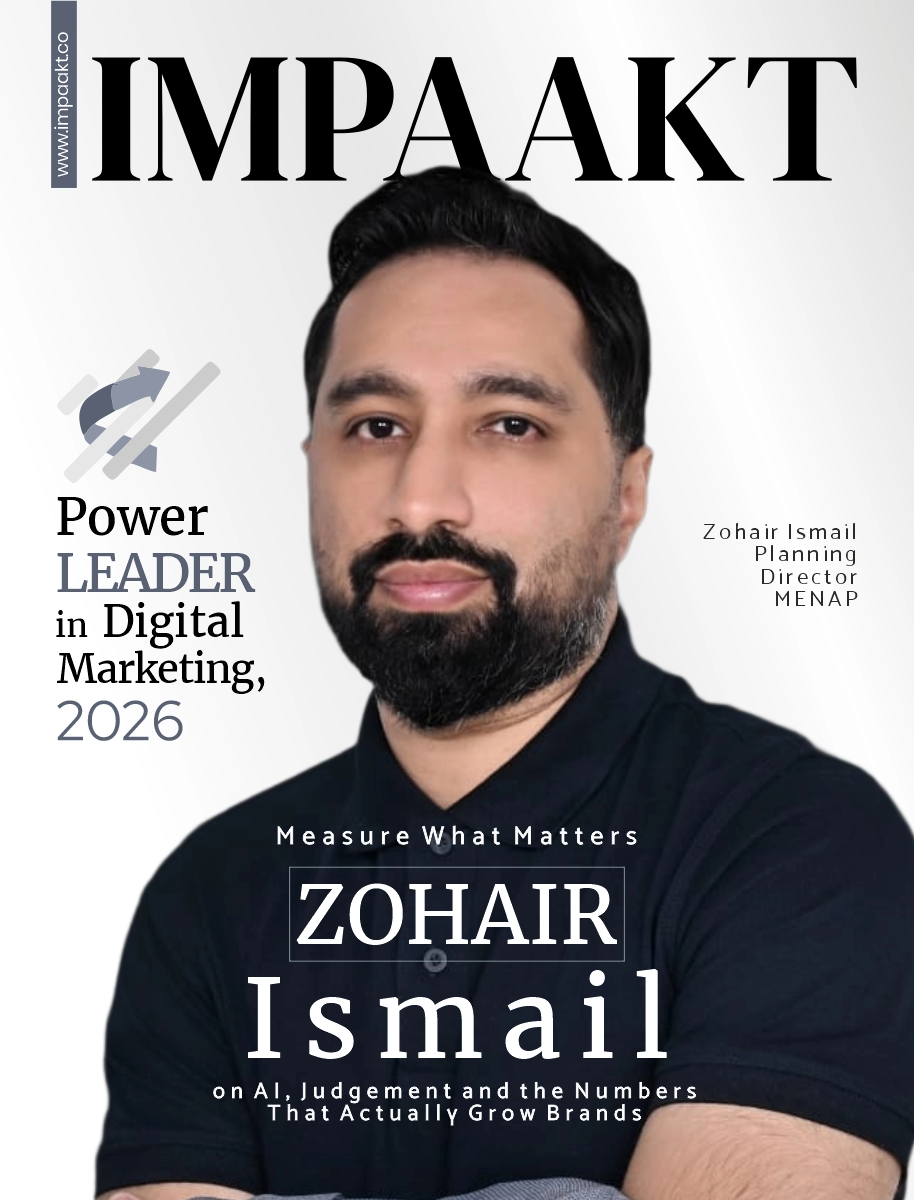
Zohair Ismail, Planning Director MENAP, has a clear answer: start with the business, then prove the media earned its place. Algorithms can recommend where to invest, which audiences to target and how to optimise. Knowing whether those decisions moved the business, and not just the dashboard, takes rigorous measurement and human judgement.
His perspective is shaped by more than a decade across MENA and APAC markets, channels and categories. He has watched digital marketing evolve from buying impressions at the right price into a discipline that demands a real understanding of consumer journeys, commercial outcomes and long-term brand health, and of the gap between what gets reported and what is real.
For Ismail, the job is to make technology work harder without letting it narrow how marketers think. That means questioning convenient metrics, testing for true incremental impact and protecting the strategic patience that brand building demands.
We sat down with Zohair Ismail to discuss measurement, judgement and what it takes to stay ahead when the tools are available to everyone.
Here are the excerpts from the interview:
Zohair, you have spent more than a decade working across markets, media channels and business objectives. How has your understanding of effective digital marketing evolved, and what do you believe marketers still get wrong about what drives growth?
When I started out, digital marketing meant buying impressions for the right audience at the right price, and that was it. Success was a reach number and a CPM. Today the consumer journey is far more complex, and so is the question of what success actually looks like.
- From channel metrics to business outcomes: The plan should start with the business number, not the channel. Impressions that only fill a dashboard don’t cut through anymore. A food brand defending its category leadership will plan, buy and measure media very differently from a tech brand chasing pre-orders. One is judged on penetration and share, the other on cost per incremental sale. Same tools, different scoreboard.
- Attention spans aren’t short; journeys are complicated: Consumers don’t lack attention; they lack patience for clutter. My own day proves it: news on X in the morning, Reels at lunch, Instagram in the evening, TikTok at night and CTV with my family. A measurement model that credits only the last touch in that journey is telling you a fraction of the story.
What do marketers still get wrong?
- Harvesting demand instead of creating it: Especially in MENA, attribution models skew towards the lower funnel because that is where results are easiest to count. But what is easiest to count is not always what creates growth. Brand building, consistent top-of-mind presence and reaching new audiences are where tomorrow’s conversions come from, and they are routinely undervalued because they don’t show up in this week’s report.
Digital marketing has become increasingly sophisticated in its ability to track clicks, conversions and customer journeys. Yet, a campaign can perform well on a dashboard without necessarily building a stronger business. How do you distinguish measurable activity from meaningful business impact?
I work on three principles.
First, agree on the business metric before the media metric. Before a plan is built, the client and I define what success means for the business: revenue, market share, penetration, customer lifetime value or margin. Clicks, CTRs and ROAS then become diagnostics that explain how we’re getting there, not the destination.
Second, measure what we actually added, not what the platforms claim. Platform attribution grades its own homework, and every channel claims the same customer. So wherever budgets allow, I use holdout and geo tests, conversion lift studies, and marketing mix modelling for the bigger picture. More than once, these have shown that a ‘top-performing’ channel was mostly capturing demand that already existed. That changes where the next riyal goes.
Third, track the short term and the long term together. Some of the most valuable work, like brand building and reaching new category buyers, shows up late in sales and barely at all in a click report. So alongside performance data, I track brand health, search demand and new-to-brand customers. Those signals tell you whether you’re building future growth or just spending this quarter’s budget.
The dashboard isn’t the problem. The problem starts when it becomes the scoreboard. In my client work, transparency means showing clients the uncomfortable numbers too. When the business number and the dashboard number disagree, I trust the business number.
You have worked across MENA and APAC, markets with distinct consumer behaviours, cultural contexts and levels of digital maturity. What have these experiences taught you about the limits of applying a successful marketing formula from one market to another?
The biggest lesson is that strategy travels, but execution doesn’t, and neither do benchmarks. The principles behind a good campaign hold almost everywhere: clear positioning, the right audience and a consistent presence. The way you bring them to life, and the way you judge them, rarely transfers intact.
- Platforms and behaviour: The channel mix that works in one market can be wrong next door. In KSA, the platforms people use, the time they spend on them and the way they discover brands differ sharply from the UAE. In parts of APAC, a super-app, messaging platform or marketplace can be the main route to the customer, not search or social. Copy a channel plan and you copy the assumptions behind it, and those assumptions are often wrong.
- Benchmarks: A strong CPM, CTR or cost per acquisition in one market can be mediocre in another. I set benchmarks locally and judge every market against its own baseline, never a borrowed global average.
- Culture and timing: Ramadan isn’t just a seasonal spike. It changes when people consume media, what they buy and which tone works. Compare Ramadan performance against an ordinary month and you will draw the wrong conclusion. A global creative idea can be strong and still feel tone-deaf locally. Local insight isn’t a finishing touch; it decides whether the work lands.
AI is rapidly changing media planning, audience segmentation, optimisation and automation. As these capabilities become more accessible, where do you believe the real competitive advantage will come from: better technology, better data, better strategy or better human judgment?
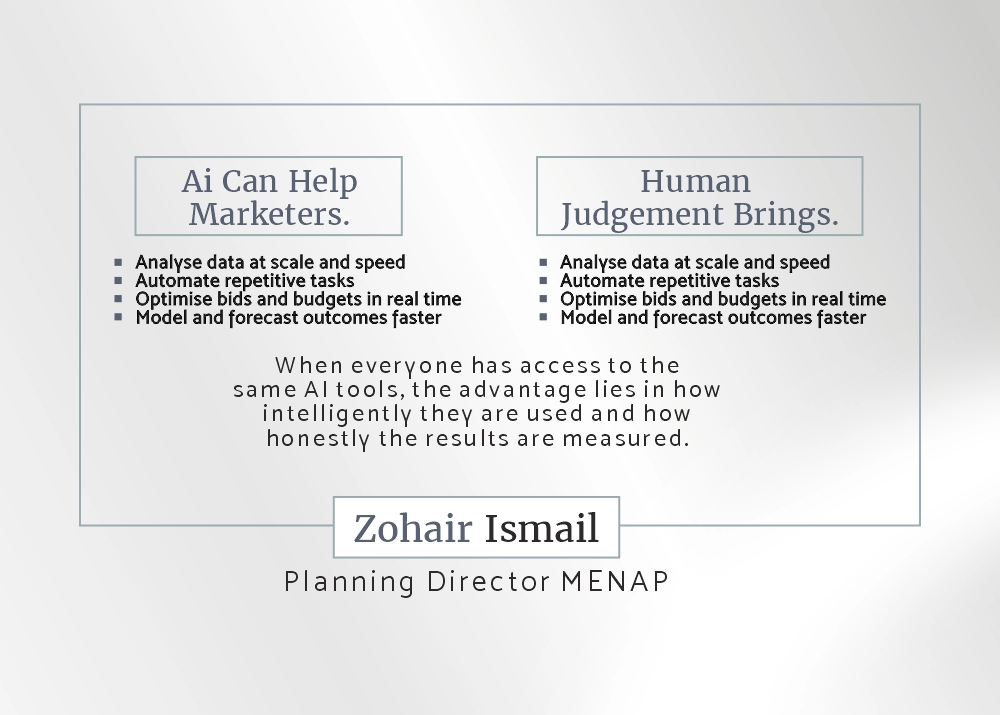
Human judgement and empathy will outlast every automation battle in our lifetime. But that judgement has to evolve and be equipped with better tools, and today those tools are AI and automation.
When every advertiser has the same AI-powered bidding, the same lookalike audiences and the same automated optimisation, technology stops being an advantage. It becomes the minimum. If everyone’s algorithm is chasing the same cheapest conversion, everyone ends up in the same auction, paying the same price.
The edge comes from two things: what you tell the machine to optimise for, and how honestly you check whether it worked. Feed an algorithm the wrong signal and it will hit the wrong target with remarkable efficiency. AI learns from past data and past behaviour. It can suggest an approach, but it cannot judge how that approach will play out in the real world. Automation can drive the car better, but it isn’t the driver, at least not yet.
As AI makes campaign optimisation faster, there is a risk that brands become exceptionally good at improving short-term performance while neglecting long-term brand growth. How should marketers balance immediate commercial pressure with the need to build lasting brand preference?
AI has shortened our patience. We want guaranteed models and instant results, and we jump to conclusions after a week of data. But brand building runs on a different clock, and it has to be measured on that clock.
The balance comes from structure, not hope. I protect a share of the budget for brand building and judge it on brand metrics such as awareness, consideration, share of search and new-to-brand customers, over months rather than days. Performance budgets are judged on incremental outcomes. Both sit on the same scorecard, so neither gets cut simply because it reports more slowly.
AI makes accurate predictions based on the past, but it doesn’t live in the present. In a market moving this fast, good planning needs the patience to let a strategy work, and a clear threshold to know when it isn’t working.
In your experience, what is the biggest measurement blind spot in digital marketing today? Are there important forms of influence, brand building or consumer behaviour that current attribution models still struggle to capture?
Attention. It’s an age-old debate, and it’s still unresolved. Platforms report millions of views, but a viewable impression is not the same as a seen one. Two seconds on a muted screen mid-scroll is counted the same as thirty seconds with the sound on. When those views are measured for real attention, many of them fail miserably.
None of the big platforms has fully solved this, which is a big part of why YouTube still anchors most upper-funnel planning. The industry needs to move from paying for the opportunity to be seen to proving that we were seen and remembered. Attention metrics, brand lift studies and quality-weighted reach are where that shift begins.
You have worked with major brands across multiple markets and led significant client portfolios. When you assess a marketing operation, what are the early signs that the problem goes beyond campaign performance and lies in the underlying strategy, processes or organisational structure?
The first sign is almost always process. I’m a big believer in governance. When it’s strong, a campaign is far less likely to go wrong, and if it does, you find out in week one, not at the post-campaign review.
So the first thing I look at is the team’s governance model. Are the KPIs agreed before launch? Is there a measurement plan from day one, or is measurement an afterthought once the money is spent? Is there a regular rhythm of reviewing, learning and reallocating budget? When nobody can say what success looks like, or results are only discussed at wrap-up, the problem isn’t the campaign. It’s the operating model.
As the industry moves deeper into AI-driven decision-making, what capability do you believe marketers must develop to remain valuable and effective?
Two things. First, the ability to use AI not just to prompt a presentation or a slide, but as a way of working: to drive efficiencies, build team capability and cut lead times. Second, measurement literacy. The marketers who stay valuable will be the ones who know which question to ask of the data, and when not to trust the answer.
If you could challenge one widely accepted belief about digital marketing today, what would it be?
I’d challenge the belief that the more precisely you target, the better your marketing performs.
It’s one of the most widely accepted ideas in digital. We’ve built an industry on micro-segments, interest stacks and ever-narrower audiences, because precision feels smart and the numbers look efficient. But they often look efficient because hyper-targeted audiences are full of people who were going to buy anyway.
For me, it’s not about how precise my audience is, but how clearly I’ve divided it across the funnel. I don’t want to serve a lower-funnel conversion ad to someone who has never heard of my brand. That’s like paying someone to like me. Efficiency on a dashboard isn’t growth; reaching the next buyer is.