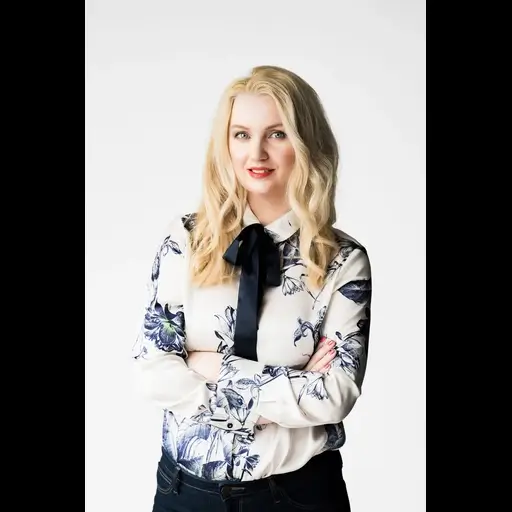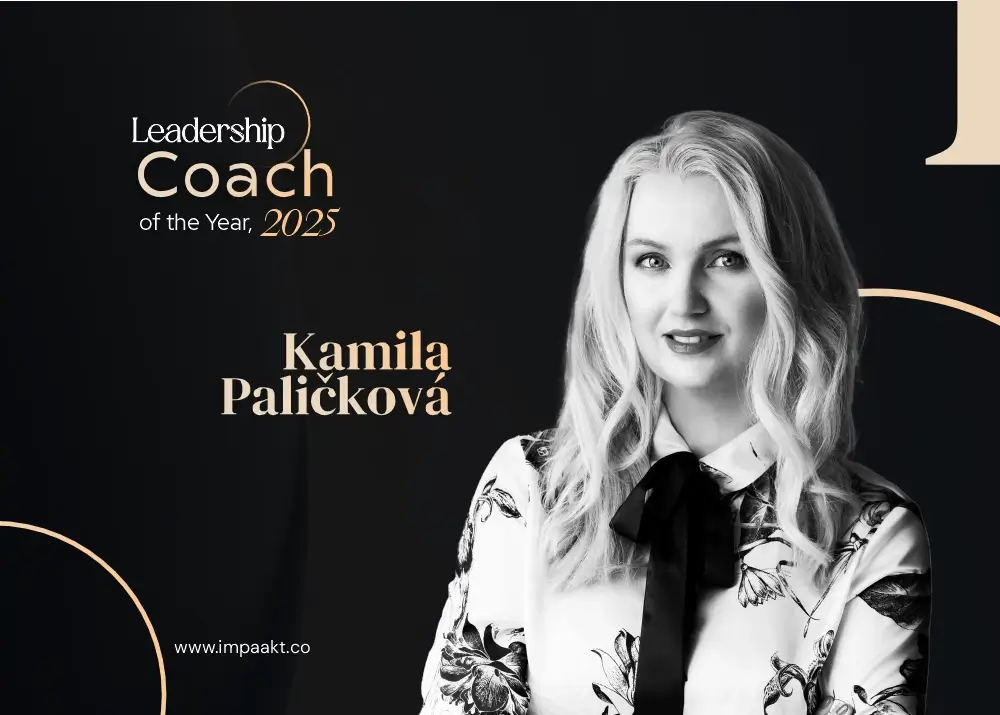
For decades, leadership success was measured by metrics like revenue charts, expansion plans, and market shares. But as the global workforce grows more disillusioned by burnout and imbalance, the old scorecard no longer defines true achievement. A quiet revolution is underway and Kamila Paličková is one of its most compelling voices.
Once a high-achieving corporate leader herself, Kamila walked away from the very definition of success she once embodied. What emerged from that turning point was not rejection, but reinvention; a new model of leadership built on consciousness, balance, and regeneration. Today, she channels that vision into initiatives that empower other women to lead differently. Through her coaching practice and the upcoming Women Changing the World Awards Czech and Slovak, Kamila is spotlighting the rise of conscious female leadership, amplifying women who are transforming industries not through competition, but through collaboration, empathy, and purpose. Most recently, she was honored with the Global Mentor of the Year award at the largest awards ceremony across the Middle East and Asia.
Her work doesn’t stop there. With initiatives like the Redline Expedition, Kamila continues to bridge business, ecology, and human consciousness, helping leaders reconnect the dots between purpose and performance, intellect and intuition, ambition and empathy.
Kamila believes the future of business will belong to those who lead from wholeness — because when leaders evolve, systems follow.
Curious to explore this new paradigm of success, we caught up with her to understand what conscious leadership really looks like in action.
You went through a psychospiritual crisis that redefined how you perceive success and leadership. What did that awakening teach you about the kind of leadership the world truly needs today?
My awakening didn’t happen overnight. It wasn’t a sudden moment of enlightenment but rather a slow dismantling of everything I thought I was — and everything Western culture had programmed me to be.
I had a successful company, teams, results — everything society defines as success. I was the prototype of what it means to be young, beautiful, and successful. Yet inside, I was empty, disconnected, and exhausted.
Until the final collapse, I had no idea how deeply misaligned I was. I didn’t even know what it meant to feel differently. I also couldn’t reconcile myself with the amount of evil and exploitation in the world — the normalized idea that to succeed and accumulate wealth, one must climb on the backs of others: people, nations, animals, the Earth itself.
That experience triggered a profound shift in my consciousness. The entire process took three years. I emerged from it more whole, more sensitive, and healthier — with a deep understanding of what it means to move from a hierarchical, extractive mindset of “power over others” to a paradigm where we are all part of one living ecology, where everything we emit eventually returns to us. I moved from linear to systemic thinking.
The world today doesn’t need more perfect managers; it needs conscious leaders — those who are willing to be vulnerable, who see the world as an interconnected whole, and who have the courage to build new systems instead of maintaining the broken ones.
In the past, you led several companies and teams — a picture of conventional success. Do you think the corporate definition of “achievement” needs to be redefined?
Absolutely. For a long time, I believed success meant growth, expansion, numbers, revenue.
Today, I know that true growth can also mean slowing down, returning to essence, and having the strength to say “no.” In the corporate world, success is often measured by how much we earn, not by what we create — and yet what we create in people is what truly remains after us.
I believe rethinking success will be one of the defining themes of this decade. People are awakening from the illusion that performance equals worth. The new definition of success lies in balance — between doing and being, between mind and heart, between profit and purpose.
And all ancient civilizations already knew this. Their wisdom is astonishing. Today, we are simply rediscovering what they never forgot — that balance is the foundation of life.
You often say, “Healing yourself is the first step to healing the planet.” How do you bring this philosophy into leadership coaching for people coming from highly analytical or profit-driven environments?
I always begin with the human being, not their position.
People from the business world are often disconnected from their inner landscape — accustomed to analyzing, managing, controlling. But true power comes from integration. When a person reconnects with their body, emotions, and intuition, they naturally begin to change the environment around them. The outer world is a mirror of the inner one — on both micro and macro levels.
I help leaders return to their bodies and experience reality not only through the mind but also through feeling. Especially men are tragically disconnected, and that disconnection harms not only them but everyone around them. We urgently need men who are in deeper contact with their inner world.
When their internal ecosystem — their relationship to themselves, their teams, and to the Earth — begins to heal, their decisions change. And those decisions ripple outward into companies, communities, and the planet itself.
That’s why I always say: every systemic change begins with an individual. When one person heals, everything they touch begins to heal too.
You speak about “the rise of healthy feminine energy.” What does that mean in today’s leadership — for both women and men?
Healthy feminine energy isn’t about gender — it’s a quality we’ve collectively suppressed: the ability to listen, to feel, to nurture, to create. For centuries, the dominant energy has been “do, achieve, conquer.” It has its place, but without its counterpart, it becomes destructive.
When I talk about the rise of healthy feminine energy, I’m talking about the return to wholeness — about leaders who can be strong and sensitive, decisive and intuitive. Men are learning to feel again. Women are learning to trust their strength again. And the world is learning that real balance doesn’t come from struggle but from the dance of these two principles.
I see it happening in many organizations today — true innovation emerges when structure (the masculine) and intuition (the feminine) work together.
This isn’t new. Ancient cultures understood this deeply. The Chinese had Yin and Yang, knowing that goodness is balance, while evil is dominance of one over the other. In South America, they speak of Pachamama and Pachatata. In Hinduism — Shiva and Shakti. Carl Gustav Jung wrote about the anima and animus within each of us.
A healthy human being is one who embraces both halves within. That’s what conscious leadership is truly about.
Can you share the story behind the Redline Expedition project — and how initiatives like this merge purpose, ecology, and leadership?
Redline Expedition was born as an answer to a question I asked myself: How can someone from the business world help the planet without losing impact?
I wanted to create a platform where science, spirituality, and leadership could meet. So we began connecting leaders from different parts of the world — entrepreneurs, artists, scientists, and indigenous communities — to explore how we can live and create “beyond sustainability.”
The name Redline symbolizes that fine red line between conscious growth and destruction.
Each expedition we organize is, in essence, a journey back to oneself — and at the same time, a journey back to Earth. When you experience the Amazon rainforest or the raw power of African wilderness, you understand that the planet is not “out there.” It’s within us.
We are animals. We are nature. Nature is not something separate from us.
If you had to design a “sustainable model of leadership” — one that considers people, planet, and profit equally — what would its foundation look like?
Its foundation would be what I call a conscious trinity: human – community – planet.
Leaders who see these three levels as interconnected stop making short-term decisions. They understand that their role is not to grow at all costs but to maintain life in balance.
The model I envision stands on four pillars: Self-awareness – because you cannot lead the world if you don’t know yourself. Service – leadership is not about power but about serving a greater whole. Integrity – actions must align with words. Regeneration – both companies and people must be capable of renewal, not just growth.
Sustainable leadership is therefore not only about ecology — it’s about the ecology of consciousness: how we manage our energy, our people, and our planet.
You often say it’s “time to let the soul go wild again.” What does a “wild soul” look like in a modern leader — and why does the world need that energy now?
For me, “wild” doesn’t mean chaotic — it means alive. It means being in touch with instinct, truth, and nature.
For too long, we’ve believed that being “professional” means suppressing our emotions, intuition, and bodies. But that’s precisely how we’ve lost our vitality and creative fire.
A wild soul in a modern leader isn’t afraid to say, “Not this way anymore.” They’re not afraid to step beyond the system, to create from a place of authenticity rather than fear. They hold both fire and humility. They can stand in their power without losing compassion.
The world needs that energy because we’ve gone far beyond our natural limits — ecologically, psychologically, and spiritually. The more we suppress, the more violently it returns. Everything buried in our shadow eventually finds its way out, often in the most destructive form — wars, burnout, ecological collapse, collective anxiety.
The only path forward is to bring that wildness back consciously — to reclaim our instinct, our truth, and our creative life force. When we dare to do that, we don’t become less human; we become fully alive again.
Looking into the future, how do you see yourself and your initiatives evolving?
I feel we are entering a time of bridging worlds.
My mission is shifting from individual transformation to systemic transformation — from guiding single leaders to building global ecosystems of consciousness and collaboration.
Through projects like The Women Changing the World Awards, Redline Expedition, and the upcoming Beyond Sustainability Conference, my goal is to unite vision, consciousness, and action — to bring together the feminine and masculine aspects of leadership, heart and intellect, purpose and structure.
I want to keep creating spaces where people from different cultures, disciplines, and belief systems can meet and realize that the change our planet needs doesn’t begin with politics or strategy — it begins with genuine human connection.
If you could leave today’s leaders — and those rising to lead — with one truth about success, fulfillment, and leadership, what would it be?
Leadership is not about control but about consciousness — about the ability to see the whole without losing the heart.
A leader who is not whole will always produce toxic solutions. They can rethink strategies a hundred times, but it’s like rearranging the scenery while the storyline stays the same.
It’s not enough to change the rules of the game — we must change the players themselves.
Only when transformation happens inside us — in our motives, our beliefs, our wounds, and our values — do the tectonic plates of the world begin to shift.
When a leader becomes a whole human being, everything changes. Because every true leader is, above all, a guardian of life — and that’s a responsibility that can never be carried by the ego.