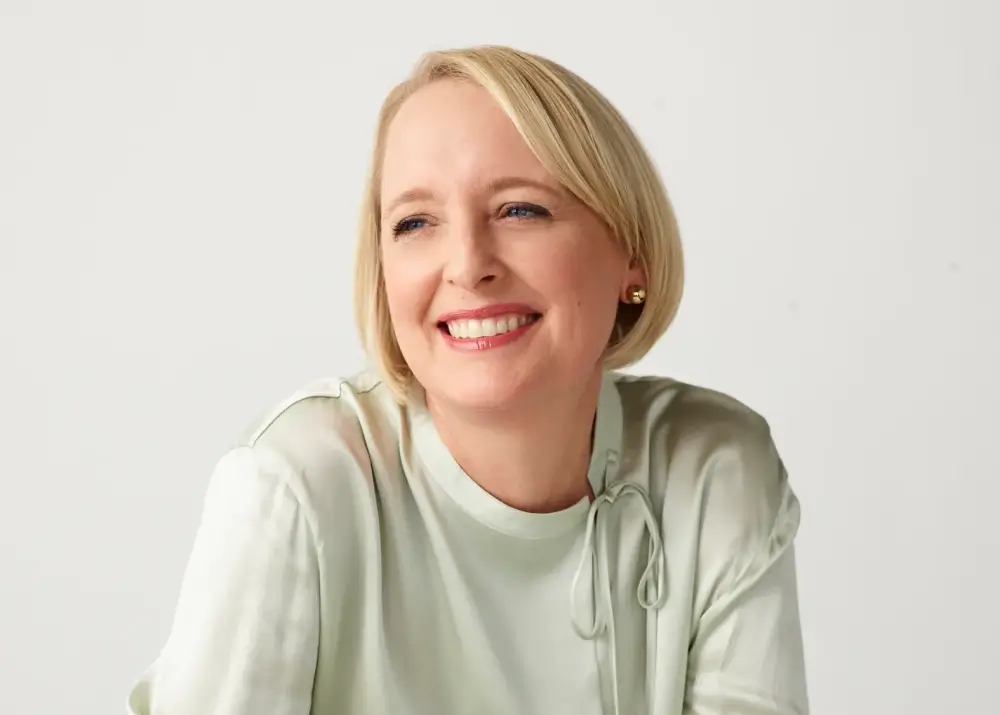
The future rarely announces itself with fanfare. It slips in quietly, through decisions that seem counterintuitive at first glance. In 2010, when a top corporate lawyer walked away from a coveted partnership at one of New York’s most prestigious law firms to join a consulting company as general counsel, few understood the magnitude of what was unfolding. That lawyer was Julie Sweet. And what she’s built at Accenture since becoming CEO in 2019 isn’t just a corporate success story—it’s a blueprint for how global enterprises must think about transformation in an age where standing still means falling behind.
Under her leadership, as of their 2024 fiscal year reporting, the firm has more than 774,000 employees across 120 countries. But numbers alone don’t capture what makes her leadership remarkable. Under her watch, Accenture has become the nerve center of corporate reinvention, the place where Fortune 500 companies go when they need to fundamentally reimagine how they operate.
The Unconventional Path to Power
Sweet’s journey to the CEO’s office defies the traditional playbook. She spent 17 years at Cravath, Swaine & Moore, becoming only the ninth woman ever to make partner at the prestigious firm. She represented major corporations in complex mergers, acquisitions, and financing deals. She helped open the firm’s Hong Kong office and later co-headed it. This wasn’t someone dabbling in law—this was a legal powerhouse at the peak of her career.
When Accenture came calling in 2010, Sweet made a choice that puzzled her peers. She joined as general counsel, a senior role but far from the traditional track to CEO at a consulting firm. What looked like a lateral move was actually something more calculated. Sweet understood something fundamental: to lead in the 21st century, you needed to understand how businesses actually worked, not just how to advise them.
For five years, she immersed herself in Accenture’s operations. She sat in meetings making lists of concepts she didn’t understand, then asked colleagues why things worked the way they did. She led the company’s legal department while serving as principal counsel to the board and senior leadership. More critically, she worked closely with then-CEO Pierre Nanterme on strategic acquisitions that would reshape the firm’s capabilities.
In 2015, Sweet was named CEO of Accenture’s North America business—the company’s largest market. It was the stretch role that proved she could lead beyond legal. Four years later, she became Accenture’s first female CEO, breaking another barrier: she was also the first CEO in the company’s history who hadn’t joined straight out of college.
Betting Big When Others Hedge Small
What sets Sweet apart isn’t just her ability to lead—it’s her capacity to see around corners. In early 2022, before ChatGPT made artificial intelligence a household conversation, Sweet was already in boardrooms talking to CEOs about AI’s transformative potential. Many dismissed it as “consulting talk.” She had conviction anyway.
In June 2023, Accenture announced a $3 billion investment in AI over three years, with plans to double its AI-focused workforce to 80,000 employees. It was an audacious bet at a scale that made competitors pause. The investment wasn’t just about building AI capabilities—it was about positioning Accenture to be the bridge between cutting-edge technology and practical business application.
The results speak for themselves. As of early 2025, Accenture has secured over $4.2 billion in generative AI sales alone. In the first quarter of fiscal 2025, the company booked $1.2 billion in AI-related work in just three months. Sweet has met with 30 CEOs across Europe, Southeast Asia, Australia, and the U.S. in recent months, and the message is consistent: enterprises are racing to integrate AI, and they need guidance through complex terrain.
But Sweet’s vision extends beyond AI. In 2024, she acquired Udacity and launched LearnVantage, committing an additional $1 billion over three years to help clients upskill their workforce. The move acknowledges a hard truth: technology transformation fails without people transformation. Accenture has trained over 600,000 of its own employees in AI basics and is now scaling that capability to clients facing acute skills shortages.
Restructuring for What Comes Next
In late 2024, Sweet announced Accenture’s most significant organizational restructure in its history, combining five operating functions into a single unit called Reinvention Services. The move streamlines how the company serves clients who increasingly need integrated solutions rather than siloed expertise.
It’s the kind of structural change that signals confidence, not crisis. Sweet has fundamentally remade Accenture’s business model during her tenure, shifting from project-based consulting to long-term managed services that embed Accenture’s people and technology into client operations. The firm’s market capitalization has grown from $90 billion when she joined in 2010 to over $149 billion today.
Leadership That Doesn’t Look Back
Sweet has been named to Fortune’s Most Powerful Women list multiple times, hitting the number one spot in 2020. Time magazine included her in its list of the 100 Most Influential People. Forbes ranks her among the World’s 100 Most Powerful Women. These accolades matter, but what matters more is what she’s built: a company positioned at the intersection of every major technological shift reshaping global business.
Her approach to leadership is deceptively simple. She emphasizes continuous learning, telling employees that a CEO’s most valuable skill is the ability to acquire new knowledge and challenge assumptions. She makes tough calls on talent, saying yes to opportunities before feeling ready, and focuses relentlessly on execution rather than visibility.
For enterprises navigating unprecedented technological disruption, Sweet represents something crucial: proof that transformation is possible when you combine deep operational understanding with the courage to invest ahead of consensus. She didn’t just transform Accenture. She’s transforming how hundreds of the world’s largest companies think about their own futures.