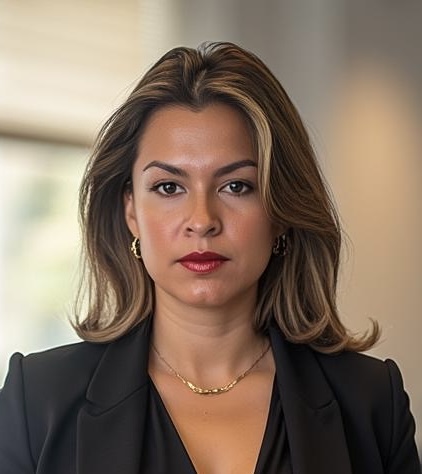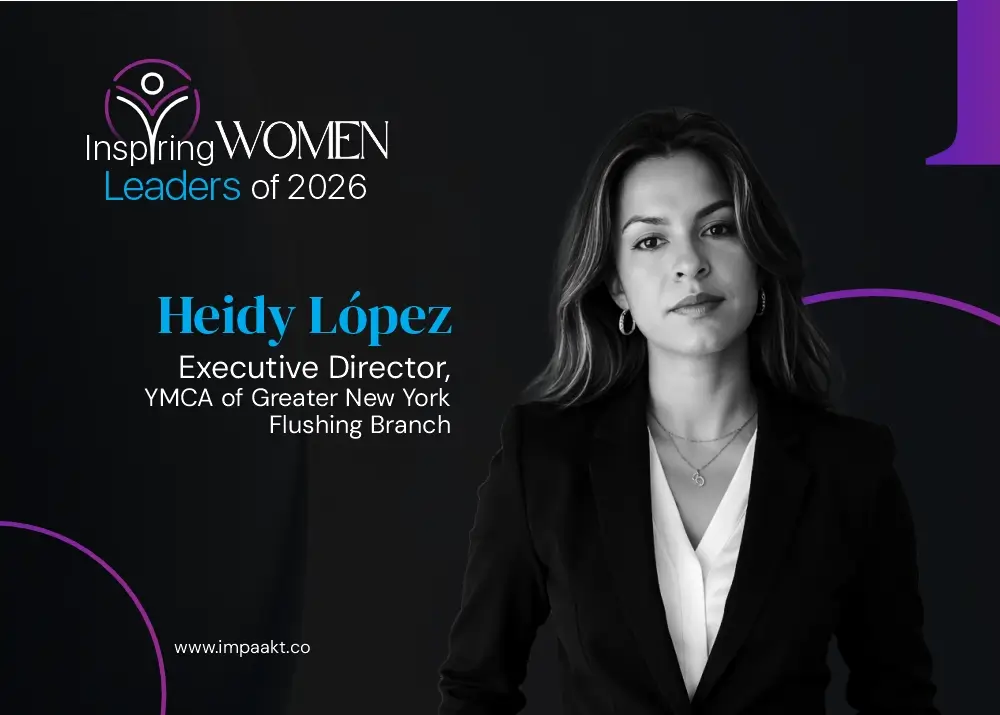
Some leaders build organizations. Heidy J. López builds belonging.
Long before she led a community institution, López experienced the power of one. Raised by Colombian immigrant parents navigating a new country with limited resources and unfamiliar systems, she witnessed how easily families can fall between structures not designed for them. During those formative years, the Yonkers YMCA became more than a resource for her family. It became stability, mentorship, and a rare sense of welcome when uncertainty defined everyday life.
That early encounter reshaped how López understood leadership. She learned that real leadership is not authority or visibility. It is creating spaces where people feel seen, supported, and capable of building a future.
Today, as Executive Director of the YMCA of Greater New York Flushing branch, she leads programs spanning youth development, workforce readiness, health and wellbeing, and family services across one of the most culturally diverse communities in the United States.
She quotes: “Now, as Executive Director, I carry an even deeper responsibility: to preserve and elevate an institution that once invested in me.
This is not simply a career. It is stewardship.”
Heidy’s work reflects a simple but powerful belief: community institutions succeed when they move beyond service delivery and become engines of trust, dignity, and collective growth.
As communities grow more complex and expectations of nonprofit institutions evolve, López sits down with IMPAAKT to discuss leadership, belonging, and the responsibility of building systems that empower people long after programs end.
Heidy, your leadership journey has been deeply shaped by education, family engagement, and community work. Looking back, what early experiences first showed you the power of leadership rooted in service?
My understanding of leadership did not begin in a classroom or a boardroom — it began in a small apartment where my parents were rebuilding their lives from nothing.
I am the proud daughter of Colombian immigrants who arrived in the United States with two young daughters in search of opportunity that was unattainable in their homeland. At the age of eight, I left behind everything familiar — language, friendships, routine — and entered a country where I did not yet understand the systems or expectations that would shape our future.
What I witnessed during those early years shaped my definition of leadership forever.
I watched my parents navigate fear, uncertainty, and financial hardship with dignity. They worked tirelessly, often juggling multiple responsibilities, determined to create stability for our family. Yet even in their own struggle, they extended themselves to others. They translated for neighbors. They shared job leads. They showed up to school meetings despite language barriers. They demonstrated that leadership is not about authority — it is about responsibility to others.
One of the most formative spaces in our early years was the YMCA.
The Y was more than a building. It was foundation. It was belonging. It was possibility.
It was the place my parents found when they were searching for guidance in a new country. It opened its doors to my sister and me without hesitation. It provided programs, mentorship, and community alongside other families navigating similar journeys. It gave my parents reassurance that they were not alone.
There was never a moment when my family was turned away.
When “more” was always uncertain — more stability, more clarity, more opportunity — the YMCA offered direction. It created a space where isolation was replaced with connection and uncertainty was replaced with access.
As a child, I did not yet have the language to describe leadership. But I understood what it felt like to be welcomed. I understood what it meant for my parents to receive guidance without judgment. I understood what access could mean when everything else felt fragile.
Today, leading a YMCA is one of the most profound full-circle moments of my life.
I now steward the very type of institution that once helped shape my family’s future. I lead with passion because I have lived the impact. I lead with gratitude because I carry the memory of what the Y gave us — dignity, stability, and the belief that more was possible.
Service, for me, has always been deeply personal.
Eighteen years is a long time to stay committed to nonprofit work. What has kept you grounded in this space — even when the challenges are real and resources are limited?
What sustains me is memory and mission.
I never forget what it felt like to navigate systems that were not built with families like mine in mind. I remember the anxiety of paperwork, the confusion of unfamiliar expectations, and the relief when someone offered patience and guidance.
Nonprofit leadership is complex. Resources are limited. Community needs are urgent. The responsibility is constant. Yet I remain committed because I understand the transformative power of access.
A scholarship can shift a child’s confidence. Workforce development can stabilize a household. A safe space can change the trajectory of a young person’s life.
On difficult days — when funding is uncertain or needs exceed capacity — I remind myself that this work is not theoretical. I see my parents in the families we serve. I see my younger self in the children who walk through our doors.
Now, as Executive Director, I carry an even deeper responsibility: to preserve and elevate an institution that once invested in me.
This is not simply a career. It is stewardship.
Much of your work supports families navigating new countries, systems, and expectations. What does it take to lead with empathy while still driving measurable outcomes?
Empathy and accountability are not opposites — they are essential partners.
Leading with empathy begins with listening. It requires recognizing that when participation is low or outcomes are inconsistent, there are often structural barriers at play — transportation, work schedules, language access, childcare responsibilities.
However, empathy does not eliminate standards. It refines how we design systems.
We establish measurable goals. We evaluate data. We track progress consistently. But we also ask deeper questions: Are our services culturally responsive? Are our processes accessible? Are we unintentionally creating barriers?
Empathy ensures humanity remains central. Accountability ensures sustainability.
The most effective leadership integrates both.
As Executive Director of the Flushing YMCA, you oversee operations, finances, and programs — but also something less tangible: trust. How do you think about it?
Trust is the most valuable currency in community leadership.
Operational excellence is non-negotiable — fiscal responsibility, compliance, safety, and strategic planning are foundational. But trust is built relationally.
It is built when families know decisions are made with integrity.
It is built when staff feel supported and heard.
It is built when community partners see consistency between mission and action.
Trust is not created through perfection. It is created through transparency and consistency. When we make mistakes, we acknowledge them. When we make commitments, we fulfill them.
In community leadership, trust is both fragile and powerful. Protecting it requires humility.
Equity-driven leadership is central to your work. What does equity look like in day-to-day decision-making beyond mission statements and values?
Equity is not a statement — it is a leadership practice.
For me, it means having the courage to ask: Who is missing? Whose voice is not being heard? Who may be navigating barriers we do not see? Women’s leadership brings a unique strength to this work because we often lead with both empathy and accountability — seeing the human impact while driving structural change.
Equity shows up in how we allocate resources, how we design programs, and how we create leadership pathways for those who have historically been overlooked — especially women and communities of color. It is reflected in scholarship access, culturally responsive services, and intentional mentorship that expands representation at decision-making tables.
Equality distributes evenly. Equity designs intentionally.
As women leaders, we are called not only to manage systems, but to transform them — ensuring opportunity is not accidental, but accessible. That is how equity moves from language to legacy.
Nonprofit leaders often balance competing needs: community urgency, limited funding, and long-term sustainability. How do you navigate those tensions without losing sight of the people you serve?
The tension between urgency and sustainability is constant — and it requires disciplined leadership.
Communities cannot wait. Families need support now. Yet if we respond to every urgent need without strategic focus, we risk weakening the very institution designed to serve them long term.
I navigate this by anchoring every decision in mission and measurable impact. We prioritize initiatives that create meaningful, lasting outcomes while maintaining fiscal responsibility and operational strength. Diversifying funding streams and building strong partnerships allows us to respond with both agility and stability.
Not every opportunity can be pursued. Not every idea can be funded. Visionary leadership requires the courage to say no in order to protect what matters most.
Sustainability is not restraint — it is stewardship. By preserving the health of the organization, we ensure that we are not only responsive in the present, but reliable for generations to come.
That is how we honor both urgency and legacy.
Outcomes matter, but so do lived experiences. How do you personally measure success when the most meaningful changes are often invisible?
Some of the most transformative outcomes are not immediately visible — they unfold quietly, over time.
Success is the parent who once felt unseen but now steps into leadership within the community. It is the young woman who discovers her voice and begins to advocate for herself. It is the staff member who grows into confidence and claims space at the decision-making table.
Data informs strategy — but lived experience reveals true transformation.
As a woman leader, I measure success not only by metrics, but by momentum. Are we expanding access? Are we building confidence? Are we shifting power in ways that allow others — especially women and families who have historically been overlooked — to lead?
I also hold myself accountable to alignment. Does my leadership reflect my values? Am I modeling integrity for my children and for the women watching? Am I creating environments where dignity and belonging are non-negotiable?
When leadership strengthens confidence, stability, and opportunity — even in ways that cannot be captured in a report — that is impact. That is legacy.
From your vantage point, how has the role of women in nonprofit and community leadership evolved, and what barriers still need to be addressed?
Women have always powered community transformation. What has shifted is not our capacity — it is our visibility and influence.
Today, more women are leading institutions, shaping strategy, stewarding multimillion-dollar budgets, and influencing policy at the highest levels. Our leadership is no longer defined solely by compassion; it is recognized for driving operational excellence, fiscal responsibility, and long-term, systems-level change.
Yet progress does not mean parity.
Women — particularly women of color — continue to face disproportionate scrutiny, inequitable compensation, and limited access to sponsorship networks that accelerate executive advancement. Too often, women are over-mentored and under-sponsored. Representation may be increasing, but authority and equitable pay have not fully followed.
Visionary change requires intentional design. We must build leadership ecosystems that invest in mentorship, sponsorship, board representation, equitable compensation, and clear succession pathways. Representation alone is symbolic. Influence and decision-making power are transformative.
Personally, I carry the legacy of my mother — her resilience, her refusal to surrender to circumstance, her unwavering belief that perseverance would create opportunity. She modeled leadership long before I understood the title. Her strength shapes how I advocate, how I mentor, and how I intentionally create space for other women to rise.
I am also a proud mother of two extraordinary children who anchor my leadership in accountability. They observe how I navigate complexity. They witness how I treat others. They remind me daily that leadership is not compartmentalized — it is lived. Motherhood has deepened my leadership, sharpening my commitment to integrity, courage, and consistency. The example I set shapes not only organizational culture, but the expectations the next generation will hold for women in power.
Women’s leadership should not be framed as exceptional. It should be expected, structurally supported, and equitably resourced.
For me, this work is both institutional and intergenerational. We are not simply stepping into leadership — we are reshaping what leadership looks like for the women who will follow.
As you look ahead, what changes do you hope to help shape — whether within the YMCA, the nonprofit sector, or the communities you serve?
As I look ahead, I am focused on building systems that do more than provide services — they create mobility.
Within the YMCA and the broader nonprofit sector, I want to expand access to workforce development, youth leadership pipelines, and culturally responsive family supports that position communities not just to participate, but to lead. Access should not be reactive; it should be strategic and future-focused.
I also hope to help redefine leadership within the sector. As women leaders, we are uniquely positioned to shift models away from rigid hierarchy and toward collaborative, community-informed approaches that elevate lived experience alongside expertise. Leadership should not be concentrated — it should be cultivated.
For the families we serve — particularly immigrant families — my vision is not survival, but stability and generational prosperity. Economic mobility, homeownership, entrepreneurship, and educational advancement should be attainable outcomes, not distant aspirations.
Transformation must move beyond programs. It must shape futures, influence policy, and expand what is possible for the next generation.
That is the change I hope to help lead.
When people look back on your leadership years from now, what do you hope they’ll say Heidy J. López stood for — not just professionally, but personally?
I hope they say I stood for dignity — not as an idea, but as a standard.
That I led with integrity when decisions were difficult.
That I never allowed growth to come at the expense of humanity.
That I never forgot where I came from — and ensured that access was never reserved for the privileged few.
I hope they say I honored the institution that once embraced my immigrant family by strengthening it for the generations that followed. The YMCA gave my parents guidance when uncertainty defined their world. It gave my sister and me belonging during one of the most formative seasons of our lives. It offered opportunity when opportunity felt fragile.
To now lead within that same movement is both privilege and responsibility. I have worked to ensure that every family who walks through our doors feels seen, welcomed, and never turned away.
As a woman leader — and as a mother — I also hope my legacy reflects courage. The courage to lead with compassion in spaces that often reward rigidity. The courage to create room at the table for other women and leaders of color. The courage to build systems that outlast my tenure.
My parents taught me that hardship is inevitable, but suffering is not permanent. The YMCA reinforced that belief by pairing structure with possibility. If, years from now, people say that I expanded access, elevated women, strengthened community trust, and led with resilience and gratitude — then I will know I honored both my family’s sacrifices and the responsibility of leadership.
And that, to me, is impact.