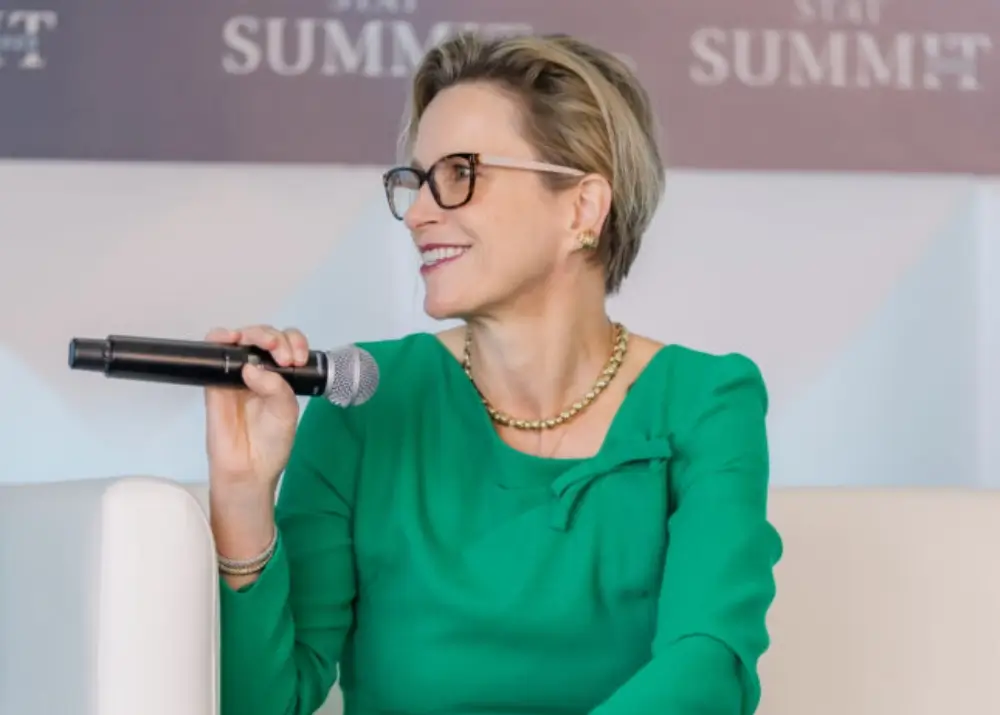
When GlaxoSmithKline announced its new CEO in 2017, the appointment raised eyebrows across the pharmaceutical sector. Emma Walmsley had spent most of her career in consumer goods, not drug development. She had no medical degree, no PhD in biochemistry. What she did have was seventeen years of building global brands at L’Oréal and a track record of turning GSK’s consumer healthcare division into one of its most profitable units. The question wasn’t whether she could do the job—it was whether she could reimagine it.
When Consumer Instincts Met Corporate Courage
Born in June 1969 in Barrow-in-Furness, Cumbria, Walmsley didn’t follow a typical route to the executive suite. The daughter of Vice-Admiral Sir Robert Walmsley, she studied Classics and Modern Languages at Oxford’s Christ Church—hardly the traditional preparation for leading a pharmaceutical giant. Yet this unconventional foundation proved to be her secret weapon.
For seventeen years, Walmsley honed her skills at L’Oréal, working across Paris, London, New York, and Shanghai. She wasn’t just selling lipstick and skincare; she was learning what makes consumers tick. In 2007, she took on perhaps her toughest assignment: running L’Oréal China as General Manager of Consumer Products. Moving to Shanghai with her husband and four young children, she immersed herself in a market where Western brands were still finding their footing. She didn’t just survive; she thrived, overseeing global brands while managing a Chinese skincare label, proving she could navigate complexity and cultural nuance simultaneously.
The pivot to pharmaceuticals came in 2010 when GlaxoSmithKline recruited her to lead Consumer Healthcare Europe. Here was a marketing executive from cosmetics entering an industry obsessed with R&D and regulatory compliance. But GSK’s then-CEO Andrew Witty saw what others missed: the industry needed transformation, not just incremental improvement.
Rewriting the Playbook at GSK
Walmsley’s rise within GSK was swift and deliberate. From President of Consumer Healthcare Europe in 2010, she ascended to head the global consumer healthcare division in 2011, turning it into a powerhouse that contributed nearly a quarter of GSK’s revenues with brands like Panadol, Voltaren, and Horlicks. When she became CEO in April 2017, she made history as the first woman to run a major pharmaceutical company.
The achievement carried symbolic weight, but Walmsley wasn’t interested in symbolism alone. She wanted results. Within months, she laid out her vision: GSK would focus its research and development firepower on four core disease areas, allocating 80 percent of pharma R&D capital to where it could make the biggest impact. The message was clear—no more spreading resources thin, no more playing it safe.
The transformation required surgical precision and steel nerves. In January 2018, Walmsley replaced fifty of GSK’s top managers and created new roles, bringing in outside talent like Karenann Terrell from Walmart as chief digital and technology officer. Colleagues describe her leadership style as a potent blend: “strong and dynamic” with a “steely” focus, yet deeply personable. She sets ambitious KPIs and measures delivery relentlessly, paying close attention to talent development while remaining “ruthless with underperformers.”
Delivering the Blockbuster Moment
In summer 2023, GSK launched Arexvy, the first vaccine approved for respiratory syncytial virus in older adults—a disease that hospitalizes and kills more people annually than influenza. Within four months, it became a blockbuster, generating over one billion pounds in sales. Under Walmsley’s watch, GSK’s focus on vaccines and specialty medicines has driven significant growth, with 2024 revenues reaching nearly $42 billion. The company doubled its cancer treatment sales that year alone.
For her achievements, Walmsley received recognition that transcends business. In 2020, she was appointed Dame Commander of the Order of the British Empire for services to the pharmaceutical industry. She’s consistently ranked among Fortune’s Most Powerful Women, topping the international list in 2018 and ranking in the top ten in 2023. In 2023, her compensation reached £12.7 million, making her the second-highest-paid CEO of a European pharmaceutical company.
Beyond titles and accolades, Walmsley expanded her influence by joining Microsoft’s board as an independent director in 2019, bringing her strategic acumen to the technology sector’s intersection with healthcare.
The Vision Beyond Tenure
In September 2025, Walmsley announced she would step down as CEO at the beginning of 2026, marking the end of nearly a decade at the helm. Yet her legacy isn’t measured in tenure alone. She proved that pharmaceutical companies don’t need to be led by scientists or physicians to succeed—they need leaders who understand consumers, embrace change, and aren’t afraid to challenge orthodoxy.
Her approach to leadership remains instructive: set clear objectives, empower talented people, hold them accountable, and don’t tolerate mediocrity. She balances empathy with performance, inspiring through her work ethic while maintaining exacting standards. Outside the boardroom, she practices yoga, spends time with her husband David Owen and their four children, and embodies the idea that powerful leadership doesn’t require sacrificing personal life.
Walmsley’s aspiration was never just about breaking barriers or claiming firsts. It was about reimagining what a pharmaceutical company could be—more focused, more innovative, more attuned to the people it serves. In an industry often criticized for being slow to evolve, she showed that transformation isn’t just possible; it’s profitable. The woman with no medical background didn’t just lead a pharmaceutical giant—she rewrote the prescription for success.