The greatest business transformation of the 21st century wasn’t about selling products. It was about building platforms that let millions of others create value. Four leaders—across chips, cloud, music, and hospitality—understood this before their competitors. They built ecosystems that became indispensable. They didn’t just serve customers. They created economies.
The Platform Principle
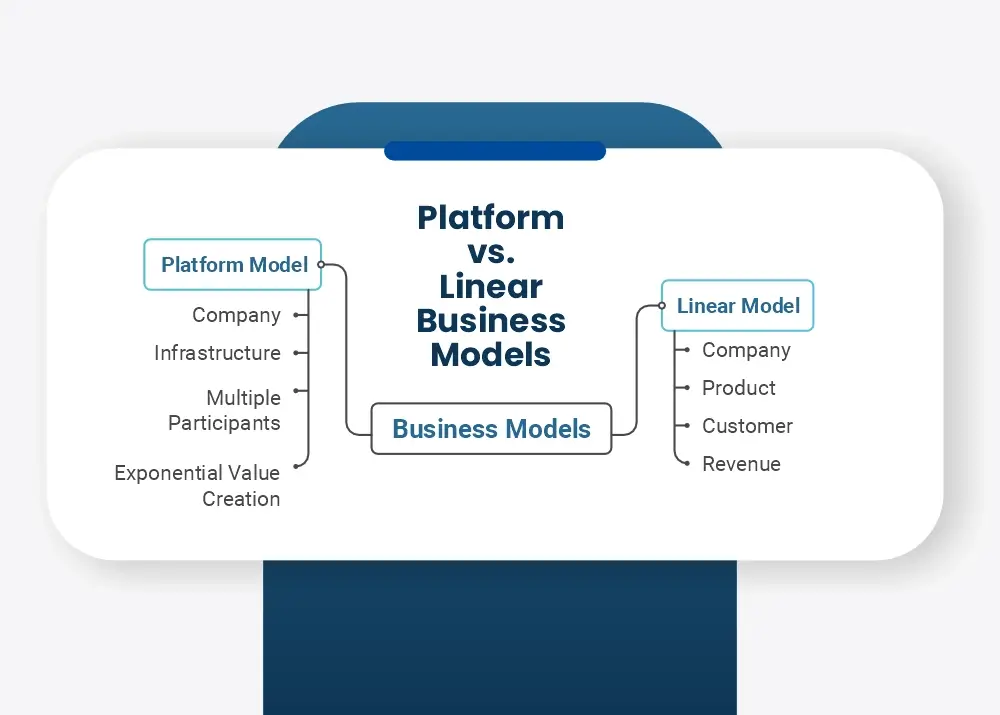
Traditional businesses follow a linear model: create product, find customer, complete transaction. Platform businesses operate differently. They build infrastructure that enables countless transactions between multiple parties, extracting value from the network rather than the product itself.
The mathematics are compelling. A linear business scales additively—one new customer equals one new revenue stream. A platform scales exponentially—each new participant increases the value for all existing participants. Economists call this the network effect. Business leaders call it the future.
But building platforms requires a fundamentally different mindset. You’re not optimizing for immediate profit. You’re engineering for ecosystem dominance. The four leaders profiled here mastered this transition—each in radically different industries, each facing unique obstacles, each ultimately reshaping their sector’s economic structure.
Jensen Huang: Building the AI Infrastructure Layer
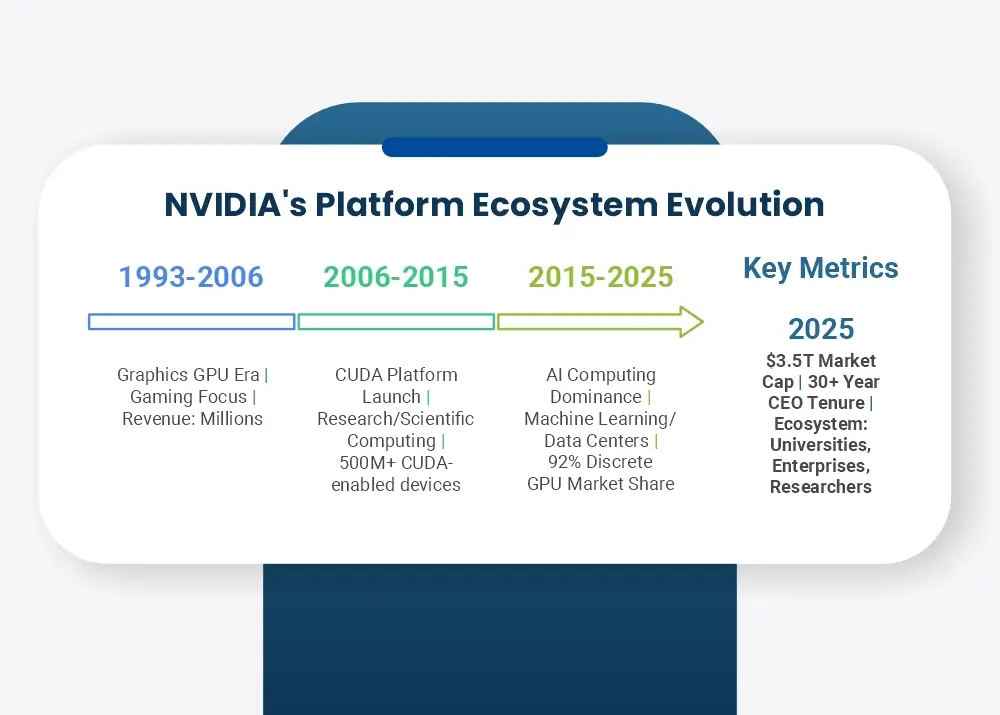
When Jensen Huang co-founded NVIDIA in 1993 with $40,000 in capital, graphics cards were niche products for gamers. His vision? GPUs could become the computational backbone for entirely new industries.
The pivot point came in the early 2000s. While competitors focused on incremental improvements to graphics performance, Huang invested over $1 billion developing CUDA—a parallel computing platform that transformed GPUs from specialized graphics processors into general-purpose computational engines. Industry analysts called it a distraction. Huang called it inevitable.
CUDA launched in 2006. Initially, adoption was sluggish. Developers needed to learn new programming paradigms. Applications were scarce. The ROI was unclear. But Huang understood platform dynamics: create the infrastructure, lower the barriers to entry, and let developers build the ecosystem.
He was right. By 2025, CUDA powers over 500 million devices. More importantly, it created a developer ecosystem that became NVIDIA’s unassailable moat. Universities teach CUDA. Researchers publish papers using CUDA. Enterprises standardize on CUDA. When AI exploded in the 2010s, NVIDIA wasn’t scrambling to catch up—the entire industry was already built on their platform.
The results speak volumes. NVIDIA controls 92% of the discrete GPU market. Its market capitalization reached $3.5 trillion in October 2025, making it one of the world’s most valuable companies. Huang, who has served as CEO for over 30 years, built more than a chip company. He built the infrastructure layer for the AI revolution.
The lesson: Platform dominance requires patient capital and technical foresight. Huang spent a decade building CUDA before the AI boom vindicated his strategy. That decade was his competitive advantage.
Andy Jassy: Selling the Factory
Amazon didn’t plan to become the world’s largest cloud provider. The infrastructure AWS sells today was originally built to solve Amazon’s internal scaling challenges.
Andy Jassy joined Amazon in 1997 as a marketing manager. By 2003, he was leading a small team exploring a radical idea: what if Amazon sold access to its computing infrastructure the same way utilities sell electricity?
The concept was heretical. Amazon was a retailer. Computing infrastructure was a cost center, not a revenue stream. But Jassy saw the platform opportunity. Every company needed servers, storage, and networking. Most built their own. This was inefficient, capital-intensive, and slow. What if they could rent Amazon’s infrastructure instead?
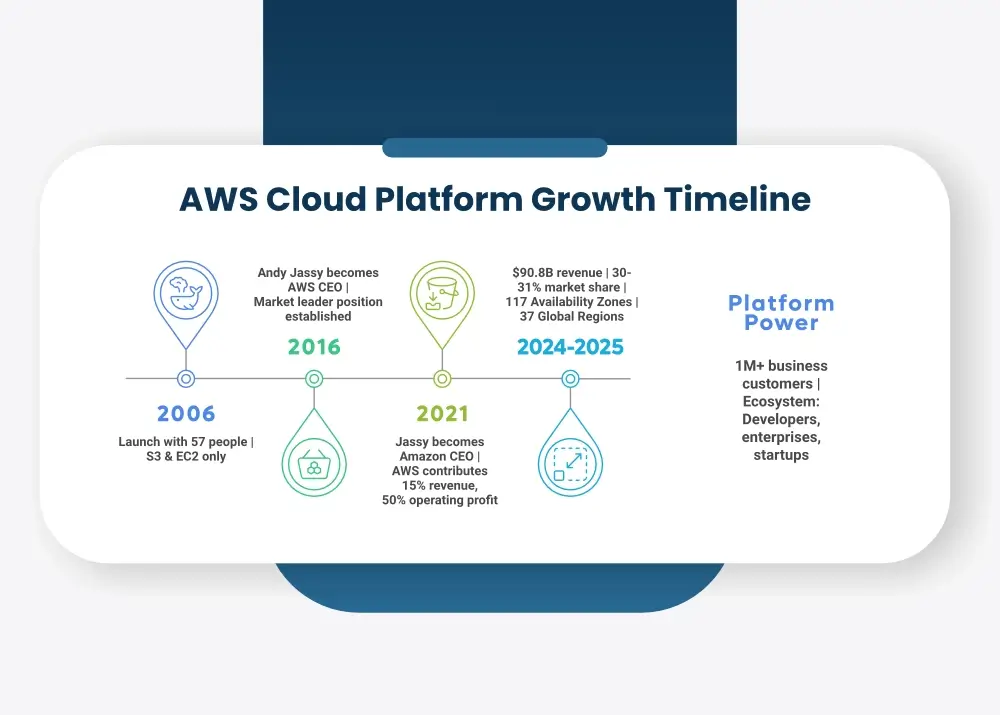
AWS launched in 2006 with a team of 57 people. The initial services were basic: storage (S3) and compute (EC2). Pricing was revolutionary—pay only for what you use, no long-term contracts, no upfront capital expenditure. For startups, it was transformative. For enterprises, it was threatening.
Jassy’s genius was understanding that the platform’s value wasn’t the infrastructure—it was the ecosystem. AWS aggressively courted developers, offering free tiers, comprehensive documentation, and a marketplace for third-party services. Each new service attracted new developers. Each new developer increased the platform’s value.
The strategy worked. By 2025, AWS holds 30-31% of the global cloud infrastructure market, ahead of Microsoft Azure (20-21%) and Google Cloud (11-13%). In 2024, AWS generated approximately $90.8 billion in revenue and $24.9 billion in operating income. When Jassy became Amazon’s CEO in 2021, he left behind a business that contributes 15% of Amazon’s total revenue but approximately 50% of its operating profit.
The lesson: The best platforms solve the builder’s problem first, then sell the solution to others. AWS succeeded because it was born from Amazon’s actual infrastructure needs, not a theoretical market opportunity.
Brian Chesky: Trust as Infrastructure
In October 2007, Brian Chesky couldn’t pay his rent. He and roommate Joe Gebbia inflated three air mattresses in their San Francisco apartment and rented them to conference attendees for $80 each.
That desperation became a $100 billion company.
But the path from air mattresses to global platform required solving an impossible problem: trust. Chesky was asking strangers to sleep in each other’s homes. Hotels existed precisely because people didn’t want that risk. How do you platform-ize hospitality when the core product is inherently personal?
Chesky’s answer: build trust infrastructure. Airbnb implemented verified photos (initially, Chesky photographed properties himself), comprehensive reviews, secure payments, and host insurance. Each feature reduced friction, making it easier for strangers to transact.
The platform strategy was elegant. Airbnb didn’t own properties—it enabled millions of people to become hospitality providers. Each new host increased inventory. Each new guest increased demand. The network effect accelerated.
But platforms face platform-specific challenges. Regulatory battles erupted as cities blamed Airbnb for housing shortages. In 2019, Barcelona fined Airbnb $2.3 million for illegal listings. Trust issues made headlines—property damage, unsafe conditions, discrimination. The COVID-19 pandemic saw bookings drop 80% in some cities, forcing Airbnb to refund $1 billion to guests and provide $250 million in host relief.
Chesky’s response demonstrated platform leadership. He engaged regulators, removed non-compliant listings, and refunded guests during the pandemic. When Airbnb went public in December 2020, it raised $3.5 billion at a $100 billion valuation—one of the largest IPOs in U.S. history.
By 2025, Airbnb boasts 5 million hosts who have welcomed over 2 billion guests across 240+ countries. The platform reached its first billion guests in 14 years; the second billion took just three more years. Chesky’s net worth stands at approximately $9.2 billion, and he’s committed to donating his CEO equity through the Giving Pledge.
The lesson: Platforms that enable peer-to-peer transactions must invest heavily in trust infrastructure. Technology alone isn’t sufficient—you need policies, insurance, verification, and community management.
[INFOGRAPHIC 4: Airbnb’s Platform Scale & Trust Infrastructure]
- Platform Participants: 5M+ hosts | 2B+ guests served | 240+ countries
- Growth Velocity: First billion guests: 14 years | Second billion guests: 3 years
- Trust Infrastructure: Verified photos | Reviews | Secure payments | Host insurance | Community policies
- Financial Milestones: Founded 2008 | IPO Dec 2020 ($100B valuation) | 2024 Revenue: $11.1B
- Crisis Response: COVID-19: $1B guest refunds + $250M host relief
The Platform Playbook
These three leaders operated in different industries but followed remarkably similar strategies:
- Infrastructure First:Each built foundational technology (CUDA, AWS, streaming platform, marketplace) before extracting maximum value.
- Subsidize Adoption:All lost money initially to drive platform participation—NVIDIA on CUDA development, AWS on free tiers, Spotify on ad-supported users, Airbnb on trust infrastructure.
- Network Effects:Each created ecosystems where new participants increased value for existing participants, creating compounding growth.
- Patience:Platform businesses require longer time horizons. Huang spent a decade on CUDA before AI vindicated the investment. Spotify operated unprofitably for over 15 years.
- Ecosystem Lock-In:Once developers, enterprises, users, or hosts committed to the platform, switching costs became prohibitive.
The results validate the strategy. NVIDIA’s $3.5 trillion market cap, AWS’s cloud dominance, and Airbnb’s 2 billion guests represent more than business success. They represent structural economic transformation.
The platform economy isn’t replacing the traditional economy—it’s becoming the infrastructure layer beneath it. Every AI model trains on NVIDIA GPUs. Every startup builds on AWS. Every traveler considers Airbnb.
These leaders didn’t just build companies. They built the operating system for their industries. And in doing so, they created the blueprint for 21st-century business leadership: think infrastructure, subsidize adoption, cultivate ecosystems, and have the patience to let compounding work its magic.
Platform dominance isn’t won in quarters. It’s won in decades. That’s the lesson Jensen Huang, Andy Jassy, Daniel Ek, and Brian Chesky teach. Build the infrastructure. The empire follows.