The traditional narrative separates profit from purpose. Companies exist to maximize shareholder value. Nonprofits exist to solve social problems. The boundary between these worlds was supposed to be clear and impermeable.
A generation of women entrepreneurs is demolishing that boundary. They’re building highly profitable, venture-backed companies specifically designed to address systemic inequalities and market failures that incumbents either ignored or actively perpetuated. Their approach challenges a fundamental assumption in capitalism: that serving underserved markets means accepting lower returns.
The data proves otherwise. These mission-driven businesses have attracted billions in venture capital, achieved unicorn valuations, and fundamentally disrupted industries worth trillions of dollars. More importantly, they’ve demonstrated that identifying structural inequalities isn’t just morally correct—it’s strategically brilliant. Where others saw niche markets, these entrepreneurs saw majority populations being systematically underserved.
This case study examines two women who transformed social problems into billion-dollar market opportunities across fintech and healthcare technology. Both faced institutional resistance from entrenched power structures—Wall Street and the medical establishment—and both proved that the greatest business opportunities often hide in plain sight, disguised as social problems that “can’t be solved profitably.”
The Market Opportunity Hidden in Plain Sight
Before examining individual cases, consider the pattern these entrepreneurs identified: massive populations with significant purchasing power being poorly served by existing solutions designed without them in mind.
Women control $31.8 trillion in global spending and will inherit 70 percent of intergenerational wealth transfers over the next decade. Yet traditional financial services were built by men, for men, using male salary trajectories and life expectancy data. The mismatch between product design and customer reality created a multi-trillion-dollar inefficiency that Wall Street either couldn’t see or didn’t care to address.
Meanwhile, healthcare systems monetized treatment rather than prevention, keeping consumers dependent on gatekeepers for basic information about their own bodies. The entire infrastructure was designed around the premise that patients couldn’t be trusted with their own health data and that wellness should flow through expensive, reactive medical interventions rather than accessible, preventive consumer tools.
These weren’t small problems. They were structural failures affecting hundreds of millions of people. And structural failures at scale create enormous business opportunities for those willing to rebuild from first principles rather than optimize existing broken systems.
Case 1- Sallie Krawcheck: Rebuilding Finance for Women
Krawcheck climbed to the top of Wall Street—CEO of Merrill Lynch Wealth Management, CEO of Smith Barney, CFO of Citigroup. Her exit revealed everything wrong with the industry.
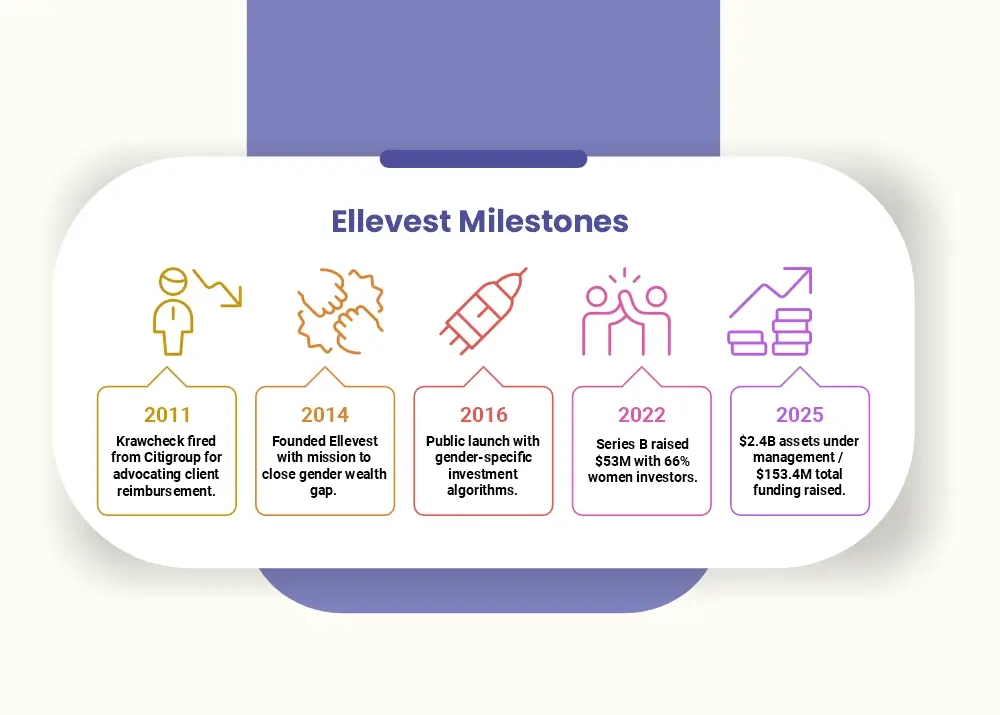
The Firing: During the 2008 crisis, Citigroup sold clients toxic mortgage-backed securities marketed as safe. Krawcheck recommended reimbursing clients, arguing the bank had fiduciary responsibility. Citigroup refused—it would cost billions. She pushed harder. In 2011, she was fired.
The experience was transformative. Wall Street’s incentive structures were fundamentally misaligned with client interests. Banks made money selling products, not ensuring those products served client needs. The entire industry optimized for extracting fees rather than building wealth.
The Market Failure: Traditional investment platforms assumed male career trajectories: steady salary growth from 22 to 65, minimal interruptions, shorter life expectancies. For women, nearly every assumption was wrong. Women live 5-7 years longer, earn 82 cents per dollar, take career breaks for caregiving, and work part-time at higher rates. Traditional tools offered “special programs for women” that were essentially male-designed products with pink branding.
Women controlled trillions in investable assets but were systematically underserved. Wall Street either couldn’t see the problem or didn’t consider it worth solving.
Building Ellevest: Founded in 2014, Ellevest rebuilt investment algorithms from scratch using female-specific data. Instead of assuming steady progression, algorithms accounted for career breaks and income gaps. Instead of planning for 20-year retirements, they planned for 25-30 years. The platform asked about career stage, family planning, and financial realities women actually navigate.
No investment minimums. Membership fees from $5-9 monthly. Revenue came from transparent fees and low-cost index funds, not commissions on expensive products. The company made money when clients stayed and assets grew, not when it sold them inappropriate investments.
The Results: By 2025, Ellevest managed $2.4 billion in assets and raised $153.4 million. The 2022 Series B was remarkable: two-thirds of investors were women. In an industry where female-led companies receive less than 2% of VC funding, Ellevest attracted a majority-female investor base.
Krawcheck’s Wall Street pedigree mattered enormously. She could walk into investor meetings and explain precisely why Morgan Stanley, Goldman Sachs, and Fidelity were leaving trillions on the table. Her credibility came from having sat in the C-suite and knowing exactly where incumbents were vulnerable and why they couldn’t easily pivot.
 Case 2- Anne Wojcicki: Democratizing Healthcare Through Data Ownership
Wojcicki co-founded 23andMe in 2006 with a mission the healthcare establishment considered dangerous: give consumers direct access to genetic information without requiring a doctor’s permission.
The resistance was fierce. The FDA argued consumers couldn’t be trusted. Doctors worried about misinterpretation. The entire healthcare system operated on a premise: health information should flow through professional gatekeepers who decided what patients needed to know.
The Radical Model: Wojcicki saw differently. Healthcare monetized illness, not prevention. Doctors and hospitals made money treating disease, not preventing it. What if consumers could access genetic predispositions directly, enabling preventive healthcare before symptoms appeared?
23andMe launched with a straightforward proposition: mail in saliva, receive comprehensive ancestry and health risk information. But the real innovation was data ownership. Traditional research recruited participants, collected data, analyzed it, and published findings. Participants had no control and rarely received results.
Wojcicki flipped this entirely. Consumers would voluntarily share genetic information for research if given genuine choice, treated as partners, and provided transparency about data use.
Over 80% of customers opted into research—unprecedented compared to traditional studies. Within two decades, 23andMe genotyped 15+ million customers, creating the largest consumer genetic database in history. By 2025, this data contributed to 275+ peer-reviewed publications. GlaxoSmithKline paid $300 million for database access for drug discovery.
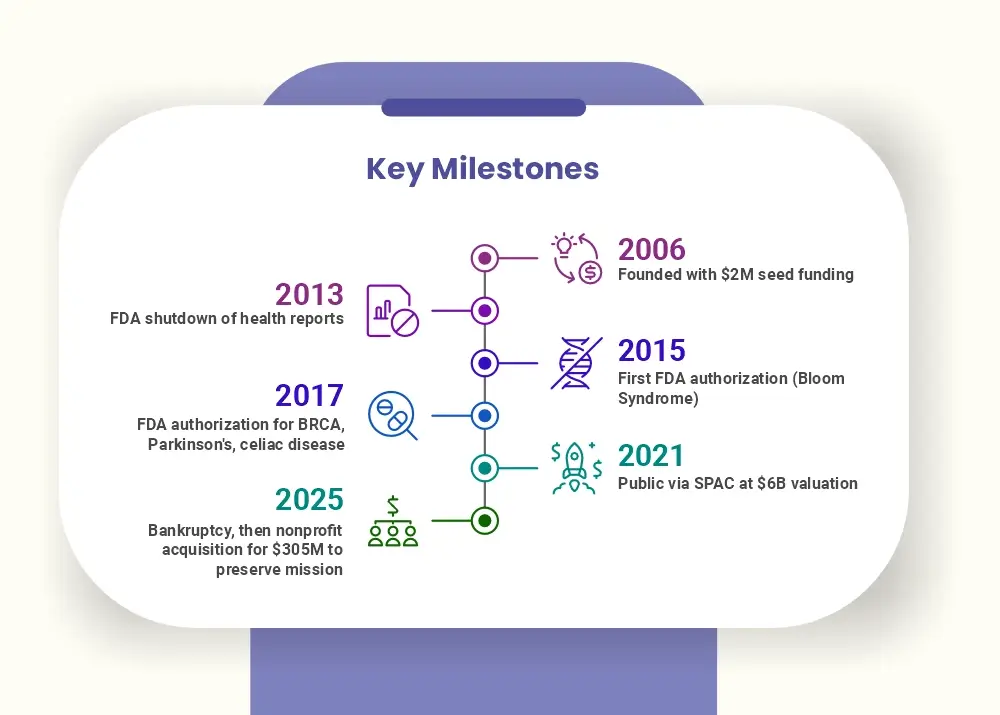
Regulatory Battle: In November 2013, the FDA ordered 23andMe to stop providing health reports. For two years, the company could only offer ancestry information. Revenue collapsed.
Rather than fight publicly, Wojcicki rebuilt the product to meet regulatory standards. She hired experts, redesigned presentations, conducted validation studies, and submitted formal applications. In 2015, 23andMe received FDA authorization for its first direct-to-consumer genetic test. Additional approvals followed. The FDA shutdown ultimately validated that consumers could responsibly access their own genetic information.
From Public to Mission-Driven: 23andMe went public in 2021 at a $6 billion valuation. By 2024, financial difficulties led to bankruptcy filing in March 2025. In June 2025, Wojcicki bought back 23andMe through her nonprofit for $305 million, refusing to let the database be liquidated or the mission abandoned.
The Strategic Pattern
These cases reveal consistent patterns in mission-driven competitive advantage:
- Identify Structural Failures:Both targeted fundamental misalignments between industry operations and customer needs. Wall Street built wealth management for male trajectories despite women controlling trillions. Healthcare locked genetic information behind gatekeepers despite preventive care being dramatically cheaper than treatment. Critically, incumbents couldn’t easily fix these problems without undermining their business models.
- Build From First Principles:Neither entrepreneur improved existing solutions. Krawcheck rebuilt algorithms using female-specific data. Wojcicki created direct-to-consumer access bypassing healthcare gatekeeping entirely. Mission-driven entrepreneurs aren’t constrained by existing business models.
- Turn Resistance Into Validation:Krawcheck was fired for advocating client interests. Wojcicki’s business was shut down for two years. Institutional resistance proved they were threatening business models that deserved disruption.
- Align Mission With Margins:Neither sacrificed profitability for purpose. The mission was fundamental to competitive advantage. When businesses genuinely serve underserved populations, customers become advocates, employees become missionaries, and investors see market opportunity rather than corporate social responsibility theater.
- Reframe Social Problems as Market Opportunities:Krawcheck raised capital by demonstrating women controlling $31.8 trillion represented the largest addressable market in financial services being served by products designed without them in mind. Wojcicki attracted pharmaceutical partnerships because her database enabled research at impossible scale for traditional models.
Conclusion
The next generation of billion-dollar businesses will follow this pattern: identifying underserved populations, building from first principles, proving institutional resistance validates market opportunity, and demonstrating that serving genuine human needs at scale is the most profitable strategy available.
For entrepreneurs who’ve experienced structural inequalities firsthand, lived experience translates into product intuition, customer empathy, and strategic clarity about where incumbents are vulnerable. The mission isn’t separate from the business model. It is the business model. And that insight is worth billions.