Public policy can sound distant until it changes something in your everyday life. A decision made in a government office can determine whether a family can access housing, whether a business can grow, or whether a young person can find opportunities close to home. The real work of public service begins when those big policy decisions have to make sense for real communities.
For the U.S. Virgin Islands, that connection between policy and people is especially important. Its geography, size and unique economic realities mean that policies designed with larger mainland communities in mind can have very different consequences on the islands. Making sure those realities are understood requires someone who can move between local priorities and federal decision-making with clarity, persistence and purpose.
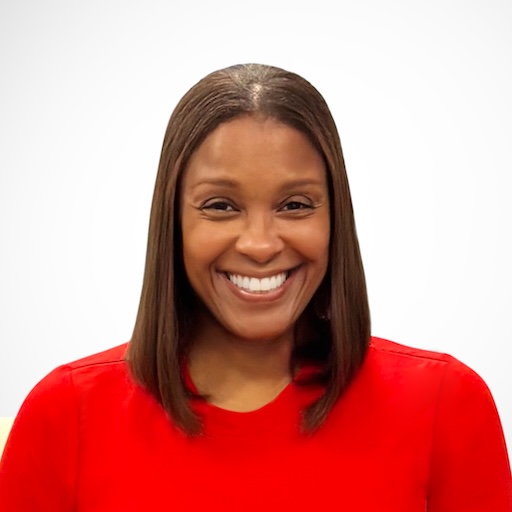
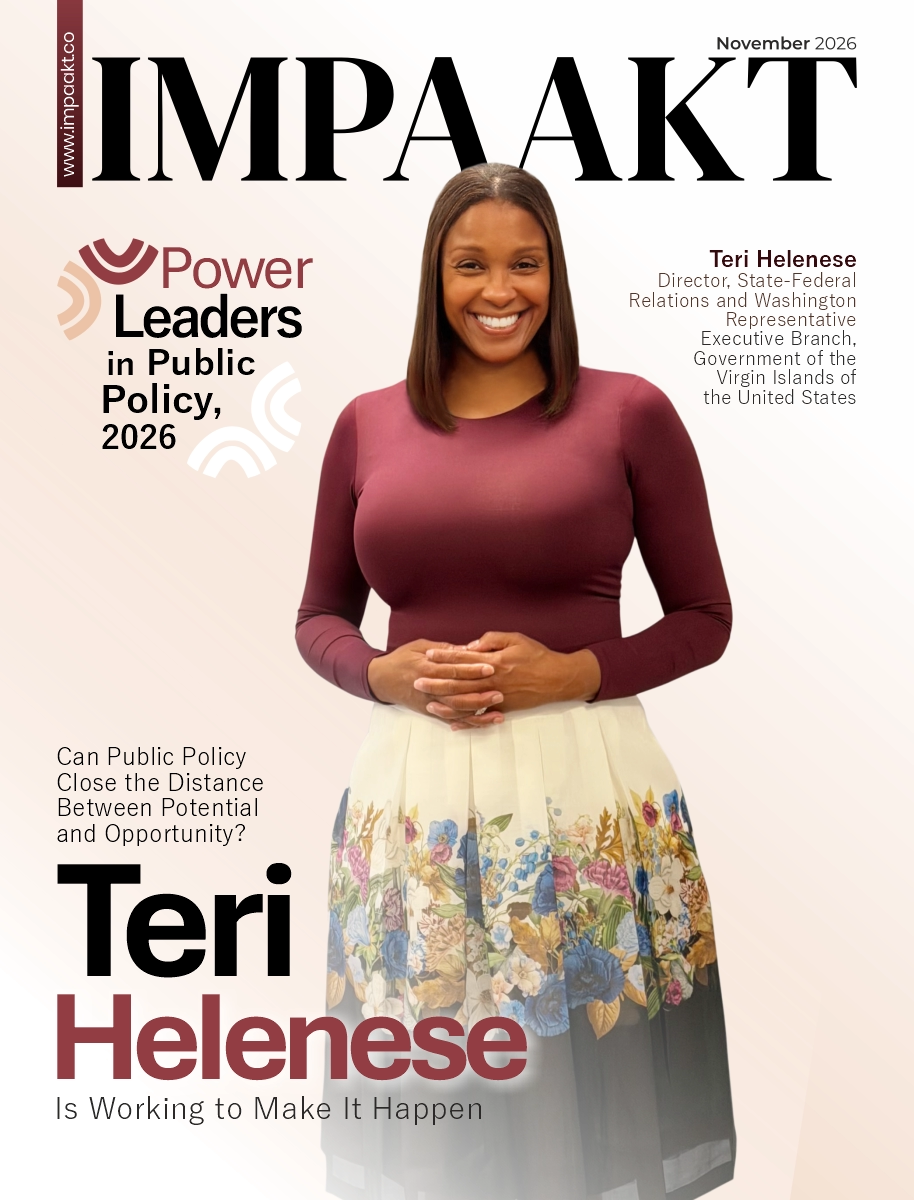
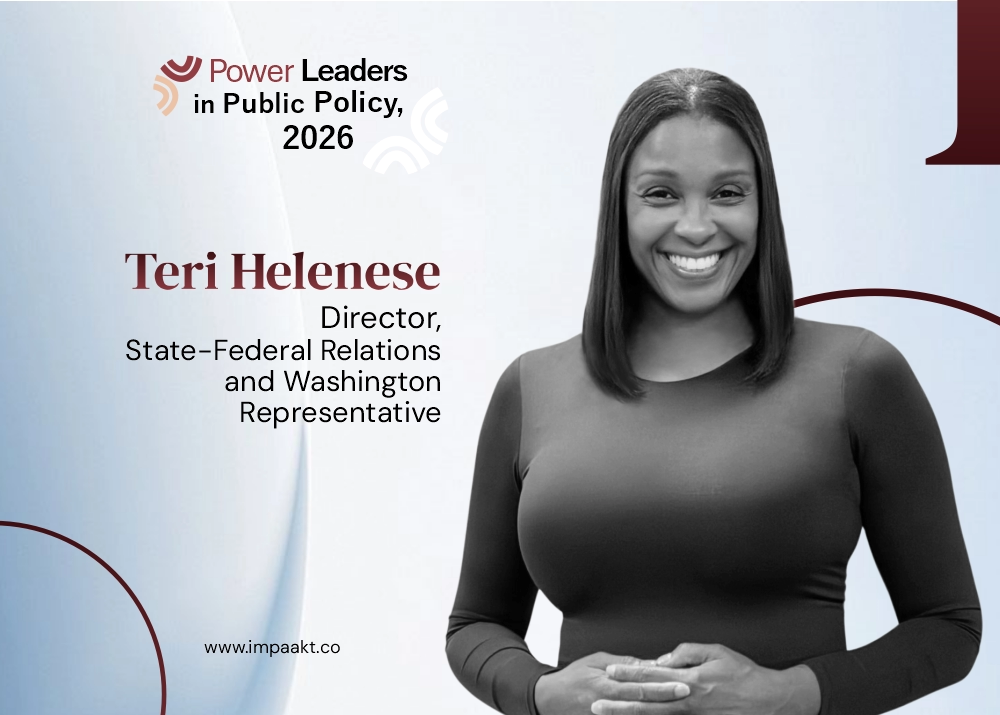
That is the space Teri Helenese, Director of State-Federal Relations and Washington Representative for the Executive Branch of the Government of the Virgin Islands of the United States, has made her own. Her work is built around a simple but powerful principle: start with the problem, understand what people actually need, and then find the policy, partnership or federal pathway that can help solve it.
Teri’s ambition extends beyond representing the Virgin Islands today. She wants to help build an island economy where young people can find pathways into technology, healthcare, entrepreneurship, public service, renewable energy and global business without having to leave home to find opportunity.
Inspired by the perspective behind her work and her vision for a more resilient, connected and ambitious Virgin Islands, we sat down with Teri Helenese to explore the experiences, ideas and convictions shaping her approach to public policy and public service.
Here are the excerpts from the interview:
Teri, your journey into public policy has taken you from a modest upbringing in St. Croix to Washington, D.C., where you now represent the interests of the U.S. Virgin Islands at the federal level. What experiences along that journey shaped the way you understand public service and advocacy?
Growing up on St. Croix taught me that public policy is never abstract. Decisions made in government eventually arrive at someone’s kitchen table, classroom, hospital room, paycheck or retirement check.
I was fortunate to grow up surrounded by family, the Catholic Church, and people who believed deeply in hard work, education and service. Later, my studies at Florida Memorial College and the George Washington University, along with a career that included Booz Allen Hamilton, Deloitte, International SOS, Diageo and government service, allowed me to see institutions from many different perspectives. I learned how organizations make decisions, how Washington works and, importantly, how easily smaller communities can be overlooked if someone isn’t consistently advocating for them.
That shaped my philosophy of public service. Advocacy isn’t simply about being present in the room. It’s about understanding the system well enough to turn relationships into results and making sure those results reach the people you were sent there to serve.
As Director of State-Federal Relations and Washington Representative for Governor Albert Bryan Jr., you operate at the intersection of local priorities and federal decision-making. What does it take to make sure the voice of the Virgin Islands is not only heard in Washington, but understood?
It takes persistence, preparation and relationships.
The Virgin Islands is geographically distant from Washington and doesn’t have the same congressional representation as a state, so we have to be especially intentional. My responsibility has been to help close that distance.
That means translating a Virgin Islands issue into terms federal policymakers understand without losing the human reality behind it. A healthcare reimbursement formula isn’t simply a formula when it affects whether a hospital can recruit nurses or provide services. Rum cover-over isn’t merely tax policy when the revenue supports retirees, public services and the Territory’s fiscal stability.
I’ve also learned that relationships cannot begin when you need something. You build trust over years by being credible, providing accurate information and showing up consistently. When the critical moment comes, that foundation matters.
A significant part of your work involves turning policy priorities into tangible resources for communities. How do you identify the federal opportunities that can make the greatest difference to people across the Virgin Islands?
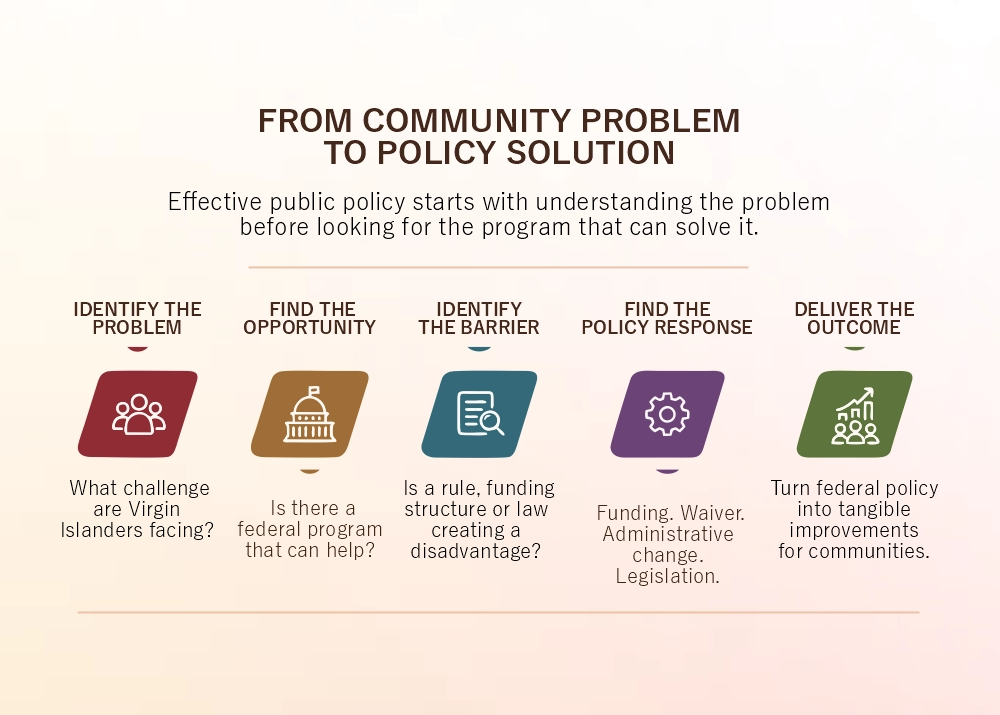
I start with the problem, not the program.
There are thousands of federal programs, grants and legislative opportunities, but securing money simply because it’s available isn’t a strategy. The question should always be: What challenge are we trying to solve for Virgin Islanders?
Then we work backward. Is there an existing federal program that can help? Does the Virgin Islands qualify? Is there a statutory barrier preventing equitable treatment? Do we need an appropriation, an administrative change, a waiver or new legislation?
Sometimes success means bringing new federal dollars home. Other times, it means protecting funding already awarded or changing a policy that puts the Territory at a disadvantage.
The goal isn’t federal funding for its own sake. The goal is to use federal policy as a tool to improve people’s lives.
You have worked on initiatives spanning affordable housing, homeownership, education, STEM, economic development, tourism, public safety and healthcare. How do you balance such a wide range of priorities while keeping the larger vision for the territory in focus?
To me, these issues aren’t separate.
Housing affects workforce development. Education affects economic competitiveness. Healthcare affects quality of life and our ability to attract and retain professionals. Reliable energy affects businesses, families and investment. Public safety affects tourism. Infrastructure touches everything.
Once you understand those connections, the larger vision becomes clearer. My role requires me to move between issues constantly, but I try to maintain one test: How does this strengthen the Virgin Islands over the long term?
The Territory’s size can present challenges, but it can also be an advantage. We’re small enough to connect sectors that are often siloed in larger jurisdictions. With the right partnerships, we can develop solutions that advance multiple priorities at once.
Your work has helped secure funding for historical transformations and other community-focused programs. When you look at a successful federal funding effort, what happens behind the scenes that people rarely see?
People often see the announcement. They rarely see the months and years that precede it.
Behind a successful federal effort are countless conversations, research, strategy sessions, follow-up calls, rewritten proposals, budget discussions and meetings with congressional offices and federal agencies. There are often setbacks that never become public.
A large part of advocacy is also timing. You have to understand when an agency is developing guidance, when Congress is drafting legislation, when an appropriations request needs to move and when a coalition can influence an outcome.
And then there’s persistence. Washington can tell you “no” in many different ways. Sometimes “no” means you need better data, a broader coalition or another route.
The public sees the ribbon cutting. Public servants often remember the hundred conversations that made the ribbon cutting possible.
The Virgin Islands face policy challenges that can look very different from those on the mainland because of geography, scale and the territory’s unique economic realities. What is one policy area where you believe a more island-specific approach is essential?
Healthcare is one of the clearest examples.
Federal healthcare policies are often designed around assumptions that work differently in a geographically isolated island territory. We don’t have the option of driving across a state line to another major hospital system. Recruiting specialists is more difficult.
Transportation costs are higher, economies of scale are different, and outdated federal reimbursement structures have an outsized effect.
That’s why Territorial Equity in Medicare and Medicaid has been such an important part of our federal advocacy.
But the larger lesson applies beyond healthcare. Whether we’re discussing energy, transportation, shipping, disaster recovery or workforce development, federal policymakers need to recognize that equal treatment doesn’t always mean identical treatment. Good public policy has to account for the conditions in which people actually live.
You have also worked across political lines, including on issues such as the rum cover-over. What have you learned about building bipartisan support when the issue is bigger than party politics?
I’ve learned that relationships are infrastructure.
The permanent rum cover-over is a good example. It required years of engagement with members of Congress, committees, federal officials, the rum cover-over working group and private-sector partners.
Ultimately, the enhanced rate of $13.25 per proof gallon was made permanent, ending the cycle of repeatedly seeking temporary extensions.
That didn’t happen because everyone involved shared the same politics. They didn’t. It happened because we could establish why the issue mattered and build relationships around a legitimate policy objective.
My approach has always been to know the substance, respect the people at the table and look for common ground without compromising the interests I represent.
Partisanship has its place in democracy, but governing requires something more. When the wellbeing of Virgin Islanders is at stake, my responsibility is to find a path to results.
From bringing DC United and Bermuda soccer initiatives to St. Croix to connecting sports with health and community engagement, you have explored unconventional ways of advancing public priorities. What does this tell us about the role of partnerships and creativity in public policy?
It tells us that government doesn’t always have to be the creator. Sometimes government should be the connector.
Bringing D.C. United and Bermuda’s national team to St. Croix demonstrated what can happen when sports, tourism, private investment, health and community engagement intersect.
We weren’t simply bringing soccer to St. Croix. We were creating economic activity, introducing visitors to the island, engaging young people and opening conversations around fitness, hypertension, diabetes and healthier communities.
Public policy needs creativity. Some of our greatest opportunities exist between traditional categories. A sporting event can become tourism promotion. Technology can become a healthcare tool. A cultural commemoration can become economic development.
The best partnerships allow each participant to bring something different to the table and create an outcome none could achieve alone.
Your mother was among the first Black flight attendants at TWA before becoming a director, and your aunt prepared home cooked meals for you every day after work at the bank, while your father built his career at the Hess Oil Refinery. How have their examples, and the values you grew up with, influenced the leader you have become?
They taught me that excellence and service can take very different forms.
My mother’s journey taught me courage. Flight attendants flew across the world as pioneers long before the time of the Internet, globalization and AI. To enter an industry at a time when very few Black women were given those opportunities, and then rise into leadership required confidence, discipline and resilience.
My father showed me the value of technical excellence, consistency and responsibility through his work at the Hess Oil Refinery, and later when he opened Le Baron Men’s Clothiers in the Sunny Isle Shopping Center. Owning a small business, paying employees, taxes, rent, and paying for merchandise and shipping to St. Croix for 40 years required Herculean strength.
And my aunt taught me something equally important. After she finished work at Scotiabank, there was a home-cooked meal waiting for me. That may sound like a small thing, but with my mother in the sky, it represented care, cooking with love, consistency and family.
Together, they taught me that leadership isn’t only about titles. It’s about what you build, what you give, how you treat people and whether others can depend on you.
As a woman working in spaces where policy, politics and power intersect, what has your experience taught you about finding your voice, earning credibility and making room for others to follow?
I’ve learned that credibility is built before you walk in the room.
It comes from doing the homework, understanding the issue and keeping your word. You have to be willing to do the work when no one is watching.
There have been rooms where I was one of very few women, one of very few people from the Caribbean, or perhaps the only person advocating specifically for the Virgin Islands. I learned not to see being different as being less qualified to occupy that space.
But finding your own voice isn’t enough. Leadership also means widening the doorway. I want younger women and young Virgin Islanders to understand that Washington, technology, engineering, public policy and corporate leadership are not distant worlds that belong to someone else.
They belong there too.
I’ve demonstrated that commitment through more than words, by helping women, including young women, build meaningful careers in the Government of the Virgin Islands, the private sector and Washington. Leadership is not only about the doors you walk through, but the doors you help open for others.
Looking ahead, what do you believe the Virgin Islands can become with the right combination of policy, investment and leadership, and what is the piece of that future you most want your work to help build?
I believe the Virgin Islands can become a model for what a modern island economy looks like: resilient, technologically connected, energy-secure, culturally grounded and globally competitive.
Our size should never determine the size of our ambition.
We have extraordinary assets: our people, our geographic position, our culture, our natural beauty, our connection to the United States and the Caribbean, and a diaspora with tremendous expertise.
I want my work to help build a Virgin Islands where a child growing up on St. Croix, St. Thomas or St. John doesn’t have to leave home permanently to imagine a world of opportunity. They should be able to see pathways into technology, healthcare, entrepreneurship, skilled trades, public service, tourism, renewable energy, science and global business from right where they are.
For much of my career, my job has been about closing the distance between the Virgin Islands and Washington.
The future I want to help build closes another distance: the distance between the extraordinary potential of the Virgin Islands and what we know our islands can become. As Americans, with deep Caribbean roots, we are uniquely positioned to be the gateway to the Caribbean region for the United States, help expand US trade, Made in the USA manufacturing and technology, and become a leading-edge model for the rest of the Caribbean. Hence, creating greater economic opportunity, building generational wealth and improving the quality of life for Virgin Islanders while simultaneously developing an economy that is innovative, prosperous, globally connected and unmistakably Virgin Islands.