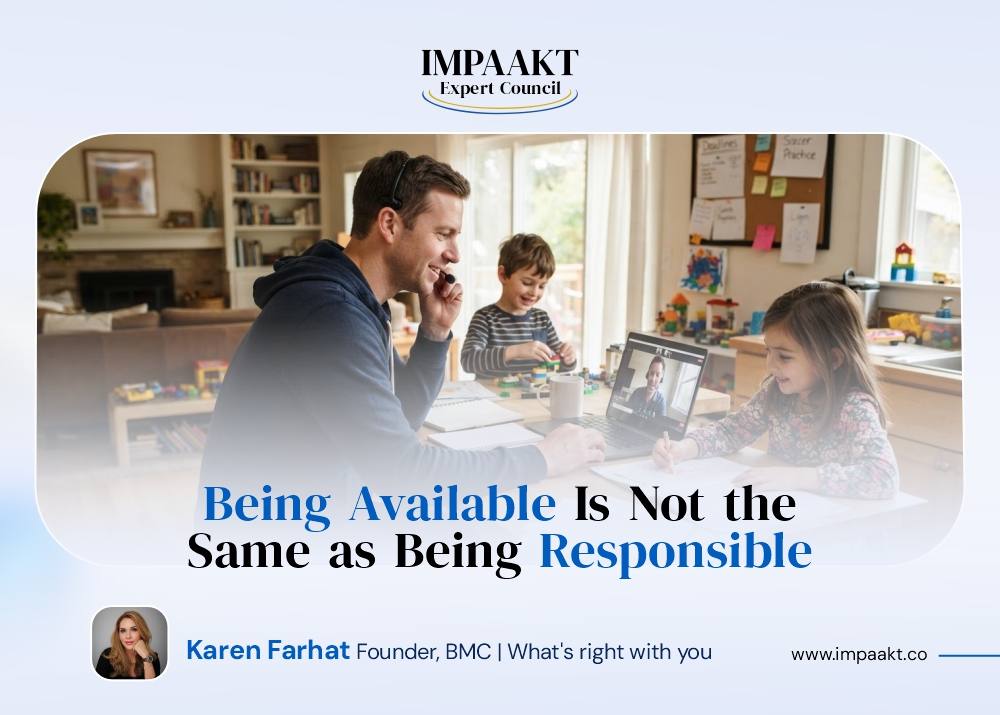
How always-on leadership shapes judgment, boundaries and team culture
Dr Karen Farhat is an integrative psychotherapist and intercultural specialist, and founder of Body & Mind Consultancy (BMC). Through BMC, her work explores human behaviour, relationships, identity, emotional wellbeing, and the psychology of how we connect and function in an increasingly demanding world.
Most leaders know how to set some sort of boundary. Others don’t know what to do with the guilt, second-guessing, and internal debate that follow. Yet those quiet moments, often at 9 p.m. with a phone in hand, reveal more than how rested a leader feels. They shape the culture a team absorbs over time.
Picture the end of a long day. You have moved from meeting to meeting and call to call, and you don’t even have the energy for the 7:45 p.m. yoga class you keep promising yourself you’ll join. A quick look at your inbox makes your heart race: dozens of emails, all waiting for an answer within the next 48 hours. You deal with the most pressing ones and leave the rest for tomorrow. By the time you look up, it’s too late for yoga, so you go home determined to switch off. You’ve overdone it today.
And yet, somewhere in the back of your mind, a quiet voice keeps count: eleven still waiting.
That is where that little voice in the head starts chattering. You have something to eat, put your feet up, and the itch to check your inbox begins. Psychologists have long noticed that unfinished tasks tug at us. In the 1920s, Maria Ovsiankina showed that when people are interrupted partway through a task, they feel a strong pull to go back and finish it. A recent meta-analysis confirmed the effect. The emails stayed at the office. The urge to finish them didn’t.
Maybe I could finish a few while I watch TV. No, you tell yourself, they can wait. Then, at 9 p.m., a message arrives from a team member asking about a file for tomorrow’s meeting, and your nervous system switches straight back on. I should answer. It is for a meeting tomorrow…
Another conversation begins, not with your team member but inside your own head. Why didn’t they check this during office hours? Why are they messaging me at night? Don’t they have a life? Or maybe they think I don’t. Questions, answers, interpretations and arguments: an entire internal dialogue, with only one person in the room.
You know that you are going to answer anyway, almost as though a magnet is pulling you towards your phone, because if you don’t, the guilt that followed you home will only grow louder. Perhaps your reply is slightly curt. Perhaps you add a comment because you are irritated with them for messaging you and, underneath that, irritated with yourself for answering.
The message is sent, and the interaction is technically over, but psychologically it isn’t. Now the rumination begins. Was I rude? Was my tone too sharp? Should I send another message? Your team member sent one message; your mind has managed to organise a meeting, a debate, a prosecution and an appeal.
Unconsciously, this is where leaders rarely stop to consider the consequences: your reply didn’t just end a conversation. It told your team that the workday doesn’t end in the specified working hours.
When availability starts to feel like responsibility
In life, every action has a consequence, and this is reflected in “our always-on culture”: being reachable has gradually become confused with being responsible. A message arrives now, so it feels as though we must answer now. An email lands in the evening and, because we have seen it, we assume we have acquired an obligation to deal with it. But arrival time and urgency are not the same thing.
The problem is that our nervous system does not make that distinction quite so neatly. The ping arrives, attention shifts, and the body activates a “high-alert state”. We assess, interpret, decide and respond, then try to return to whatever we were doing before. Management researcher Sophie Leroy calls what happens next attention residue: when we switch tasks, part of our attention stays behind with the previous one, and our performance on the next task suffers. Every “evening ping” leaves a little aftereffect. We may have left work hours ago and still never quite left at all. That is why boundaries are more complicated than switching off notifications.
Switching off is not the same as detaching
Work psychologist Sabine Sonnentag, who studies how people recover from work, makes an important distinction: being physically away from work does not mean being psychologically detached from it. Detachment means not only stopping the work, but stopping thinking about it. Her research links it to better mood, greater life satisfaction and less strain, without making people any less engaged when they return.
You can decide not to answer the 9 p.m. message and still spend the next hour thinking incessantly about it. Will they think I’m not doing enough? Maybe it really is urgent. It will only take two minutes. The external boundary is set; the internal one isn’t.
Much of that inner chatter feels like guilt, but not necessarily the true kind. The Scottish psychiatrist R. D. Laing drew the distinction in his 1961 book The Self and Others:
“True guilt is guilt at the obligation one owes to oneself to be oneself…False guilt is guilt felt at not being what other people feel one ought to be or assume that one is.”
— R. D. Laing, The Self and Others(1961)
The guilt that follows you home at 9 p.m. is rarely about having done something wrong. It is about not being the person you imagine others expect: always there, always quick, always on.
Here is where we set an internal boundary: accept that the message has arrived, notice the urgent effect it creates, evaluate whether it really needs your attention now, and accept the discomfort of not responding.
In practice, the hard part is usually not setting the boundary, but expressing it out loud and dealing with the feelings that follow. A boundary is not a wall. Someone can email you at 9 p.m., but that doesn’t mean you have to answer instantly. They choose when to send it; you choose when to answer.
Who taught them that you are always available?
Another uncomfortable question is worth asking: who told people that you are always reachable? Sometimes the answer is the organisation, the culture or the technology. And sometimes, without meaning to, it is us.
Every time we answer immediately, either from holiday, check emails during dinner, or apologise for taking two hours to reply when nothing was urgent, we teach people something about our availability. Eventually, we begin to resent the expectation we helped create.
In leadership, this matters even more. A leader might say, “I don’t expect anyone to answer emails after working hours.” But if that same leader routinely sends messages at 10:30 p.m., responds throughout the weekend and answers emails from the beach, the spoken message and the behavioural message are different.
The spoken message says: You don’t have to respond.
The behavioural message says: This is what dedicated people do.
Culture pays close attention to behaviour. France introduced a statutory right-to-disconnect framework in 2017, and Australia introduced comparable protections in 2024, allowing employees to refuse unreasonable out-of-hours work contact. But no policy can override what a team watches its leader do at 10:30 at night.
When being always on changes judgment
Since the invention of mobile phones, constant availability affects more than boundaries. It affects judgment, because scattered attention makes us more likely to react than to reflect. Sometimes we answer an email because it is important, and sometimes because seeing it sitting there is unnerving. Sometimes we make a quick decision because it is the right one, and sometimes because we just want the issue out of our inbox. From the outside, the two look identical, but are they?
One important question to pause at before responding is: Am I dealing with this because it needs my attention, or because I need relief from thinking about it? That small distinction can change the decision.
The leadership skill we rarely talk about
We often associate good leadership with responsiveness, and responsiveness matters. But responsiveness isn’t permanent availability, and leaders who maintain good judgment over the years tend to know the difference.
To sum it up, perhaps one of the most important leadership skills today is knowing when not to respond: knowing which problems require immediate attention, when tiredness is influencing judgment, and when answering tonight only teaches someone to expect an answer tonight.
It also means recognising that the evening you protect for yourself is an evening you give back to your team.
A few practical places to start:
- Write when you like, send when it’s reasonable. Use scheduled send for anything written after hours, so your working style doesn’t become everyone else’s.
- Agree what “urgent” means. Decide with your team what actually needs an evening response, and give it its own channel, such as a phone call, so everything else can wait without guilt.
- Pause before the late-night reply. If the issue can wait, make a note for the morning rather than using a quick response to silence it tonight. Research suggests that writing down when you will deal with something is often enough to stop it tugging at you.
- Notice the conversation in your head. If you are still arguing with a message an hour after it arrived, the external boundary has done all it can. The work now is internal.
Being reachable is easy; technology has made it so. Being present, rested and clear-headed enough to lead well is harder. It asks us to accept that messages will arrive whenever others choose to send them, and to decide for ourselves what each one deserves.
Perhaps the “responsible” thing to do as a leader is simply to take a deep breath, count to four, and not reply straight away. At least not yet.
References
Ghibellini, R., & Meier, B. (2025). Interruption, recall and resumption: A meta-analysis of the Zeigarnik and Ovsiankina effects. Humanities and Social Sciences Communications. https://www.nature.com/articles/s41599-025-05000-w
Laing, R. D. (1961). The Self and Others. London: Tavistock Publications.
Leroy, S. (2009). Why is it so hard to do my work? The challenge of attention residue when switching between work tasks. Organisational Behaviour and Human Decision Processes, 109(2), 168–181.
Masicampo, E. J., & Baumeister, R. F. (2011). Consider it done! Plan making can eliminate the cognitive effects of unfulfilled goals. Journal of Personality and Social Psychology, 101(4), 667–683.
Ovsiankina, M. (1928). Die Wiederaufnahme unterbrochener Handlungen. Psychologische Forschung, 11, 302–379.
Sonnentag, S. (2012). Psychological detachment from work during leisure time: The benefits of mentally disengaging from work. Current Directions in Psychological Science, 21(2), 114–118.