For years, information governance has been treated like a safety net something you turn to when things go wrong.
Policies are written, systems are patched, and teams react. But rarely is governance seen for what it truly is: a strategic function that shapes how organizations think, act, and are trusted.
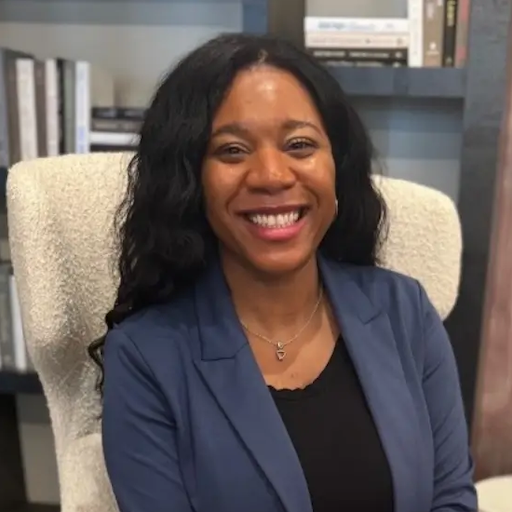
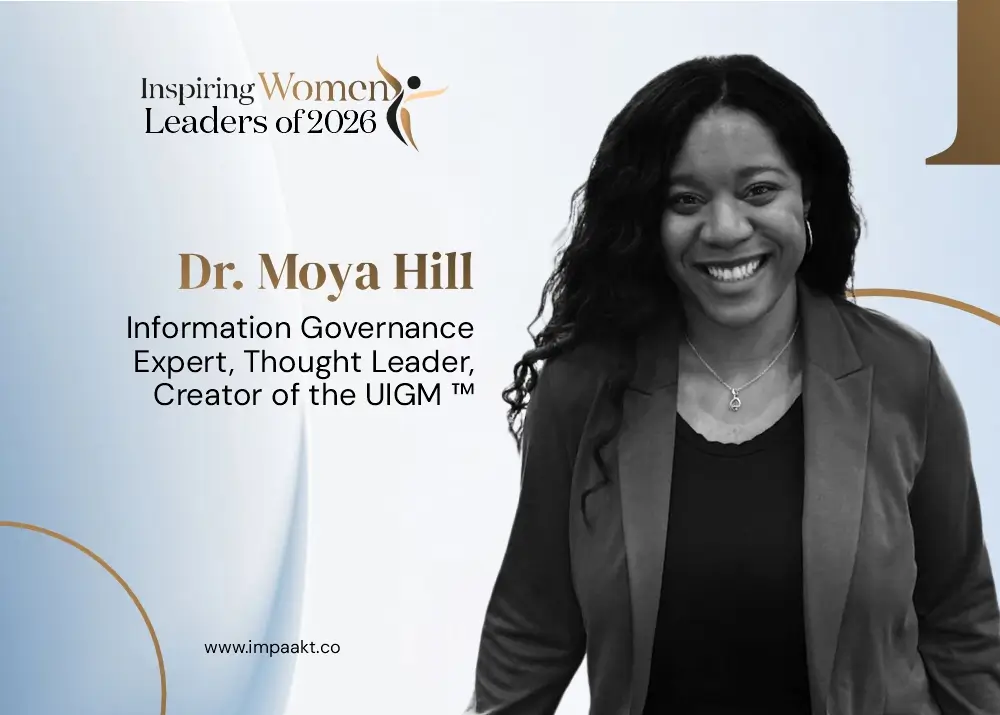
Dr. Moya Hill is changing that narrative.
She doesn’t position governance as a defensive move, but as a leadership advantage. With a career rooted in service, accountability, and high-stakes decision-making, she brings a perspective that cuts through complexity and challenges long-held assumptions. To her, information is not static, it is active. It influences outcomes, defines credibility, and determines whether organizations lead with confidence or confusion.
Her Unified Information Governance Model (UIGM™) reflects that belief bringing together fragmented disciplines into one cohesive system that leaders can actually understand and apply. It’s not just a framework; it’s a shift in thinking.
Because the organizations that win trust are not the ones that react faster, but the ones that govern better.
Intrigued by her bold redefinition of governance, we connected with Dr. Moya Hill to explore the thinking behind her work and the future she is helping shape.
Here are the excerpts from the interview:
Dr. Moya, as a U.S. Veteran and federal leader, your work is rooted in service and accountability. How has your military and public service experience shaped the way you lead today?
My leadership was shaped in two environments where accountability is non-negotiable: the U.S. military and the federal government. Both institutions demand clarity, discipline, and a commitment to something larger than yourself. In the military, I learned that leadership is not about rank — it’s about responsibility. You are accountable for the people you lead, the mission you support, and the integrity of every decision you make.
Transitioning into federal leadership reinforced those values. Public service requires a deep respect for the trust placed in you. Every action, every policy, every decision has a ripple effect on citizens, veterans, families, and communities. That level of responsibility shapes you. It forces you to think beyond convenience and focus on impact.
Today, I lead with the same principles:
- Clarity over confusion, because ambiguity creates risk.
- Responsibility over convenience, because shortcuts erode trust.
- Integrity over optics, because leadership is about doing what’s right, not what’s easy.
Service taught me that leadership is stewardship. It’s about protecting people, protecting systems, and protecting trust — and that philosophy guides every framework I build and every team I develop.
 Information governance is often overlooked until something goes wrong. What first made you see information not as a burden, but as a powerful organizational asset?
Early in my career, I noticed a pattern: organizations weren’t failing because they lacked information — they were failing because they didn’t understand it. Information was treated like clutter, something to store, archive, or react to only when a crisis occurred. But when I looked closer, I saw something different.
Information, when governed correctly, becomes a strategic asset. It reveals patterns, exposes risks, strengthens decision-making, and builds public trust. It is the foundation of transparency, accountability, and operational excellence.
I realized that information is not passive. It is active. It drives outcomes. It shapes reputations. It determines whether an organization is trusted or questioned.
Once I saw that, I stopped viewing information as a burden and started viewing it as capital — something that, when managed well, can transform how an organization operates and how it serves people.
You created the Unified Information Governance Model. What gap did you see in existing systems that pushed you to build something entirely new?
The gap was undeniable: every discipline was operating in isolation.
- The Freedom of Information Act/Transparency
- Privacy
- Records Management
- Risk Management
- Training and Culture
- Legal and Compliance
- Cybersecurity
Each discipline was doing critical work, but none of them were working together. Organizations weren’t struggling because they lacked expertise — they were struggling because they lacked unity.
I saw leaders trying to solve problems one discipline at a time, not realizing that information governance is a system, not a collection of programs. When one discipline is disconnected, the entire ecosystem becomes vulnerable.
I created the Unified Information Governance Model (UIGM™) because the field needed a blueprint that reflected reality:
Information governance is one system with these disciplines working in alignment across the entire lifecycle of information.
UIGM™ is the first model that shows how these disciplines intersect, support each other, and create a unified, predictable, and accountable governance structure. It gives organizations a way to see the whole picture — not just the pieces.
FOIA, privacy, and records management can feel overwhelming to most organizations. How do you translate complexity into systems that leaders can actually understand and use?
I start with a simple rule: If a leader can’t understand it, they can’t govern it.
Information governance is often presented in technical language that alienates the very people responsible for making decisions. My approach is to remove the intimidation factor by breaking down each discipline into its purpose, its impact, and its relationship to the others.
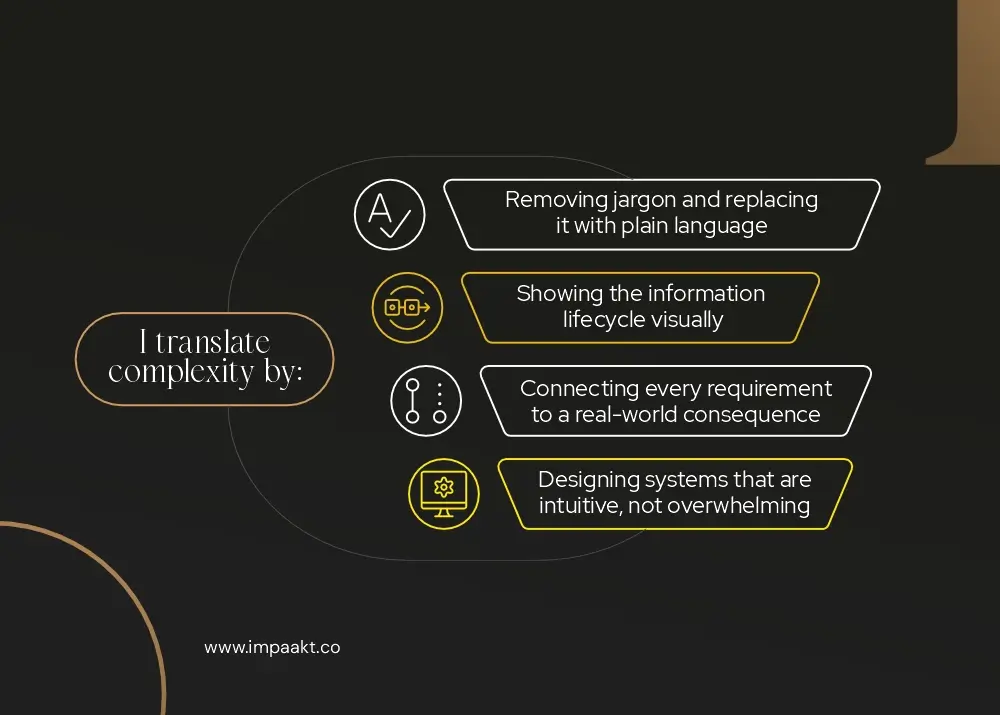 When leaders understand that the Freedom of Information Act protects transparency, Privacy protects people, Records Management protects accuracy, Risk Management protects stability, Training and Culture protect behavior, Legal and Compliance protect accountability, and Cybersecurity protects systems — the work becomes manageable.
Once leaders see the “why,” they become fully capable of owning the “how.”
Working within federal systems means operating under scrutiny and responsibility. What has that taught you about decision-making and leadership under pressure?
Federal leadership teaches you that every decision has a ripple effect — on citizens, on veterans, on families, and on public trust. You learn quickly that pressure is not an obstacle; it is a constant.
Under pressure, I’ve learned to:
- Slow down when everything around you is speeding up
- Anchor decisions in law, ethics, and evidence
- Communicate clearly even when the environment is chaotic
- Protect people first, processes second
Leadership under scrutiny forces you to be intentional. You cannot rely on assumptions. You cannot cut corners. You cannot prioritize convenience over correctness.
Pressure doesn’t change your values — it reveals them. And in federal service, your values must be stronger than the moment you’re in.
Government environments are often seen as rigid. How do you drive innovation within systems that are designed to prioritize control and consistency?
Innovation in government is not about breaking rules — it’s about reimagining how we operate within them.
Government systems are designed to protect people, resources, and public trust. That structure can feel rigid, but it also creates a foundation for thoughtful, sustainable innovation.
I drive innovation by:
- Challenging assumptions, not regulations
- Showing leaders the cost of staying the same
- Demonstrating how unified governance reduces risk
- Designing systems that make compliance easier, not harder
Government isn’t rigid — it’s cautious. And rightfully so. But when you show that innovation strengthens accountability, improves transparency, and reduces risk, people become open to change.
Innovation becomes possible when people understand that it doesn’t threaten control — it enhances it.
 Your field is highly specialized and often underrepresented in mainstream leadership conversations. What challenges did you face building visibility and authority in this space?
Information governance is often invisible until something goes wrong. That means the work is essential, but the visibility is limited.
My challenge was to bring this field out of the shadows. I had to:
- Educate leaders who had never heard the term “information governance”
- Advocate for disciplines that were historically siloed
- Build a model that made the invisible visible
- Show that governance is not administrative — it is strategic
Authority came when people realized I wasn’t just describing the problem — I was offering a solution.
Creating the Unified Information Governance Model gave the field a structure, a language, and a unified identity. It allowed leaders to see governance not as a backoffice function, but as a leadership imperative.
You actively support professionals entering the information governance space. What advice do you give someone trying to build a meaningful career in this field today?
Three things:
- Learn the lifecycle.
Understand how data becomes information, how information becomes a record, and how governance protects it. The lifecycle is the backbone of every discipline. - Master all seven information disciplines.
- The Freedom of Information Act/Transparency
- Privacy
- Records Management
- Risk Management
- Training and Culture
- Legal and Compliance
- Cybersecurity
Professionals who understand all seven disciplines become invaluable. They can see patterns others miss. They can solve problems others can’t.
- Lead with purpose.
This field protects people, rights, and trust. When you understand the mission, the work becomes meaningful — and your career becomes impactful.
With AI, data expansion, and digital transformation accelerating, how do you see the role of information governance evolving over the next decade?
We are entering an era where information moves faster than organizations can manage it. AI, automation, and digital transformation will only widen that gap.
The next decade will require:
- Unified governance models
- Lifecycle driven decision-making
- AI assisted compliance and transparency
- Stronger public trust frameworks
- Governance embedded into technology, not added after the fact
Information governance will shift from a support function to a core leadership competency. Organizations that fail to govern information will fail to operate.
The future belongs to organizations that treat information as an asset, not an afterthought.
 When people look back on your work years from now, what do you hope they’ll say Dr. Moya Hill changed — not just in governance, but in how organizations think about information and trust?
I hope they say I changed the way organizations think about information — not as paperwork, not as risk, but as a form of trust.
I hope they say I gave professionals a model that empowered their careers, gave employees clarity, and gave organizations a unified way to protect the people they serve.
And I hope they say I built something bigger than a framework —
I built a movement that made governance accessible, human, and essential.
If my work helps one organization protect people better, one leader make a more ethical decision, or one professional find their purpose in this field, then I’ve done what I came to do.