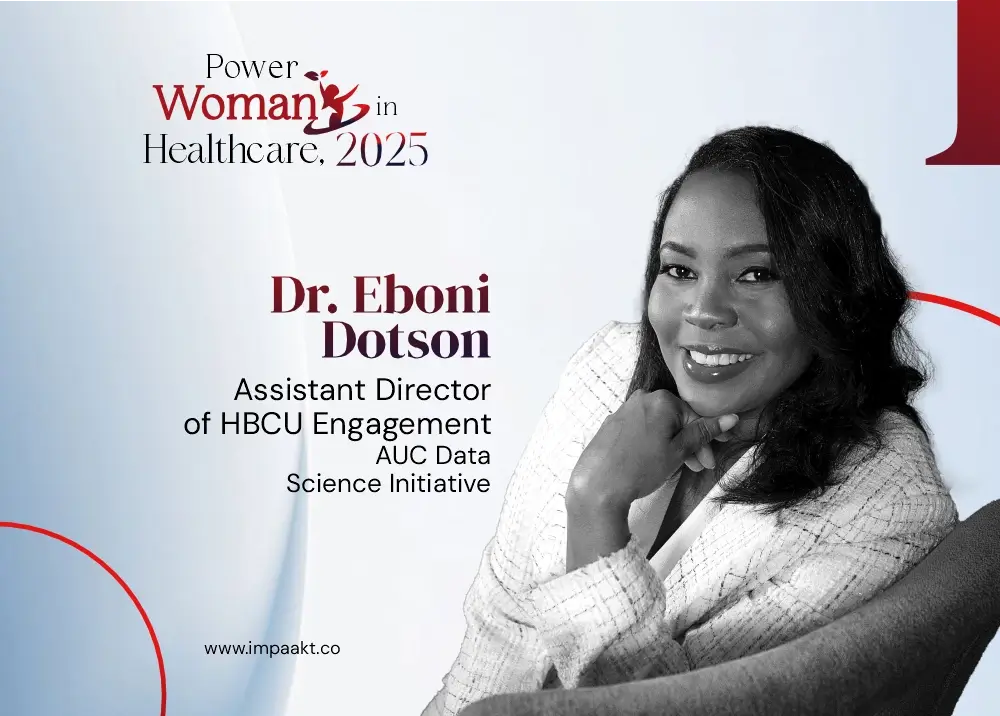
Healthcare today is overflowing with innovation, yet it continues to stumble on the same stumbling block: equity. While many leaders focus on improving access, lowering costs, or upgrading technology, Dr. Eboni Dotson insists the conversation must begin with something deeper—trust. Without it, policies ring hollow, interventions fall flat, and patients retreat from a system that was never designed with them in mind. Her perspective is unapologetically clear: equity isn’t a side project or a glossy initiative. It has to be written into the very DNA of healthcare.
Dr. Dotson’s authority comes not only from her two decades of leadership in healthcare operations but also from the lens of her lived experiences—as a Black woman, a caregiver for her parents and child, and a patient navigating the very system she sought to improve. These dual perspectives, both professional and personal, sharpened her resolve to confront inequities that others often overlook.
Her path hasn’t been straight, but every pivot has been purposeful. A pre-med student turned healthcare management professional, she entered patient safety roles that gave her a front-row view of systemic complexity. Then, in a bold move many questioned, she stepped away from traditional hospital leadership and into the emerging world of data science. That decision wasn’t just a career shift; it was a declaration. She had seen how data drives everything in healthcare—budgets, policies, outcomes—and she knew it needed champions who could wield it responsibly. Today, as the Assistant Director of HBCU Engagement at the AUC Data Science Initiative, she is equipping the next generation to do exactly that.
For Dr. Dotson, data isn’t sterile. It’s alive. It carries stories, biases, and power. Handled carelessly, it deepens disparities. Used responsibly, it becomes a lever for justice, accountability, and transformation. That conviction shapes how she mentors students and faculty—teaching them not just the technical skills to handle data but the ethical compass to question what it represents, whose voices it includes, and whose it silences.
Her leadership is bold because it doesn’t settle for easy wins or symbolic gestures. She demands equity be woven into every decision—from clinical pathways to hiring practices, from research design to community engagement. And in doing so, she is redefining what healthcare leadership looks like for this generation and the next.
Inspired by her fearless work at the intersection of healthcare and data science, we sat down with her to explore her journey, her impact, and her vision for a more equitable future.
Dr. Dotson, you’ve spent over two decades leading healthcare operations and now bridge that expertise with data science in higher education. Looking back, what defining moments shaped your journey into healthcare leadership?
My journey into healthcare wasn’t linear. I began as a Chemistry/Pre-Med major, certain that medical school was the only path to making a tangible impact. But life shifted when I relocated to Georgia and transferred to a school that didn’t have a four-year chemistry program. Rather than uprooting again, I pivoted to Health Care Management. That decision—born out of necessity—became a revelation. I discovered that I could have just as powerful an impact on the healthcare system outside of clinical practice.
Early roles in patient safety and quality improvement exposed me to the immense complexity of U.S. healthcare. As a Black woman, I also carried my own lived experiences as both a patient and a caregiver for my parents and child. That dual lens—professional and personal—made me see gaps and inequities others sometimes overlooked. Those experiences sharpened my advocacy and informed my teaching philosophy.
And then came data. I quickly realized that data—good or bad—transforms decisions, policies, and outcomes. Wanting to understand data more deeply eventually led me to the AUC Data Science Initiative, where I’ve spent the past four + years helping faculty and students learn how to use data responsibly to change healthcare, education, and justice. Those defining moments remind me that pivots are often purposeful—even if you only recognize it in hindsight.
In your opinion, what’s the most overlooked barrier to equity in healthcare—and how can it be dismantled?
One of the most overlooked barriers is trust—or the lack of it. Communities that have been historically marginalized often don’t trust healthcare systems, and for good reason. Structural racism, discriminatory practices, and dismissive care experiences have eroded confidence.
We tend to focus on access and affordability, which are critical, but trust is equally fundamental. Without it, even the best interventions fail because patients don’t feel safe engaging with the system. Dismantling this barrier requires humility from healthcare leaders, greater cultural competency among providers, transparent use of data, and deeper partnerships with communities. Equity can’t be a buzzword; it must be woven into every decision, from how hospitals design services to how data is collected and interpreted.
If equity were truly at the center of healthcare, how would a patient’s experience look different from today?
If equity were truly centered, a patient would feel seen, heard, and valued the moment they walked through the door. They wouldn’t have to brace themselves for disbelief when describing their symptoms or anticipate being dismissed because of their race, gender, socioeconomic status, or insurance coverage.
Equity-centered care would mean providers who take the time to listen, electronic health records that flag not just conditions but social determinants of health, and policies that ensure affordability without forcing patients to choose between a prescription and rent. It would look like clinical trials that actually represent the communities most impacted by disease. And it would mean a system where compassion, cultural humility, and evidence-based practices coexist seamlessly.
Sometimes leaders have to push for change before others are ready. What’s a bold decision you made that people didn’t understand at first — but you knew was right?
When I transitioned from a traditional healthcare operations track into the world of data science and higher education, many people were puzzled. They wondered, “Why step away from hospital leadership roles to do something so different?” But I knew it was right.
I had seen firsthand how data drives everything in healthcare—from resource allocation to quality improvement to policy decisions. Yet, I also saw how data can be misused or misinterpreted, often to the detriment of marginalized communities. Leaning into data science gave me the tools to advocate for data ethics and data equity in ways I couldn’t before. Today, I see that decision validated in the students and faculty who are now equipped to use data responsibly to change outcomes.
You’ve partnered closely with executives for years. In your opinion, what do healthcare leaders still “get wrong” about equity and inclusion?
Too often, equity is treated as an initiative instead of a mindset. Executives may hire a Chief Diversity Officer, create a task force, or launch a training series—important steps, but sometimes they stop there. Equity and inclusion can’t live in a silo. They must infuse budgeting, staffing, clinical pathways, research priorities, and community engagement strategies.
Leaders also underestimate how much their workforce—especially women of color—carry invisible labor to “fix” inequities while also navigating them personally. True equity requires redistributing power, resources, and accountability, not just creating programs.
Your role at the AUC Data Science Initiative is at the intersection of healthcare, education, and data. How do you see data science reshaping the future of healthcare, particularly for underserved populations?
Data science holds extraordinary promise for transforming healthcare. Predictive analytics can help us anticipate disease, machine learning can uncover hidden patterns, and real-time data can guide more personalized care. But here’s the key: unless equity is prioritized, these same tools can deepen disparities.
At the AUC Data Science Initiative, we work to ensure students and faculty understand not just the “how” of data but the “why.” For underserved populations, responsible data science can help identify inequities faster, track whether interventions are working, and amplify patient voices that are too often overlooked. Used responsibly, data becomes a lever for justice, not just efficiency.
Faculty and student development at HBCUs are central to your work. Can you share a success story where your initiatives helped prepare students to thrive in data-intensive healthcare fields?
On recent visits to Hampton University and Bowie State University, I encountered some phenomenal students whose brilliance left me both inspired and hopeful. These students were hand-selected by faculty to participate in research through our Microsoft Mini-Grant Program, which funds faculty-led projects that bring students directly into the heart of data-driven inquiry.
At Hampton, I saw students leveraging data to influence health behaviors, challenging long-standing inequities in access, outcomes, and education. Their dedication was palpable; they weren’t waiting to graduate to make an impact—they were doing it now. At Bowie State, I met students who were using data not just to measure disparities but to actively design solutions for erasing them. They weren’t approaching research as an abstract exercise—they were motivated by the urgent needs of their own communities and were determined to prove that data can be a catalyst for justice.
What makes this success story powerful is the model itself: faculty create projects rooted in real-world issues, and students bring their lived experiences, technical skills, and passion to the table. The result is a pipeline of future [healthcare] leaders who don’t just understand the mechanics of data science but also its responsibility.
You’re preparing HBCU students for a data-driven future. What excites you most about how this next generation will transform healthcare?
What excites me most is their fearlessness. This generation isn’t afraid to question why systems [healthcare] work the way they do. They don’t automatically accept “that’s how it’s always been done.” They bring cultural insight, personal lived experiences, and a fluency in data that allows them to see solutions others miss.
I believe they will demand accountability in ways we haven’t seen before. They won’t just crunch numbers; they’ll ask, “Whose story does this data tell? Whose story is missing?” That mindset has the power to revolutionize healthcare delivery and policy.
What advice would you give to young women — especially women of color — who want to step into leadership in industries that weren’t designed for them?
My advice is threefold:
Own your seat at the table. Don’t wait for permission to lead.
Build your village. Surround yourself with mentors, sponsors, and peers who believe in you and will speak your name in rooms you aren’t yet in.
Protect your authenticity. Industries not designed for us will often try to mold us into something else. Resist that. Your perspective, your voice, and your lived experiences are not liabilities—they are your superpowers.
And remember: leadership is not about perfection. It’s about persistence, clarity of purpose, and the courage to advocate for those who can’t always advocate for themselves.
Finally, when you think about your legacy, what impact do you hope to leave behind—for healthcare, for education, and for the communities you serve?
I hope my legacy is one of opening doors and clearing paths. For healthcare, I want to leave behind stronger systems that treat equity as essential, not optional. For education, I want to be remembered as someone who poured into students and faculty so that they could lead with both skill and conscience.
For my community, I hope my work helps ensure that when my child, my nieces, my nephews—or anyone’s loved ones—walk into a hospital or classroom, they encounter a system that affirms their dignity, protects their safety, and invests in their future.
Ultimately, my legacy is not about me. It’s about using my platform to ensure the next generation doesn’t just inherit our challenges but is equipped to solve them.