Think back to when you were eighteen. Did you know who you were, or only who you were expected to be? Did you know where you belonged? When the plan stopped working, who did you tell? Most of us worked out the answers slowly, and some of us are still working them out. Today’s college-bound students are asking the same questions. Will I find my people? What if I choose the wrong path? Who am I becoming? Too often, students keep those questions to themselves, behind talk of acceptance letters, majors, and housing.
We invest heavily in preparing students to get into college. We invest far less in preparing them for what happens once they arrive. Our newest documentary, College Unscripted: Find Your Place. Make Your Mark., was made to open that conversation.
Freedom meets responsibility
College is one of life’s major transitions. For many students, it is the first time they hold this much freedom and this much responsibility at once. How will I spend my time, and with whom? What will I pursue? When do I need help? What do I do when the plan I had no longer fits?
Freedom can be exhilarating, and it can be overwhelming. Academics compete with friendships, work with sleep, and opportunity with capacity. Anyone who has led an organization will recognize the tension: more options than hours, and decisions made before all the information is in. Students face it while they are still learning to understand and trust themselves.
There is no script
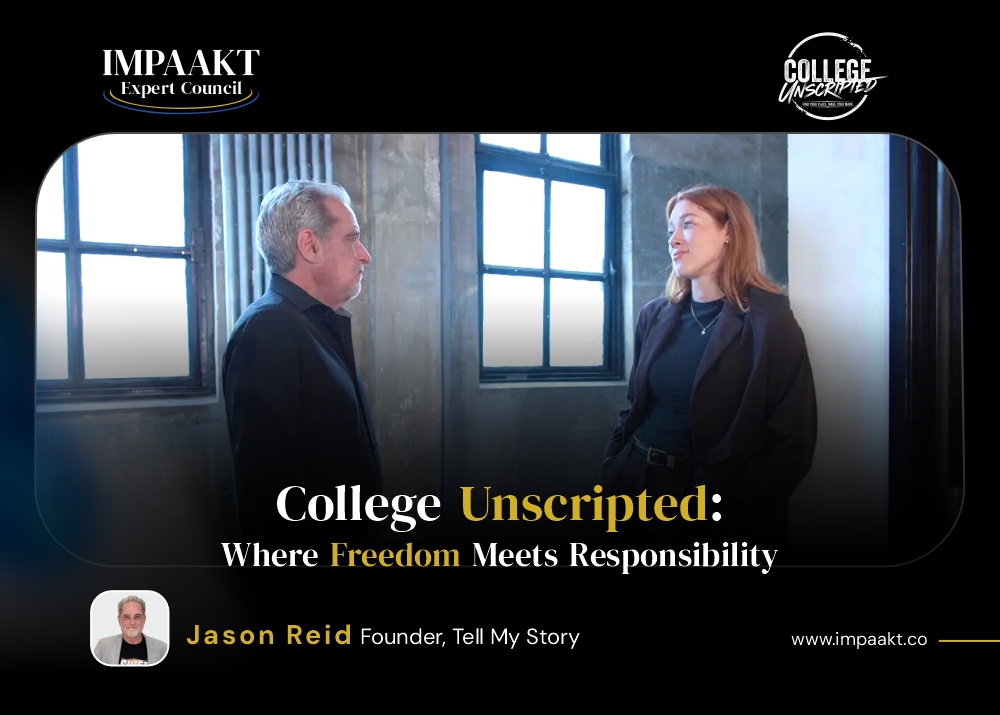
College Unscripted is a 30-minute documentary in which 14 college students speak candidly about their experience. There are no actors, no scripted answers, and no single version of college presented as the right one.
The students talk about belonging and loneliness, relationships, achievement and burnout, managing time and money, changing direction, asking for help, facing setbacks, and figuring out who they are and how they want to show up in the world.
Many arrive carrying a script. Sometimes they wrote it themselves. Sometimes parents, schools, peers, or cultural expectations shaped it: the right school, the right major, the right friends, the right timeline, the college experience they are “supposed” to be having. Then real life intervenes. Questioning those expectations can feel like losing your way. For many students, that is how they find it.
Finding your place
Belonging is the strongest thread in the film. Students want acceptance and connection, and that is natural. Lasting belonging asks something harder of them: building relationships and joining communities without losing themselves in the process.
That takes courage. The courage to say yes and to say no, to introduce yourself, to ask for help, to change your mind, to recognize when you are overwhelmed, and to walk away from what does not feel right. Underneath all of it is the courage to trust your own voice.
A different role for parents
The transition changes the parent’s role as well. For years, parents could often see in real time when something was wrong. College removes that proximity, and connection has to become more intentional and less directive.
The opportunity is to stop writing the script from a distance and to remain a trusted place a student can return to while they learn to run their own life. Alongside questions about grades, exams, and schedules, there is room for others. Who are you spending time with? What has been harder than you expected? What has been surprisingly good? What are you learning about yourself?
Nobody needs to have every answer. What matters is keeping the relationship safe enough that the real answers surface over time.
Why people watch together
At Tell My Story, the film is only part of the experience. Across more than 400 screenings, we have seen what happens when young people and adults hear honest stories in the same room.
A student recognizes an experience they thought was uniquely theirs. A parent hears something their own child may not yet know how to say. An educator sees past achievement to the person carrying everything underneath it. Everyone leaves with a shared understanding of one another.
That is why our screenings do not end when the credits roll. A mental health professional facilitates a conversation afterward. We leave the question of how college should look to the students themselves. Our role is to create space for them to hear from one another, reflect on their own experience, and learn more about who they are.
The rest is yours to write
Every student in College Unscripted is still in the middle of their story. None of them has it all figured out, and that is much of the point.
College is career preparation. It is also where young people practice making choices, navigating change, building relationships, recovering from setbacks, and discovering what matters enough to guide a life.
If students leave the film with one message, I hope it is this: pay attention, know yourself, trust yourself, and make choices that reflect your values and who you are.
College Unscripted: Find Your Place. Make Your Mark. is available to high schools, colleges, universities, and communities at no cost. To host a free screening, visit https://www.tellmystory.org/films/college-unscripted
– By Jason Reid, Founder, Tell My Story