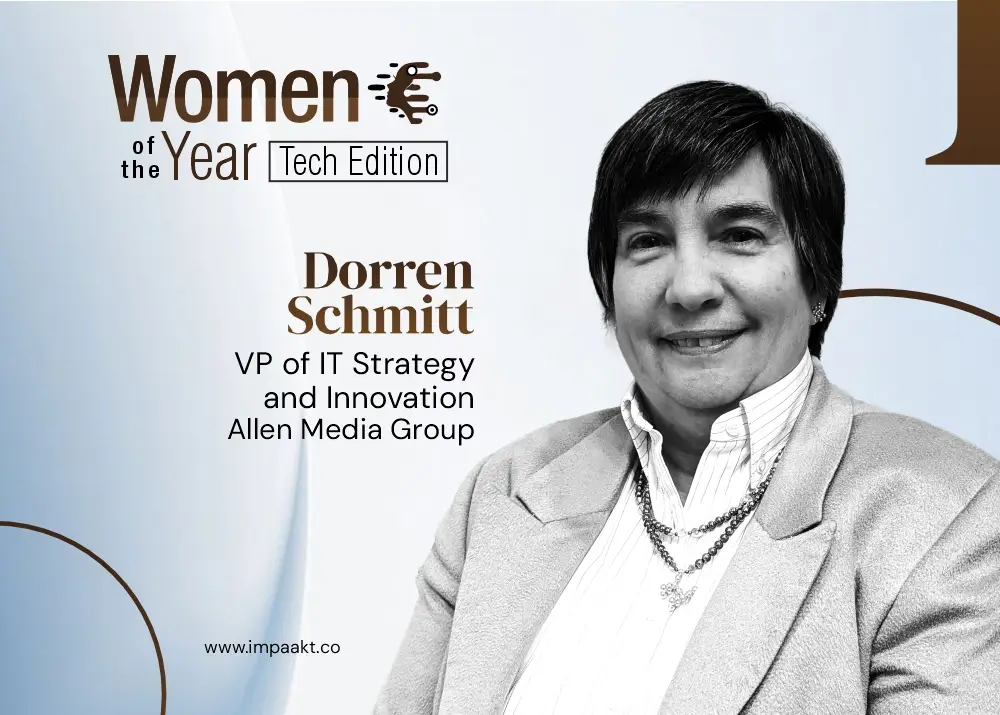
When a statistics professor becomes the architect of corporate AI strategy, you get Dorren Schmitt, PhD—a leader who treats technology like a research problem and solves it with the rigor of academia mixed with the urgency of enterprise warfare. As VP of IT Strategy and Innovation at Allen Media Group, she’s spent three decades proving that the best tech leaders aren’t the ones who chase every shiny new tool. They’re the ones who ask the hard question first: should we?
Dorren’s career defies the typical Silicon Valley origin story. No garage startup, no coding prodigy narrative. She earned her Ph.D. in applied statistics, taught at the University of New Orleans, and secured National Science Foundation grants that turned her into an accidental technologist. She was the person faculty called when systems broke. The one students sought when software confused them. That early role—half teacher, half troubleshooter—gave her something rare in tech leadership: the ability to make the complex feel obvious without dumbing it down.
Fast forward to 2026, and Dorren is managing what she calls the “wild wild west” of AI adoption. On one side, executives demand—”I don’t care, make it work.” On the other, employees freeze in fear of being replaced. She occupies the pragmatic middle, deploying AI not as a replacement for humans but as a co-pilot. She’s also fighting a quieter battle: changing how women rise in tech.
Curious about how she balances visionary thinking with operational ruthlessness, we pulled up a chair with Dorren to hear how she’s redefining what it means to lead through transformation, not just survive it.
Your career sits at the intersection of IT strategy, AI, and cybersecurity — fields that weren’t always welcoming to women. How did your journey into technology leadership begin, and what early experiences shaped your confidence to lead at scale?
My professional trajectory is rooted in a strong academic foundation, culminating in a Ph.D. in applied statistics. I transitioned into a teaching role at the University of New Orleans, where I dedicated my efforts to educating the next generation. Several grants from the National Science Foundation (NSF) were secured, focused on introducing technology into the classroom. These grants were instrumental, not only in funding research but also in providing me with the resources and mandate to integrate technology deeply into the academic environment. This led me to a dual role: continuing my teaching duties while simultaneously becoming the primary technological resource for my department.
In those early days, I was hands-on in the deployment and maintenance of our department’s computing infrastructure. More importantly, I took on the responsibility of instructing both faculty and students on the appropriate and effective use of these emerging technologies. This involved everything from statistical software packages to computational methods. This period of direct practical support, teaching others how to embrace technology as a tool for research and learning, was the crucible in which my current expertise was forged. It is this unique blend of statistical rigor, pedagogical experience, and hands-on technological leadership that serves as the bedrock for my current journey in pioneering and championing our organization’s contemporary AI innovation strategy.
My transition into the corporate workforce was a natural extension of my early problem-solving acumen, which quickly translated into significant contributions and numerous innovative projects. This strong foundation enabled me to lead the charge on initiatives that were often ahead of their time. For instance, I was instrumental in architecting and deploying high-performance compute clusters, optimizing complex systems for maximum efficiency. Furthermore, I embraced and implemented virtualization technology at a time when its potential was largely unrecognized by the broader technologist community, providing significant cost savings and agility. A notable achievement was the successful migration of a top 100 website to the cloud, a complex undertaking that required deep technical expertise and strategic planning.
More recently, I have channeled this passion for pioneering technology into the realm of Artificial Intelligence. Across three decades, this consistent record of innovation and successful project delivery has fostered a deep trust in my leadership abilities among my peers and executives. This trust has been the bedrock, allowing me to forge a path of continuous technological advancement, consistently driving the respective companies I have served forward through strategic innovation and the successful execution of complex, transformative projects.
You’ve led cloud transformations, cybersecurity unification, and enterprise-wide AI initiatives. At what point did you realize your real strength wasn’t just technical execution, but seeing how systems connect and fail together?
The fundamental breakthrough in approaching large-scale, transformative projects, a realization that solidified around two decades ago, lies in the strategic alignment of three core pillars: people, process, and technology, and crucially, in that specific order of priority.
For any initiative aiming for genuine transformation rather than mere incremental change, the people component is paramount. This encompasses not just the technical teams but every stakeholder: the end-users who rely on the systems daily, the support staff who maintain their operation, and the leadership that champions their adoption. Their alignment, understanding, training, and collective buy-in are the true prerequisites for success. A technically perfect system will fail if the people tasked with using and supporting it are not engaged, prepared, or properly aligned with the new way of working.
Following the people are the processes. Data, the lifeblood of modern organizations, is invariably fed from a multitude of disparate sources—legacy systems, external APIs, manual inputs, and various platforms. Understanding these data flows and the underlying business processes is critical. These processes must be rigorously analyzed, optimized, and redesigned to be clear, robust, and efficient. Furthermore, they must be secure and resilient, ensuring data integrity and business continuity even when faced with system outages, security threats, or scaling demands. A well-designed technical solution applied to a fundamentally broken or inefficient process merely accelerates the chaos.
Finally, the technology serves as the enabling layer, the means by which the aligned people execute the optimized processes. This technological evolution has taken significant leaps over the past quarter-century. The journey began in the early 2000s with initial efforts focused on integrating siloed, monolithic systems, primarily utilizing specialized middleware solutions to bridge communication gaps and standardize data exchange across the enterprise. However, the true acceleration of digital transformation came much later, beginning around 2015, catalyzed by the widespread adoption of microservices architectures in the cloud. This shift provided the agility, scalability, flexibility, and resilience necessary to build complex, highly distributed systems capable of rapidly adapting to market changes, marking a fundamental departure from the rigid integration methods of the previous decade. The technology now enables, rather than dictates, the transformation.
Cybersecurity is often framed through fear and risk. How do you communicate security priorities in a way that empowers teams instead of paralyzing them?
Cybersecurity, at its core, is fundamentally a discussion about risk management, but its true strategic value is unlocked when this risk is interpreted and framed through the eyes of the broader business objectives. Every organization inherently accepts a certain level of risk in its pursuit of growth, innovation, and operational efficiency. This acceptance is visible across the entire enterprise, from strategic financial decisions, such as determining the necessary limits of corporate insurance coverage, to tactical market decisions, like the calculated risk of launching a minimum viable product (MVP) or a beta version to achieve first-mover advantage. By deliberately reframing cybersecurity concerns, moving the conversation beyond technical jargon and into the language of business risk, executives are empowered to make informed, non-technical decisions. This business-centric perspective allows leadership to effectively prioritize the digital risks they are willing to accept (the cost of doing business) versus those they must actively mitigate or transfer. This crucial shift in perspective transforms cybersecurity from a cost center into a strategic enabler, fostering far more thoughtful, comprehensive discussions at the executive and board levels. These discussions move beyond simply approving budget requests and focus on an informed, holistic business protection strategy. In essence, by treating cybersecurity not as a technical mandate but as a core component of the enterprise risk portfolio, organizations can achieve a more robust and strategically sound posture, leading to a better-protected and more resilient business.
One of your stated strengths is communicating with brevity and impact. How did you learn to distill complexity without oversimplifying it?
My approach to effective communication, particularly when dealing with complex or technical subjects, is rooted in the principle of radical clarity and conciseness, which is the very definition of communicating with brevity and impact. This skill, which I acknowledge is an ongoing process of refinement, was fundamentally honed during the process of writing my Master’s Thesis and doctoral Dissertation. A core piece of advice from one of my professors provided the essential framework: “If in three sentences I could not explain my research to my grandmother, then I don’t understand the topic well enough.” This simple but profound test became my benchmark for achieving genuine comprehension. It forces a complete mental distillation of highly specialized, often jargon-filled technical topics into accessible, plain language that can be understood by someone with no prior knowledge of the subject matter.
This practice of explaining the complicated in an uncomplicated way has served me exceptionally well across various professional contexts. It is not merely a soft skill; it becomes absolutely paramount, and frankly, a critical professional necessity, when I am tasked with communicating about innovative or high-risk projects where the outcome is inherently uncertain or where success is not guaranteed. In these situations, stakeholders need clarity, not complexity, to make informed decisions and manage expectations.
From where you sit, what’s the most persistent barrier keeping women from senior technology leadership, and what practical change would make the biggest difference?
Historically, a clear and persistent disparity exists in the criteria and speed of career advancement, particularly when comparing the trajectory of men and women into management and executive roles. Data consistently illustrates that men are generally promoted on potential, while women are promoted on performance. This distinction is critical because the evaluation of potential is inherently faster and often less objective than the comprehensive documentation required to validate sustained high performance. This difference in evaluation criteria creates a significant structural advantage for men in the race to the management level, making their ascent both faster and, arguably, less strenuous. The resulting impact is evidenced by a stark statistical imbalance: we see almost a 2-to-1 promotion rate of men to women into management positions across many industries. This gap is not a reflection of competency but of systemic biases in how talent is identified, assessed, and rewarded.
To fundamentally address this inequity and accelerate the advancement of female leaders, the single biggest change that must occur is a strategic transition from a mentorship model to a sponsorship model. A mentor provides invaluable guidance, offering advice, sharing insights, and acting as a confidential sounding board. This relationship is crucial for skill development and navigating organizational culture. However, a mentor’s influence is often confined to the individual’s growth and does not inherently translate into direct career acceleration. A sponsor, in contrast, is a senior leader—typically an executive or high-level manager—who wields their accumulated social capital and political influence to actively advocate for a high-potential candidate. A sponsor ensures that the candidate’s name is championed in the rooms where crucial decisions are made—rooms the candidate may not yet have access to.
In contemporary technical and high-growth environments, senior roles are rarely filled through open applications alone. They are predominantly filled through internal visibility garnered from high-stakes, mission-critical project assignments. These are the “make-or-break” opportunities that provide the intense visibility and cross-functional exposure necessary for executive-level consideration.
A sponsor acts as a strategic gatekeeper, ensuring that a female leader is intentionally assigned to these career-defining opportunities. Examples include leading a multi-million dollar Vertex AI project, spearheading a complex global infrastructure overhaul, or driving the integration of a major acquisition. By securing these assignments, the sponsor directly facilitates the visibility and proven leadership experience needed for promotions to levels like Director or Vice President.
The sponsor’s role is not simply to advise, but to actively lobby for stretch assignments, defend the candidate’s successes, buffer against potential failures, and ultimately, ensure that the female leader is recognized, recommended, and selected when a VP-level promotion opportunity arises. This proactive advocacy is the essential catalyst that transforms high performance into executive power.
Everyone is talking about AI. Few are governing it responsibly. What worries you most about how organizations are adopting AI today — and what excites you?
The current landscape of Artificial Intelligence adoption can best be described as a “wild wild west,” marked by a striking dichotomy in organizational response. On one end of the spectrum, we see aggressive, sometimes impulsive, executive mandates. Leaders, captivated by the promise of AI, are instructing their IT departments, “I don’t care, I want to use X, Y, or Z product—just make it work.” This approach often prioritizes speed over strategy, leading to fragmented implementation, security vulnerabilities, and integration challenges. Conversely, a significant portion of the workforce, both employees and some executives, is paralyzed by fear. This apprehension stems from concerns over job displacement, ethical misuse of data, algorithmic bias, and a general lack of understanding regarding how AI systems operate. The sustainable path forward necessitates establishing a pragmatic middle ground. AI should not be viewed as a silver bullet for total automation but rather as a powerful co-pilot designed to enhance, not eliminate, human effort. The core strategic goals for AI integration must be to enhance productivity, eliminate mundane and repetitive tasks, and innovate new ways of doing things. A critical reality check is the understanding that AI rarely delivers a perfect, final product. It only gets you 80-90% there. This gap has led to the coining of the term “workslop”; the necessary and often tedious effort required to edit, verify, contextualize, and polish the AI-generated output to meet organizational standards and accuracy requirements. Paradoxically, in the initial stages of adoption, this workslop can actually increase the overall workload for employees. Without proper training and guidelines, employees spend valuable time correcting flawed output or grappling with complex new tools, negating the intended productivity gains.
Despite the current implementation challenges, the potential for AI to drive major advancements across critical sectors is immense. This is truly the tip of the iceberg: Health Care: AI is set to revolutionize patient care and research, including the ability to design highly specific, personalized drugs (designer drugs) to target individual diseases with unprecedented precision. Furthermore, advanced AI-driven diagnostics are significantly improving the early detection of illnesses like cancer and neurological disorders, leading to better outcomes. Finance and Security: AI is a formidable tool in the fight against sophisticated cyber threats and fraud. It can process millions of transactions in real-time to detect anomalous behavior, vastly improving fraud detection and providing robust protection against increasingly complex scams and financial crimes. Environmental Science and Climate Modeling: AI can process vast climate datasets to create more accurate predictive models, optimize resource management, and accelerate the discovery of sustainable energy solutions.
You’ve led multiple AI initiatives aimed at operational efficiency. How do you decide when AI is truly the right solution, versus when it’s just the loudest option in the room?
The fundamental key to successfully implementing and scaling Artificial Intelligence (AI) initiatives lies in their direct and deliberate alignment with the overarching strategic priorities of the organization. These strategic priorities are the compass of the company, explicitly defining its most critical goals, values, and areas of focus for long-term growth and success. When AI projects are tethered to these core priorities, whether they involve enhancing customer experience, optimizing supply chains, driving new revenue streams, or improving operational efficiency, they immediately shift from being isolated, experimental innovations to integral components of the company’s strategic pillar.
This strategic alignment offers several pivotal advantages including resource allocation (personnel, financial capital or technology), executive sponsorship, and governance and scalability.
How would the teams you’ve built describe your leadership style, and how intentionally have you shaped that culture?
At the core of my team is diversity. And it is not simply gender or ethnicity. My desire is to have a diverse team of thought and experiences. We have members that come from small and large companies, the military, college, graduate school, and high school. We have team members right out of college, and decades of experience. This all leads to a balanced team that bring in different perspectives to solve problems. Although there have been multiple specialized teams under my leadership, the culture is we are one team. There is never “thats not my job” or “you need to ask Mary”. I forster collaboration, innovative thinking, and a customer focus while still maintaining a high degree of risk mitigation.
I would say my team sees me a a visionary leader. I have encouraged innovations and problem solving. I make data driven decisions and do them in a timely manner. I have my teams’ back.Fostering a Culture of Diverse Thought and Unified Action
At the core of my successful teams is a deep-seated commitment to diversity, one that extends far beyond conventional metrics like gender or ethnicity. My strategy is centered on building teams that reflect a rich tapestry of thought and experiences. This deliberate heterogeneity is the engine of our innovation. Our team members are drawn from a broad spectrum of backgrounds, including individuals who have thrived in small startups and large multinational corporations, those who have served in the military, and graduates from college, graduate school, and even individuals whose journeys began right after high school. This blend of origins creates a valuable friction of ideas. We integrate members fresh out of college, eager to apply the latest theories, with seasoned professionals boasting decades of practical, hands-on experience. This generational and professional diversity ensures a balanced team dynamic, guaranteeing that a multitude of perspectives are brought to bear on every problem we face.
While I have overseen and managed multiple specialized teams, each with distinct expertise and responsibilities, the overarching, non-negotiable cultural principle is that we are one unified team. This means the toxic phrases “that’s not my job” or “you need to ask Mary” are nonexistent within our environment. I relentlessly foster an atmosphere of radical collaboration, where knowledge-sharing and mutual support are the norm, not the exception. My leadership philosophy is built on three pillars: encouraging innovative thinking, maintaining a relentless customer focus, and instilling a high degree of risk mitigation discipline. This balanced approach allows us to pursue bold solutions while ensuring operational stability and responsibility.
I believe my team views me primarily as a visionary leader. My role is to not only set an inspiring direction but also to empower my people to navigate the path. I actively encourage intellectual curiosity, pushing the boundaries of what is possible, and celebrating proactive problem-solving at every level. A cornerstone of my leadership is the commitment to objectivity and speed through data-driven decisions. In today’s dynamic environment, inertia is a risk. I ensure that we utilize the best available data to inform our choices and, crucially, that these decisions are made in a timely manner to maintain momentum and capitalize on opportunities. Perhaps most essential to our trust and cohesion is my unwavering support for my team. I have their back, publicly and privately. This psychological safety is vital; it is what permits them to take necessary risks, challenge the status quo, and bring their best, most authentic selves to work without fear of unfair repercussion. This foundation of trust, collaboration, and clear, data-informed vision is what drives our sustained success and ability to meet complex challenges head-on.
What kind of technological future are you actively trying to build, not just for Allen Media Group, but for how enterprises operate more broadly?
The future of humanity is intrinsically linked to technological advancements, many of which we are only just beginning to grasp the full implications of. The concept of Artificial Intelligence (AI), for instance, was first formally discussed and named in the seminal Dartmouth workshop in the 1950s. However, the ambitious vision laid out by those early pioneers was far ahead of the computational capabilities of the time. It took over a half-century of exponential growth in processing power, data storage, and algorithmic sophistication to finally bring that theoretical vision of practical AI into reality. To gain perspective on what might be possible, one need only look to the rich history of science fiction. If we examine foundational works from the mid-20th century, such as 2001: A Space Odyssey with its sentient AI, HAL 9000, the domestic automation depicted in The Jetsons, or the sophisticated robotic companions in Lost in Space, we can draw a direct line to the technological realities of 2025. Many of these fictional concepts, from voice-activated assistants to rudimentary self-driving capabilities and advanced robotics, have moved from the realm of fantasy to the everyday.
Looking at science fiction from the last 25 years offers a glimpse into our more immediate future. Movies like I, Robot explore the ethical and societal complexities of widespread advanced robotics, a discussion that is highly relevant today. Avatar delves into advanced biotechnology, digital consciousness transfer, and immersive virtual reality, areas that are seeing rapid development. Even films like 2067, which tackles radical solutions to a dying environment, underscore a critical theme: technology must be fundamentally leveraged to improve and safeguard human life.
This imperative focus means directing technological innovation toward solving the most pressing global challenges. A primary goal must be mitigating climate change through technologies such as carbon capture, sustainable energy systems, and advanced climate modeling. Furthermore, we must enhance global and local transportation systems with autonomous vehicles, hyperloop technology, and optimized logistics to reduce both environmental footprint and congestion. Crucially, technology must be deployed to reduce the impacts of climate on our lives—this includes sophisticated early warning systems for extreme weather events, resilient infrastructure planning, and drought-resistant agriculture. The true measure of our technological success will be its contribution to creating a more sustainable, equitable, and resilient future for all.
Years from now, what do you hope people say Dorren Schmitt, PhD helped organizations do better, not just faster or cheaper?
What I truly hope people would say about my impact is that I was a catalyst in moving each organization forward, ensuring we consistently stayed on the cutting edge, not just of technology, but in providing an unparalleled experience for all our customers. This customer base is defined broadly, encompassing not only our external clients and consumers who rely on our products but also every single employee within the company. My approach centered on driving innovation and efficiency across the board. For the technical teams, this meant pioneering initiatives like self-healing automation to make an engineer’s on-call experience significantly easier and less stressful, drastically reducing mean time to recovery and increasing system stability. For the marketing department, I championed the deployment of sophisticated tools and data platforms that empowered them to produce highly targeted, effective materials and campaigns, dramatically improving return on investment and market penetration.
Ultimately, for our external viewers and consumers, the focus was on delivering a more comprehensive and detailed information experience. By enhancing our data visualization, accessibility, and quality, we ensured that the people we serve were consistently equipped with the best possible data to make better, more informed decisions in their daily lives, cementing our reputation as a trusted, forward-thinking authority.