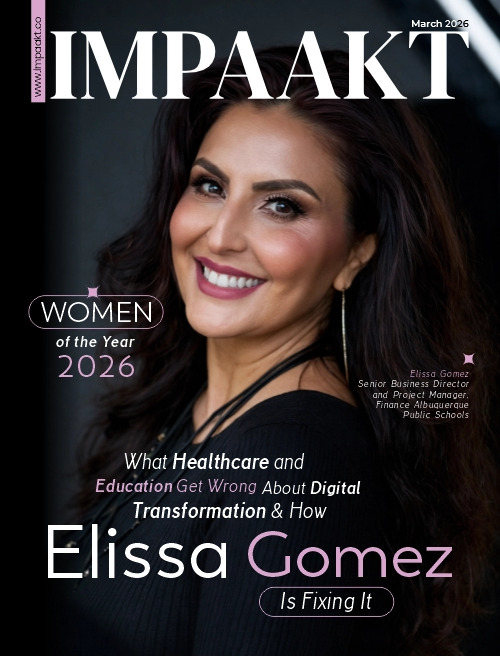
She has spent over two decades inside the two most human-centered industries in America. Healthcare. Education. And in both, she has seen the same mistake made at scale.
Organizations invest millions in new systems, new software, new infrastructure. They plan the technology meticulously. They map the architecture. They set the go-live date. And then they forget the most critical variable: the people who have to wake up the next morning and actually use it.
Elissa Gomez knows this pattern intimately. Over 19 years at the University of New Mexico Hospital, she led the full transition from paper to electronic health records, oversaw more than 500 system and training initiatives, and helped earn the hospital recognition as a Top Training Organization nationally for over a decade. Today, as Senior Business Director and Project Manager, Finance at Albuquerque Public Schools, she is leading Enterprise Resource Planning and Human Capital Management implementations across one of the largest public school districts in the Southwest.
Two industries. Two institutions. One consistent conviction: people do not resist change. They resist confusion.
That insight has shaped every transformation she has led, every team she has built, and every room she has walked into. We sat down with Elissa to understand what that conviction looks like in practice, what the cost of ignoring it really is, and why resilience is not what most leaders think it is.
What core leadership principles have remained constant throughout your journey?
From the way we learn to the way we heal, progress has redefined both education and healthcare, introducing smarter tools, more complex systems, and a broader range of professional identities.
I have always believed that leadership is not about authority. It is about responsibility. Responsibility to build systems that work, to protect the people within them, and to leave every environment stronger than you found it.
Three principles have guided me consistently:
Clarity before control. People do not resist change. They resist confusion. My role has always been to create clarity so others can succeed.
Emotional bandwidth matters. High performance requires emotional capacity. Leaders must model composure, resilience, and grounded decision-making, especially during pressure.
Integrity is non-negotiable. Systems can be redesigned. Processes can be improved. But once trust is broken, recovery is costly. I protect trust fiercely.
Whether in a school district or hospital, the mission is the same. Serve people well. Build structures that outlast you.
Finally, to me true leadership isn’t about being the smartest person in the room; it’s about making others’ brilliance so visible that the room thrives long after you leave it.
What was the most transformative initiative you spearheaded at UNM Hospital?
One of the most transformative initiatives I led during my 19 years at the University of New Mexico Hospital was the full implementation of Computerized Order Entry for Physicians and Nursing Documentation. This was a complete replacement of paper with electronic tools for their daily work. The entire organization, with approximately 2000 employees, needed to be trained and ready for the day of go-live. The project was a huge success.
Over the years I was there, we were transitioning through large-scale EMR optimizations and technical upgrades that affected physicians, nurses, residents, and operational teams. The complexity was enormous. Over 500 system and training initiatives occurred during my tenure.
We rebuilt the training environments from the ground up, ensured standardized instructional design practices, and set measurable performance goals for our analysts and coordinators.
The impact was measurable and lasting:
UNM Hospital was recognized as a Top Training Organization nationally for over a decade.
Training satisfaction and compliance rates significantly improved.
We reduced implementation delays by aligning technical teams and instructional teams earlier in project lifecycles.
We built a culture where training was not an afterthought but a strategic pillar.
How did you balance operational excellence with people-centered leadership during major system transitions?
Large-scale implementations such as Cerner and Oracle demand precision. But precision without empathy leads to burnout.
I balanced both through intentional structure:
First, we separated urgency from panic. Deadlines were real. Pressure was real. But I refused to let anxiety drive decision-making.
Second, we translated technical language into human language. Physicians do not want to hear about system architecture. They want to know how their workflow will change at 2 AM when a patient is in critical condition.
Third, we created feedback loops. During transitions, I made it clear that problems were data, not personal failures. That mindset allowed teams to surface issues early.
Operational excellence requires discipline. People-centered leadership requires presence. I learned that the two are not opposites. They are partners.
What strategies did you use to build and sustain high-performing teams?
Sustained performance does not happen by accident.
At UNM Hospital, we built high-performing teams using four strategies:
Clear role definition. Every Instructional Design Analyst understood their scope and expectations.
Accountability with support. I operated with a high degree of integrity. I also removed barriers whenever possible.
Professional development. The team was exposed to executive strategy conversations and involvement in the project early in the initial stages.
Recognition and trust. I acknowledged excellence. People rise when they feel seen.
High-performing teams are not built on pressure alone. They are built on alignment, purpose, and growth.
How has your pivot into wellness coaching influenced your leadership perspective?
Before retiring from the hospital, I expanded further into wellness coaching and community fitness leadership in Los Lunas. That chapter deepened my understanding of resilience in a different way.
In fitness classes, I see people show up tired, discouraged, and overwhelmed. Yet they move. They build strength slowly. They trust the process.
Leadership is no different.
Coaching reminded me that transformation happens incrementally. Systems change as bodies change. Through consistency, accountability, and belief.
It also reinforced my understanding of the need for leaders to model vitality. We cannot preach sustainability while operating in chronic exhaustion.
That chapter has sharpened my belief that physical wellness and executive performance are directly connected.
What are the biggest challenges in transforming educational infrastructure at scale?
Leading the Enterprise Resources Planning and Human Capital Management implementations at Albuquerque Public Schools presents unique challenges.
Education systems carry decades of legacy processes. Financial systems, HR structures, and reporting mechanisms have often evolved independently over time.
- The biggest challenges include:
- Data integrity across multiple departments.
- Resistance rooted in fear of disruption.
- Ensuring security and compliance during transition.
- Balancing modernization with budget constraints is a reality.
- Unlike private sector implementations, public education operates under intense scrutiny and accountability. Transparency and accuracy are critical.
- Transformation at scale requires both technical governance and cultural alignment.
- Currently, Albuquerque Public Schools’ teams are applying Change Management principles to change culture as part of the new system implementation.
How are you ensuring digital transformation aligns with long-term district goals?
Better systems lead to better learning. We serve the student by implementing the foundation.
At Albuquerque Public Schools, alignment happens through:
- Cross-functional steering committees and teams.
- Clear documentation of policies and audit-ready procedures.
- Defined success metrics tied to financial transparency and operational efficiency.
- Ongoing training matrices that ensure staff readiness.
We aren’t adopting technology just to stay current; we are investing in a foundation that will reliably serve our students and staff well into the next decade.
Sustainability means relevant data, documented processes, and trained personnel. Anything less creates future instability.
What advice would you give women aspiring to lead complex transformations?
First, master your craft. Know what you are truly good at doing. Competence builds credibility.
Second, develop emotional discipline. You will be tested. Stay grounded.
Third, do not shrink in technical conversations. Learn the language. Ask the hard questions.
Fourth, build alliances across departments. Transformation and change never happen in isolation.
And finally, understand that you do not have to choose between strength and empathy. The most effective leaders integrate both.
How do you define success at this stage of your career?
Success for me now is alignment.
Alignment between my values and my work. Alignment between integrity and performance of integrity. Alignment between leadership and service.
It is no longer about the title. It is about the impact. If I can build systems that protect and help people, mentor emerging leaders, and model resilience, that is success.
What message would you share about resilience and reinvention?
Reinvention is not abandoning who you were. It expands who you are. Resilience is not hardness. It is flexibility under pressure.To emerging leaders, especially women navigating complex systems, I would say this:
Your voice belongs in rooms where decisions are made. Your perspective is not secondary. And your lived experience is not a weakness. It is your competitive advantage.
Lead with competence. Lead with courage. Lead with heart.