Performance is often misunderstood.
The word still conjures images of intensity. Long hours. Endless productivity. A belief that pushing harder is the fastest path to better results. Yet the human body and mind tell a different story. When energy is depleted and recovery disappears, performance does not rise. It declines.
A growing body of research in physiology, psychology, and leadership science is challenging the myth of relentless output. Human performance behaves less like a machine and more like an ecosystem. Energy flows, attention fluctuates, and recovery determines how well we can show up again tomorrow.
This evolving understanding sits at the center of IMPAAKT’s Women of the Year 2026 edition.
The leaders featured in these pages are not simply achieving results. They are redefining how sustainable performance is built.
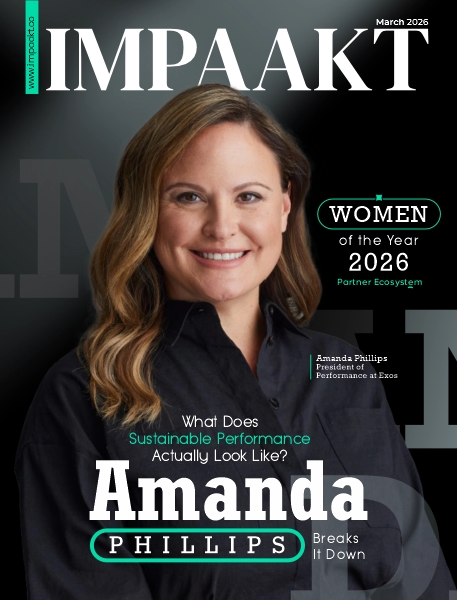
Our cover story features Amanda Phillips, President of Performance at Exos, whose work has helped translate the science of elite sports into a framework for modern leadership. At Exos, performance is not reduced to a single variable. It is treated as a system in which nutrition, movement, recovery, and mindset operate together to expand human capacity.
Athletes have understood this principle for generations. Training programs balance exertion with recovery because the body rebuilds strength during renewal, not during strain. Amanda and her team have applied that same philosophy to leaders, organizations, and teams navigating demanding professional environments.
The result is a shift in how performance itself is defined. Instead of chasing short bursts of productivity, organizations are learning to build the capacity that allows people to perform consistently over time.
This edition also highlights leaders whose work helped bring the science of sustainable performance into the global conversation.
Jim Loehr, a pioneer in performance psychology, introduced the concept of energy management, demonstrating that resilience is not the ability to endure endless pressure. It is the ability to restore energy after it is spent. His work has shaped leadership development programs across industries and continues to influence how organizations think about resilience.
Arianna Huffington expanded the conversation by bringing the realities of burnout into public view. Her advocacy for healthier workplace cultures has encouraged organizations to reconsider how ambition and wellbeing intersect. Through her work, the conversation around productivity has begun to include recovery, sleep, and mental clarity as essential ingredients of success.
Our feature article explores why sustainable human performance is becoming a leadership priority across industries. As technology accelerates the pace of work and decision making grows more complex, the capacity of people to remain focused, resilient, and creative is becoming one of the most valuable resources an organization possesses.
The stories in this edition reveal an important truth. High performance is not the result of endless effort. It emerges from systems that support energy, resilience, and renewal.
The leaders highlighted here understand that performance should strengthen the people responsible for delivering it.
Because the real measure of performance is not how hard we push in a single moment.
It is how consistently we are able to show up, contribute, and grow.
Happy Reading!