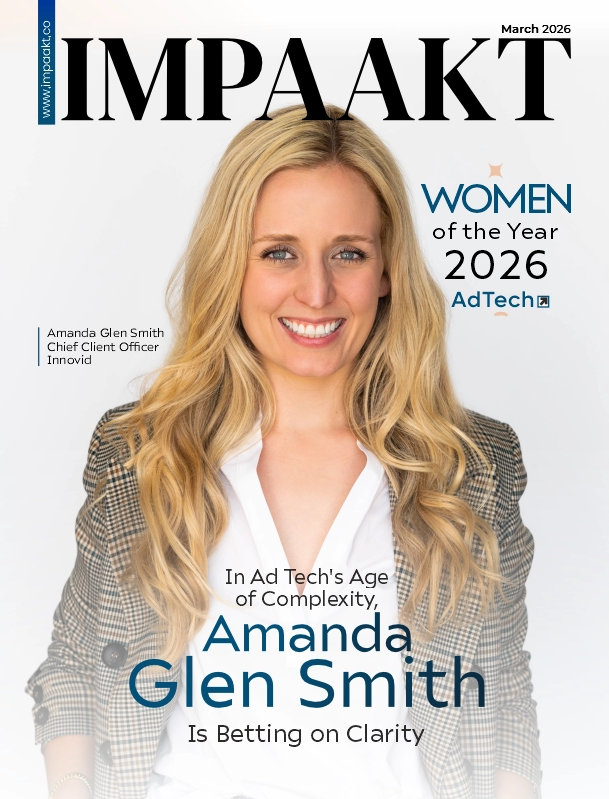
Ad tech does not reward hesitation. It rewards people who can hold complexity in one hand and a client’s trust in the other, without dropping either.
Amanda Glen Smith has spent her career doing exactly that. As Chief Client Officer at Innovid, she oversees $300 million in revenue across one of the most fragmented, fast-moving media ecosystems in the world. Through merger integrations, AI acceleration, identity shifts, and measurement recalibrations, she has helped maintain a 99% enterprise retention rate in an industry where volatility is the norm.
But ask her what actually drives that number, and the answer is not a playbook. It is a belief she has held since the earliest days of her career: people do their best work when they feel ownership instead of fear.
That conviction has shaped how she builds teams, handles pressure, and shows up: as an executive, as a mother, and as a leader who refuses to hide behind complexity when clarity and honesty will do the job better.
This Women’s History Month, we pulled up a chair with Amanda to talk about what client-first leadership really requires in an era of constant change, and why they industry may be looking in the wrong place for answers.
Amanda, before titles like Chief Client Officer and before Innovid, what did your early career teach you about work, people, and responsibility that still shapes how you lead today?
Early in my career, I learned that responsibility isn’t something you wait to be given. You have to take it. I started out in roles where you’re close to the work and even closer to the consequences. If something broke, a client noticed. If something succeeded, it was because a team pulled together under pressure.
Those experiences taught me two things that still guide how I lead today. First, that people do their best work when they feel ownership instead of fear. Second, that leadership doesn’t mean having all the answers, but creating clarity and trust so others can move with confidence.
Today, I oversee $300 million in revenue, but I still lead with the same mindset I had when I was responsible for a single campaign: stay close to the impact, own the outcome, and never hide behind complexity.
That perspective has shaped every role I’ve taken on since.
Ad tech is complex, fast, and often opaque. When you first entered this space, what felt most unfamiliar — and how did you find your footing?
The pace and the language of ad tech can be almost disorienting at first. This space has its own shorthand, its own assumptions, and it moves incredibly quickly. It can feel like you’re expected to know everything immediately.
What helped me find my footing was asking questions without ego and grounding myself in the client perspective. When you focus on what a brand or agency is really trying to achieve — whether it’s reach, outcomes, efficiency, brand building, or a bit of everything — the complexity starts to organize itself.
I also learned to lean on the expertise around me. While we are all in charge of our own education, you are also only as strong as the people and team you surround yourself with. Ad tech rewards curiosity and collaboration far more than pretending you’ve already mastered it.
At Innovid and throughout your career, you’re known for treating client success as a partnership, not a transaction. How does that belief actually show up in how you structure teams, conversations, and decisions?
It starts with how we define success internally. We don’t measure client relationships purely by renewals or revenue. We look at impact, stickiness, adoption, and whether clients feel genuinely supported in moments that matter.
Structurally, it’s through cross-functional teams that stay connected to clients beyond onboarding or implementation. Strategically, it means having honest conversations — even when they’re uncomfortable — about what’s working, what isn’t, and what needs to change. And at the decision level, it often means choosing the long-term trust play over the short-term win.
Partnership requires accountability on both sides. We aim to show up as consultants to our clients’ challenges, not vendors.
When Innovid and Flashtalking came together under Mediaocean, we had the opportunity to elevate our client success model at scale. We evolved it into a strategic growth engine that connects creative, delivery, measurement, and optimization into a unified experience for clients navigating increasing complexity.
“Client-first” is easy to say and hard to execute. What does being genuinely client-centric require in moments of pressure, deadlines, or competing priorities?
It requires discipline. I often remind my team that the decisions we make today will shape how our clients operate tomorrow. So, we have to ask what will truly matter to them a year from now, not just in the short term. When timelines are tight or priorities collide, it’s tempting to optimize for internal convenience. Being truly client-centric means pausing and asking, “What decision would we want made if we were on the other side of this?”
Sometimes that means pushing back internally or slowing down to get it done right instead of fast. And sometimes it means acknowledging a miss quickly and transparently. Clients don’t expect perfection. Honesty, responsiveness, and follow-through are the things that build credibility over time.
As organizations grow, relationships can become diluted. What systems or habits have you put in place to ensure trust doesn’t disappear as Innovid scales?
Growth can create distance if you let it. We’ve been intentional about putting structure around listening through things like our Executive Client Council, regular feedback loops, and sustained senior level engagement that doesn’t disappear once a contract is signed. That discipline has helped us maintain a 99%+ enterprise retention rate, even through a major merger integration and significant industry disruption.
On a personal level, I stay close to our teams and clients. I want to hear about what’s hard, what’s changing, and where we’re falling short. Trust isn’t maintained through systems alone. At its core, it’s people who build and maintain trust. That trust needs to be reinforced through consistency and presence. At the end of the day, we’re all human, and humans want to work and surround themselves with other good people. Scale doesn’t excuse detachment.
The media and advertising ecosystem is constantly shifting. From where you sit, what’s the biggest misconception leaders still have about navigating change in this industry?
I think there’s still a belief that change can be managed purely through technology or transformation initiatives. But change is a human process first. Tools matter, but adoption, alignment, and trust matter more.
Right now, the industry is navigating fragmentation across media channels, evolving identity frameworks, AI acceleration, and measurement recalibration. There’s a misconception that either a single solution will magically eliminate that complexity, or that fragmentation is simply something we have to accept and work around. The reality is more nuanced. Technology can meaningfully reduce friction and bring clarity, but only when it’s paired with alignment, adoption, and shared accountability.
The leaders who navigate change well invest in communication, training, and empathy. They recognize that uncertainty is part of the job now, and they equip their teams and partners to move through it together instead of trying to eliminate it entirely.
You lead at a high level while raising a family and maintaining a life outside work. How has your definition of ambition evolved over the years?
Earlier in my career, ambition was about acceleration, titles, scope, visibility. Today, it’s about sustainability and impact. I still care deeply about performance and growth, but I’m equally focused on building a life and a career that can coexist and create a well-blended life.
Becoming a mother sharpened my priorities. When I took a four-month parental leave at a critical moment for the company, it was both a personal decision and a cultural signal. Leadership doesn’t have to come at all costs. If we want women to stay and rise, we have to model that visibility.
Being a mom first and executive second has made me more intentional with my time and more empathetic as a leader. If we let it, ambition matures to become less about constantly proving and more about building something that lasts when you’re not in the room.
As you look toward the next phase of your journey, what kind of leader do you aspire to become — and what kind of organization do you want Innovid to be known as?
I aspire to be the kind of leader who creates space for others to grow and evolve. Someone who sets direction clearly, trusts deeply, and holds high standards without sacrificing humanity.
For Innovid, I want us to be known as the partner clients trust in moments of complexity and change. Not just because of our technology, but because we show up thoughtfully, transparently, and with a genuine commitment to helping them succeed in a rapidly evolving landscape.
When someone looks back at your career one day, what do you hope they’ll say wasn’t just effective — but meaningful — about the way you led?
I hope they say that I cared about the work, even more deeply about the people, and about doing what’s right, especially when it’s hard. That I created environments where teams felt empowered, clients felt heard, and progress felt shared. That women, especially working mothers, felt they didn’t have to shrink themselves or choose between ambition and authenticity in order to succeed.
Effectiveness matters but meaning comes from how people experience working with you. Relationships still matter most. If I’ve helped others grow, take risks, and believe in themselves, that’s what will matter most to me.
What would you tell young women stepping into client-facing, high-impact leadership roles about confidence, credibility, and staying true to themselves?
You don’t need to earn your voice, you already have it. Confidence doesn’t come from knowing everything; it comes from trusting your perspective and intuition, and being willing to learn out loud.
Credibility is built through consistency, integrity, and follow-through. And staying true to yourself doesn’t mean refusing to evolve but rather anchoring your growth in your values.
You can be exacting and empathetic. You can demand performance and build belonging at the same time. The strongest leaders I’ve been fortunate to learn from integrate strength and softness versus choosing between them.
There’s room for ambition, nuance, and humanity in leadership. You don’t have to narrow or change yourself to fit someone else’s definition of power. Be genuine to yourself and create your own definition.