The laboratory benches at Tuskegee University have witnessed history before, where George Washington Carver once transformed peanuts into hundreds of products, proving that science could serve the underserved. Decades later, those same halls would see another kind of transformation, one happening at the molecular level. Nanotechnology, the science of manipulating matter at atomic and molecular scales, has long promised to revolutionize everything from medicine to manufacturing. Yet for all its potential, the field faces a fundamental challenge: how do we harness these tiny building blocks to solve massive, real-world problems without creating new environmental crises in the process?
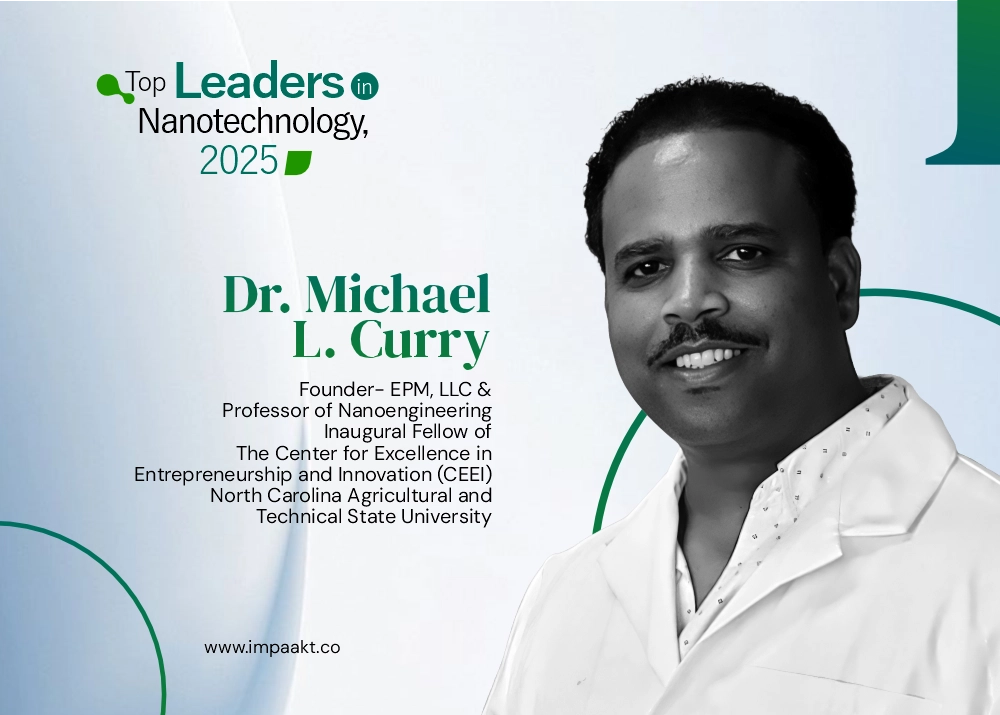
Dr. Michael L. Curry has spent his career answering that question through nanocellulose, nature’s own nanomaterial. A Professor of Nanoengineering and the Inaugural Faculty Fellow at the Center for Excellence in Entrepreneurship and Innovation at North Carolina A&T State University, he works with sugar chains derived from plants—abundant, renewable, and biodegradable—to develop alternatives to petroleum-based plastics. His approach, however, moves beyond traditional academic pathways. While many scientists remain focused on publishing research, Curry pushes his discoveries out of the lab and into the marketplace, taking on the complex work of commercialization that most researchers avoid.
That entrepreneurial drive comes to life through his role as Founder of EPM, LLC, where scientific discovery meets real-world applications. His time at Tuskegee University marked a significant moment in this journey: he became the first professor there to secure a U.S. patent alongside an African American student as co-inventor, demonstrating that innovation could create pathways for the next generation while honoring the past.
Yet Dr. Curry’s vision extends beyond materials science alone. He’s building something larger, an ecosystem where diversity drives discovery, where students don’t just learn nanotechnology but understand its power to address challenges their communities face.
Compelled by his mission to make nanotechnology serve people rather than just possibility, we sat down with Dr. Curry to explore how he’s turning molecular science into meaningful change.
Dr. Curry, your work as a Researcher and an Entrepreneur, is tackling one of the most pressing challenges of our time; replacing traditional petroleum products with biodegradable alternatives. What sparked your commitment to creating sustainable materials, and what does “eco-friendly innovation” mean to you at its core?
My passion for developing sustainable materials is driven by a deep desire to leverage my experiences, education, and training to create real-world solutions that solve community challenges. As researchers, we often become trapped in the ‘publish or perish’ mindset, mistakenly limiting ourselves to our academic silos and missing opportunities to address everyday challenges faced by many communities.
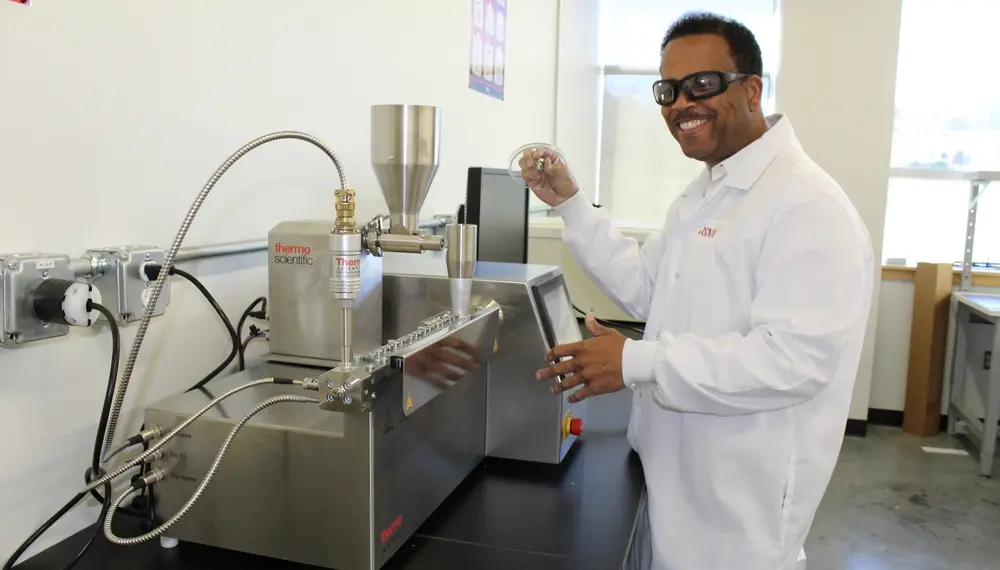
To me, innovation is the “utility of discovery”—the transformative power of applying knowledge to solve practical problems. When combined with eco-friendliness, innovation takes on an even more profound significance, offering solutions that not only improve lives but also protect our environment.
Eco-friendly approaches represent a chance for us as scientists to demonstrate creativity, thoughtfulness, and responsibility—proving that sustainable solutions can be both effective and morally grounded. This is where true impact lies: in developing technologies and materials that serve communities today while safeguarding our planet for future generations.
Nanocellulose is still a mystery to many outside the scientific world. Could you explain, in simple terms, how this material works — and how it could change the future of plastics, manufacturing, and climate impact?
Nanocellulose is truly a gift from nature! It’s one of the most versatile, abundant, renewable, and biodegradable materials on our planet. Imagine tiny, powerful chains of sugar derived from plants—it’s as if nature’s building blocks are at our fingertips. Its remarkable combination of eco-friendliness and incredible strength makes it the perfect game-changer, ready to replace traditional petroleum-based materials. With endless possibilities, from innovative packaging to cutting-edge biomedical devices, nanocellulose is paving the way for a sustainable and exciting future!
Many scientific breakthroughs remain trapped in labs. What were the biggest challenges you faced in turning your nanocellulose research into real-world, scalable products?
Many researchers prefer to focus primarily on their designated research areas because venturing into new, unfamiliar territory can be challenging. Transitioning discoveries from the research laboratory to the marketplace often requires a significant amount of time, patience, and effort. For many researchers, this process is complicated by limited exposure, training, and access to resources necessary for acquiring the essential skills needed for successful commercialization. Developing an entrepreneurial mindset is crucial in overcoming these barriers, as it fosters the ability to think creatively, take calculated risks, and navigate the complexities of bringing innovations to
market. However, the lack of such an entrepreneurial mindset can itself act as a significant obstacle, preventing researchers from seizing opportunities and effectively translating their research into real-world applications. Personally, this challenge was a key obstacle that I had to address as I worked to develop the skills and confidence required to navigate and facilitate pathways of bringing my research discoveries to the marketplace.
You’ve spoken about continuing George Washington Carver’s legacy of using science to empower communities. How has his work influenced your vision, both as a scientist and as a mentor to minority students in STEM?
My passion for developing sustainable materials is inspired by the enduring legacy of the late George Washington Carver. Carver dedicated his life to improving society holistically through scientific innovation aimed at helping underserved communities. His commitment to education and his relentless pursuit of solutions for the less fortunate demonstrated how science can genuinely transform lives. His approach and impact as a scientist has reshaped my understanding of the “power of science” within communities. His belief that innovation should serve humanity rather than personal gain has influenced both my entrepreneurial and research pursuits. I view innovation as a vital tool for addressing unmet needs and challenges facing many communities today.
You’ve built educational platforms and partnerships to increase diversity in STEM. Why do you believe representation is crucial in scientific innovation, especially in a field like nanotechnology?
It has been shown that having a breadth of experiences at the table is one of the key drivers for discoveries. I believe that diversity – in my opinion – brings a wider range of lived experiences to the table that can inspire scientists to ask new questions that have not been considered before, broadening the scope of scientific discoveries and the challenges that it can address. Having diverse representation at the table allows scientists flexibility in their approach to problem solving – discoveries from many different angles – which ultimately leads to innovative solutions that are more relevant to the challenges that communities face. Simply put, diversity increases the utility of discoveries.
You were the first professor at Tuskegee to receive a U.S. patent with an African American student co-inventor — a powerful milestone. What did that moment mean to you personally and professionally?
Personally, I felt an overwhelming sense of satisfaction that I have continued to live up to the weight of my scientific ancestors and their mission to push discovery and innovations at the forefront of every community across the globe. Being the first professor to pave the way for students to gain an inventor’s voice at the Legendary Tuskegee University was not only a remarkable achievement for me, but an opportunity also to chart the university on a new pathway – understanding that part of their discovery and inventor ecosystem included the legacy of their students, as well. From a professional standpoint, it is truly a breathtaking experience to walk and discover once where the Legend – Dr. Carver – once roamed, and to add to the legacy and advancement of what he achieved – simply breathtaking. I was once asked what would be the one accomplishment that I would like to be known for as the legacy of my career continues to unfold. My reply was simple; I want to be known for using the utility of my discoveries to change lives on every level.
As a leader in research, education, and entrepreneurship, how do you balance being a scientist, mentor, and business founder? Has leadership in science changed for you over the years?
Many would see these titles as separate jobs or career paths – I see them as one. I have focused on one common goal – create discoveries that have the utility to change lives by solving real world problems, whether that is through mentoring, training, teaching, or even breaking scientific boundaries in my research labs.
Over the years, I found that discoveries without innovation are just what they are – discoveries that sit on a shelf and have no real-world applications towards solving everyday common challenges. As an emerging leader in research, education and entrepreneurship, I have realized that my outlook on scientific discovery and its purpose had to shift towards a more application approach. That approach now focuses more of my efforts on training the next generation of scientists to understand how to increase the utility of their research discoveries.
What excites you most about the next decade of nanotechnology? Are there emerging applications or innovations that could redefine how industries think about sustainability?
I am extremely excited about the increased convergence of fields like medicine, AI, and materials science to create unprecedented, targeted solutions for major global challenges, from eradicating diseases to enabling a green energy transition. With emergence of AI and ML applications and innovations current and future industries are in an excellent position to redefine their approach towards increasing the sustainability of their process – shifting from those traditional linear models to a more efficient, circular, and data-driven future model. Industries that embrace this shift will revolutionize the way communities and people experience healthcare, education, and so many other products that they produce.
For young scientists and entrepreneurs, especially those from underrepresented backgrounds, what advice would you give about building not just careers, but impactful careers in STEM?
I once saw a video on social media that experimented with people’s ability to resist confirmation to change based on a behavior experiment of the others around them. The video showed that each person conformed to their environment in fear of being different. I have learned that to truly have an “impactful career” you must be willing to embrace and empower the uniqueness of others. Carver famously said, “When you do the common things in life in an uncommon way, you will command the attention of the world.” You must be willing to explore spaces where others dare to go. You must embrace that uniqueness inside of you and never let go – bring it to the table in every instance in your career. This is how you will, if you are lucky, make an impact that extends far beyond any scientific discovery you will ever produce in your lab.