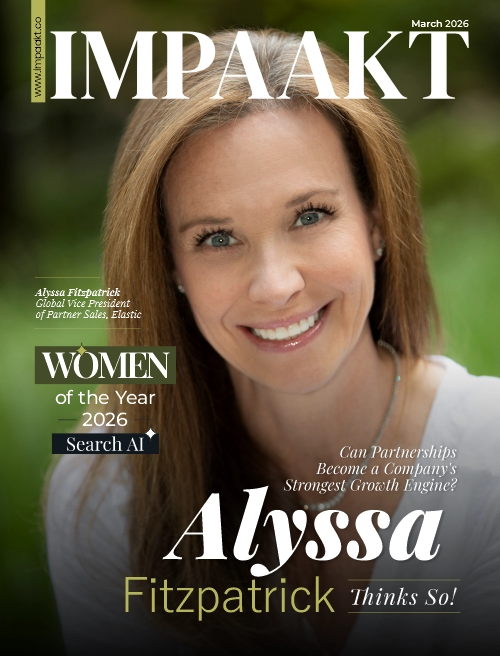
Technology partnerships today are no longer about logos on slides or last-minute co-sell motions. They are about trust built over time, ecosystems designed with intent, and leaders who understand that growth does not scale unless collaboration does. As AI, security, and data move from optional tools to business-critical infrastructure, the real differentiator is not who adopts technology first, but who knows how to connect people, platforms, and purpose into something durable.
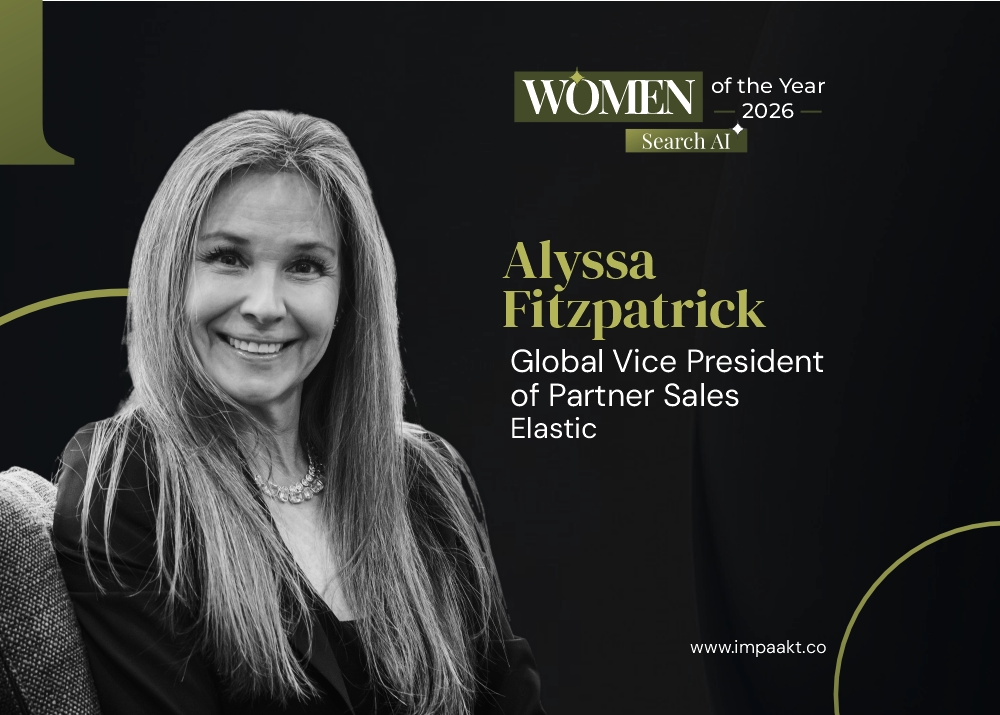
That philosophy sits at the heart of how Alyssa Fitzpatrick, Global Vice President of Partner Sales at Elastic, approaches leadership. With a career shaped by curiosity rather than comfort, Alyssa has built, rebuilt, and transformed partner ecosystems across consulting, enterprise software, and global technology organizations. At Elastic, she stepped into a role that required more than scale. It demanded structure, clarity, and the patience to turn fragmented efforts into a unified, partner-powered growth engine. Her work reflects a rare balance of strategic rigor and human judgment, where AI accelerates decisions, partnerships mature with trust, and teams grow because they understand the why behind the work.
Inspired by how she connects ecosystems, people, and long-term value, we sat down with Alyssa to explore the decisions, beliefs, and experiences shaping her leadership journey.
Here are the excerpts from the interview:
Alyssa, you’ve worked across some of the most influential technology ecosystems — from alliances and consulting to global partner strategy. When you look back, what has been the consistent thread that’s guided your decisions?
The consistent thread has been curiosity and learning — building a career by leaning into new challenges as they emerged rather than repeating the same experiences.
Early in my career I started at Andersen Consulting (now Accenture), which gave me exposure to corporate structure, customer segmentation, industry alignment and the breadth of applicable technologies. From there I moved into enterprise software and global roles, working in Europe for several years, and later across the span of strategic alliances, ISVs, channels, distribution, and direct sales. Each move wasn’t about a title — it was about gaining a capability I didn’t yet have and stretching my comfort zone.
Over time I realized I was learning and creating a “recipe.” I learned how consulting organizations approach complex problems, how software companies build products, how partners go to market, and how ecosystems scale. None of those skills alone makes a leader in partnerships — but together they do.
I’ve always leaned into curiosity. Whenever I encountered something new — a different partner model, a new geography, a new business motion — I raised my hand and stepped in. I made it a habit to say YES. Sometimes that was intentional planning, sometimes it was simply following opportunities opened through my network. But the pattern was consistent: diversify experience so you can connect dots others can’t.
You joined Elastic in 2024 during a major AI acceleration moment. What excited you most about stepping into this role — and what problem did you feel uniquely positioned to solve?
Elastic was exciting for two reasons.
First, the timing. AI was accelerating rapidly, and Elastic doesn’t just apply AI — it’s foundational to what the company does. My original academic focus was AI, and throughout my career I had worked adjacent to it at companies like Microsoft and Intel. Joining a company where AI is core to the platform felt like a full-circle moment.
Second, the opportunity. The existing partner engagement model was being driven across multiple teams, lacking global strategy and coordination. That meant Elastic had incredible potential and an opportunity to further align and unify its ecosystem strategy.
I came in thinking I would grow a partner business. What I discovered was the opportunity to build and scale it — to operationalize it and elevate it as a strategic pillar of the company.
My background across alliances, ISVs, co-sell, channel, distribution, and transformation uniquely prepared me for that. I’ve rebuilt organizations before, established trusted metrics with leadership, and aligned partner sales with company growth models. At Elastic, the work is about scaling the ecosystem in a way that strengthens our product-led foundation — extending our reach and impact through partner-powered collaboration. Fundamentally, I am working to expose and support a lucrative and powerful opportunity for our partners that we have not done yet at scale.
That’s a very different challenge — and exactly the kind I enjoy.
At Elastic, you’re scaling partnerships around AI, security, and data-driven solutions. How do you ensure partnerships are built around long-term value creation, not just short-term revenue?
I think the first step is making sure Elastic and our partners share an understanding of the relationship we want to build together.
Over the past couple of years, we’ve evolved how we engage — moving beyond just closing the deal in front of us, to planning how we’re creating sustained value over time. We focus on how we build capability, where we can innovate together, and what opportunity we create for customers when we combine our strengths.
It starts with being clear about the intent, and then building trust by saying what we’re going to do and consistently following through as a team. When partners see that consistency, the relationship naturally shifts from transactional to strategic.
That evolution is also reflected in our upcoming partner program relaunch — connecting partners to value across the entire customer lifecycle so we’re not just engaging at the point of sale (co-sell), but for co-innovation, co-marketing, co-delivery, managed services and ongoing success. When both organizations are invested in helping the customer succeed over time, growth follows for everyone involved.
You’ve helped scale partner ecosystems touching millions of customers globally. What’s the biggest misconception leaders have about building partner ecosystems today?
That it can happen fast.
Partner ecosystems are built on trust, capability, and mutual investment. None of that scale on a quarterly timeline. Leaders often expect immediate revenue impact, but real ecosystems require time to mature — and when they do, they become one of the most defensible growth engines a company can have.
But this does not mean, wait or expect less. It means impact can only happen if you start today and act everyday. Don’t wait…start now, keep going now.
AI is moving from experimentation to core infrastructure. From where you sit, what separates companies that use AI from companies that win with AI?
Clarity of purpose.
Companies that merely “use AI” scatter it across the organization — pilots everywhere, inconsistent data, disconnected outcomes. It becomes noise.
Companies that win with AI start with a defined problem. They know what decision AI should improve, what data powers it, and how humans will act on the output. AI becomes a capability embedded into workflows rather than a feature layered on top.
The human element is critical. AI does not replace human judgment — it accelerates it. It helps us ask better questions and get faster answers, but people still determine how those answers are used.
Winning companies design AI as a complement to human decision-making, not a substitute.
You’ve helped lead integrations, co-sell motions, and global channel transformations. What’s the hardest part of driving change across massive organizations — and how do you personally navigate it?
People process change at different speeds.
A strategy communicated once will be interpreted a hundred different ways. Successful transformation requires acknowledging that reality and addressing it deliberately.
I focus on four things:
- Make the strategy simple — Everyone must understand their role in it.
- Give time to absorb — Leaders have lived with the idea longer than the organization has, it takes time for everyone to comprehend change
- Provide a roadmap — Change cannot be delivered in unpredictable fragments, predictability will lead to higher success
- Maintain a feedback loop — If you ignore signals from the organization, change fails.
People accept change when they see their contribution matters and when they believe leadership is listening. Ownership creates adoption.
You’ve built a career in spaces historically dominated by technical and sales-heavy leadership cultures. What shifts are you seeing today — and what still needs to change?
Respect in the room has improved. Representation has not improved enough.
Today, when women are at the table, their voices are heard more equally than earlier in my career. That’s meaningful progress.
But there are still not enough women in senior leadership and executive positions, particularly in technical and sales-driven organizations. Mentoring becomes scarcer at higher levels — not because of lack of intent, but because there are fewer women available to guide the next generation.
Mid-career support networks exist. Senior-level sponsorship needs strengthening.
Real change will come when leadership pathways become visible and accessible, not just aspirational.
What do you look for when building global partner teams — skills, mindset, or something harder to define?
I start with skills — experience matters. But skills alone don’t build great teams.
I look at three deeper qualities:
- Origin of experience — How did they develop those skills? What environments shaped them?
- Culture fit — Empathy and willingness to listen are essential in partner leadership.
- Diversity of thought — I intentionally build teams of people who think differently.
Partner ecosystems are complex. A team of identical thinkers solves problems the same way every time. A diverse team finds better answers.
When you think about your career long-term, what kind of impact matters most — industry transformation, people you’ve mentored, or something else entirely?
For me, it’s less about a single achievement and more about creating space for broader thinking and better collaboration.
Throughout my career I’ve intentionally moved across different roles, industries, and business models because I’ve learned that the best solutions rarely come from one perspective. They come from people combining experiences and challenging each other’s assumptions.
The impact that matters most to me is helping teams operate that way. When people feel heard, understand the “why” behind decisions, and see how their piece connects to the whole, they contribute differently. The work improves, but more importantly, the team grows — individuals become more confident decision-makers and better leaders themselves.
If I’ve done my job well, my legacy won’t just be business outcomes or transformation initiatives. It will be organizations that continue to collaborate openly, solve problems more creatively, and develop leaders who naturally bring others into the process.
If someone reads about your career 20 years from now, what do you hope they understand about how you built partnerships, teams, and opportunities?
My career has been driven by three personal rules:
- Say yes whenever possible: Opportunities rarely appear perfectly aligned with your readiness. You grow into them.
- Step outside your comfort zone: The experiences that feel uncomfortable are usually the ones that expand you the most.
- Do it now: Waiting reduces opportunity. Action creates learning.
I’ve also always believed in being prepared. For me that meant continuing to invest in certifications, education, executive training, leadership workshops and new technical skills — so when an opportunity appeared I was ready, or ready to be ready. I also hired people willing to take similar leaps, because innovative teams are built by individuals comfortable with uncertainty.
If someone looks back years from now, I don’t want them to remember specific roles or companies. I want them to see a pattern: someone who was curious, fearless in learning, and always willing to jump into the water— even before knowing how deep or dark it might have been.
That mindset created the partnerships, the teams, the growth, and the career full of incredible opportunities.