A student can score well in an examination and still feel unprepared for the world waiting outside the classroom. The ability to question assumptions, adapt to unfamiliar situations, recover from setbacks and make confident decisions rarely fits neatly into a report card. Yet these are the very skills that shape how individuals navigate life long after the examinations are over.
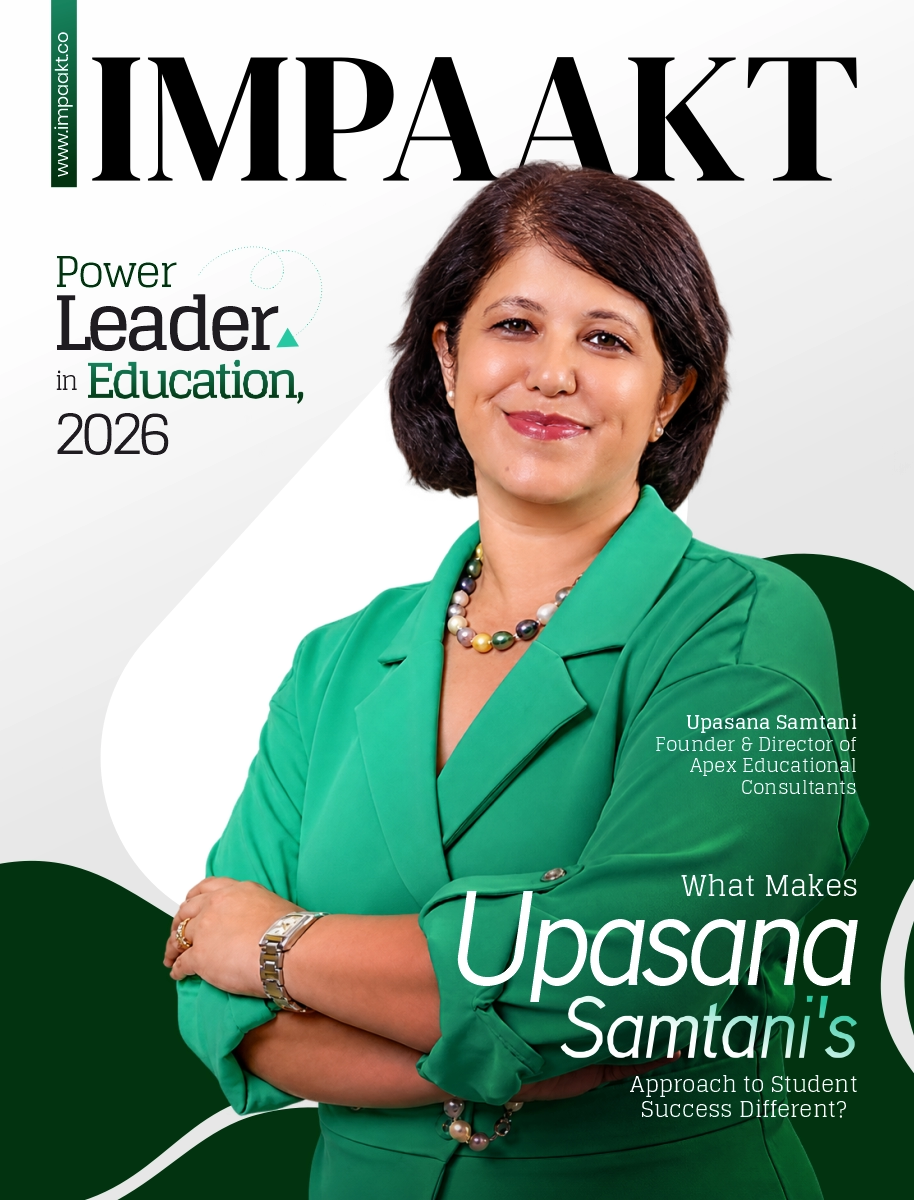
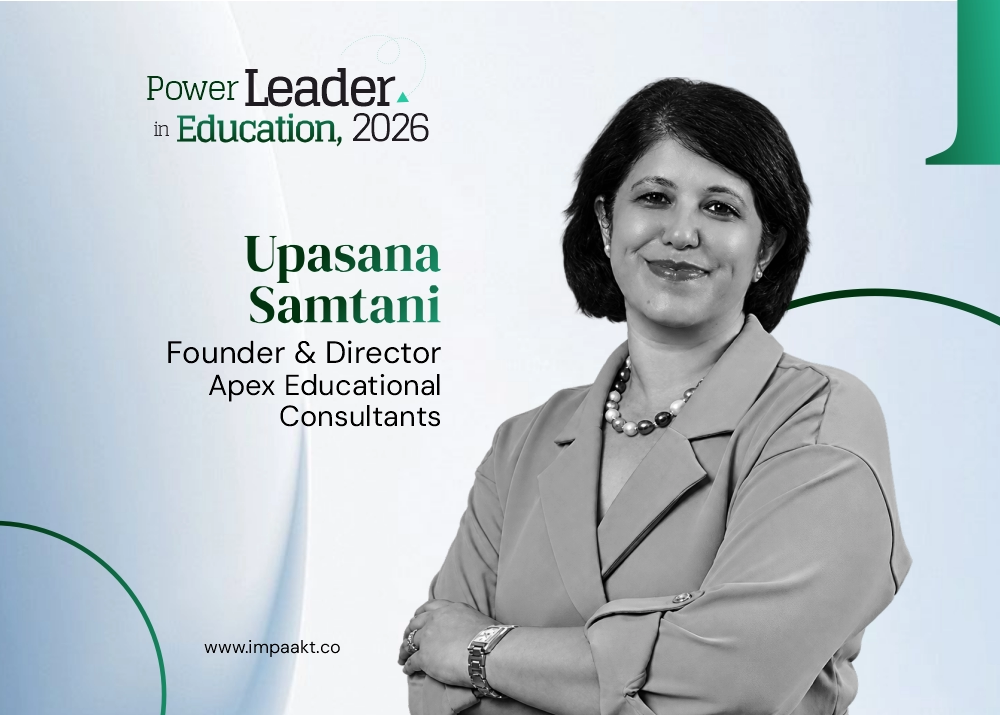
For Upasana Samtani, Founder & Director of Apex Educational Consultants, this broader understanding of education comes from experience as much as conviction. Having worked across business consulting, finance, academia and education in India, the USA and the Caribbean, she has seen how learning takes on a different meaning when theory meets real-world challenges. Her experience as a lecturer and consultant has also reinforced the importance of understanding students beyond their academic performance.
When she founded Apex in 2020, during the height of the pandemic, she brought this perspective into her own venture. Her focus extends beyond helping students prepare for examinations to building their confidence, nurturing curiosity and encouraging them to pursue opportunities that may initially feel daunting. Inspired by her belief that education should equip individuals for much more than their next examination, we spoke with Upasana Samtani about her journey, her philosophy and the future she hopes to shape through Apex.
Upasana, your career has moved across business consulting, finance, academia and education, across several countries and very different professional environments. What first drew you toward education, and how has your broader business experience shaped the way you approach it?
I have been fortunate to have had the opportunity to work in diverse fields in India, the USA and the Caribbean. I hail from a business family and have always been an academic – hence my journey thus far, as I believe that learning never stops at a certain stage of our professional lives.
When I look back, my journey into education feels less like a deliberate career decision and more like something that gradually revealed itself to me. I’ve always been someone who was curious. Even before education became part of my professional life, I found myself naturally drawn to conversations where I was learning something new. When I moved into academia and education, it felt like I was bringing together parts of myself that had been developing throughout my career.
My business experience has shaped the way I teach by keeping me grounded in the real world: theory needs context, ideas need to be tested, and learning should ultimately help people navigate real decisions and real challenges.
So, in a sense, the different chapters of my career are not as disconnected as they might appear. They have all taught me something about learning, about people, and about how we can help one another grow—and that has become the thread connecting everything I do
Having taught subjects ranging from finance and economics to entrepreneurship and strategic planning, what have you come to believe students need to learn beyond what a traditional classroom or curriculum can provide?
Growing up in India, my own education was, in many ways, quite theory-heavy. There was a strong emphasis on learning the material, remembering it, performing well in examinations and getting the “right” answer. I’m grateful for the discipline and academic foundation that gave me, but as I moved through my career, I began to appreciate what was missing: opportunities to question, experiment, make mistakes, and connect what we were learning to the world around us.
One of the biggest things my own career has taught me is that some of the most important lessons are the ones you don’t find in a textbook.
They are the ability to ask questions, adapt when circumstances change, work with very different kinds of people, and be comfortable saying, “I don’t know yet, but I’ll figure it out.”
Moving between countries and between very different professional environments taught me that what works in one context may not work in another. It made me more comfortable with ambiguity and, perhaps more importantly, taught me to listen before assuming I understood the situation.
Some of the most valuable opportunities came from being willing to step into something unfamiliar. I once read a quote somewhere “everything you want, is on the other side of fear” and that has stuck with me ever since. When students are working on their college applications and feel daunted applying to schools of a certain prestige, I always remind them that they need to pull aside that curtain of fear and just go for it! You just never know where the chips might fall!
Standardised tests continue to play an important role in determining access to higher education, while students are also facing an increasingly complex set of choices about where and what to study. What do you think students and parents often misunderstand about preparing for this journey?
Most 18-year-olds don’t know for certain what they want to pursue as a career for the rest of their lives. I know I didn’t! What I did know, however, was that a strong foundation and a strong work ethic would take me very far.
Standardised tests can place tremendous pressure on students and their families—academically, financially, and emotionally. It is important to recognise that this journey is a marathon, not a sprint.
Focusing exclusively on academics can lead to lopsided development. Education should be about developing the whole individual—building character, resilience, curiosity, confidence, and the ability to navigate challenges, alongside academic achievement. Students should allow themselves to make mistakes along the way, while remaining steadfast in making the most of whichever opportunities might come their way.
You have worked with learners preparing for very different examinations, from school-level assessments to graduate and professional entrance tests. What separates effective preparation from simply spending more hours studying?
Across all age groups, what separates effective preparation from simply spending more hours studying is having a clear methodology that works for each individual. This could mean studying during the hours when you are most productive, putting your phone on “Do Not Disturb,” having an accountability partner or study buddy, or finding other strategies that help you stay focused and consistent. The key is not necessarily to study more, but to understand how you study best and build a routine around that.
You have also experienced education from the perspective of a lecturer, consultant and now an entrepreneur building your own educational venture. How has each of these roles changed the way you think about the responsibility of an education leader?
As a lecturer, I was closest to the student—I could see how much of an impact the right guidance could have on their confidence and outcomes. It taught me that education is ultimately about people, not just content or results.
As a consultant, I began to see the broader ecosystem. I worked with different institutions, and that made me appreciate how many factors shape educational outcomes—from methodology and resources to family expectations and access to the right support.
Now, as an entrepreneur building my own educational venture, I feel an even greater sense of responsibility; I am helping design the systems, culture and experience around it. That means being accountable for the quality of what we offer
Across all three roles, one belief has become stronger: an education leader has to balance academic excellence with empathy, integrity and a willingness to continuously learn. The goal should not simply be to help students achieve a particular score or qualification, but to give them the skills, confidence and mindset to keep learning and growing long after that particular milestone is behind them
There is often a tension in education between personal attention and the need to build an organisation that can serve more students. How do you think educational businesses can scale without losing the individual attention that students ultimately value?
To build a venture in the field of higher education, I personally believe that a founder should have experience on both sides of the table – as an educator, as well as someone with strong business acumen. Fortunately, I have had the privilege of experiencing both, and I draw heavily on these experiences to ensure that we do absolute justice to every student who entrusts us with such an important part of their individual academic journey.
It is equally important to build a team that shares the same vision and passion. When we remain focused on the human element—bringing out the very best in each individual and helping them achieve meaningful, lasting success—the financial success of the operation follows naturally.
WHAT DOES IT TAKE TO BUILD A SUSTAINABLE EDUCATION VENTURE?
BUSINESS ACUMEN
Build for the long term.
EDUCATIONAL EXPERIENCE
Understand learning from the inside.
THE RIGHT TEAM
Bring together people who share the same vision.
PERSONAL ATTENTION
Give every student’s journey the consideration it deserves.
ACCESS TO OPPORTUNITY
Use technology and networks to reach learners across geographies.
Build around people. Grow with purpose.
Your background in financial management and strategic planning gives you a perspective that is somewhat unusual in the education space. What lessons from the world of business do you think education leaders could apply more often?
A sound financial perspective enables leaders and founders of educational ventures to build organisations that are designed for the long haul rather than operate as fly-by-night businesses. The demographics of the country or region in which a venture operates undoubtedly play an important role in determining its success. However, the beauty of an educational venture lies in the fact that learning—and the provision of educational services—has few physical boundaries. With the aid of learning platforms, social media and strong professional networks, an education venture can reach learners across geographies, creating enormous potential for scalability.
I also strongly believe that, just as with corporates, educational organisations have a social responsibility to support worthy individuals through complimentary or subsidised services. In doing so, we can help broaden access to opportunity and, ultimately, redefine futures—one person at a time.
Technology and AI are rapidly changing how students learn, prepare for examinations and access information. Where do you see technology genuinely improving education, and where do you think the human role will remain difficult to replace?
Technology and AI are transforming the education landscape, and I see their greatest value in making learning more personalised, accessible and efficient. AI can help students identify gaps in their understanding, adapt practice to their individual needs, provide instant feedback and make high-quality resources available at a much greater scale. It can also take away some of the more repetitive administrative tasks, allowing educators to spend more time on the areas where they add the greatest value.
That said, I do not believe technology can replace the human element of education. A student is not simply a collection of data points or test scores. Understanding what motivates an individual, recognising when they are struggling with confidence rather than content, knowing when to support them, and building the accountability and trust needed to keep them moving forward are deeply human functions.
In my experience, the most effective model is therefore not technology versus people, but technology empowering people. AI can provide the data, personalisation and efficiency; an experienced educator brings context, judgement, empathy and encouragement. Ultimately, technology can make education smarter and more scalable, but it is the human relationship that makes it meaningful and transformative.
After working within established organisations and now taking the entrepreneurial route yourself, what has building something of your own taught you about leadership, decision-making and knowing when it is time to create a new path?
Working within established organizations provided me with a defined structure and hierarchy, allowing me to focus primarily on my own role and responsibilities and deliver on them efficiently.
The idea of building an educational venture came to me at a time when my family had relocated to Jamaica from the US. I was at a stage in my career where I did not feel ready to start all over again within a new organization, working my way up from the beginning.
Instead, I chose to channel that same effort and energy into building something of my own. It took immense grit, enthusiasm and strategic planning, particularly as I embarked on this journey at the height of the pandemic in 2020!
When you look ahead at the next generation of students, what kind of educational ecosystem do you hope to help build through Apex, and what would make you feel that your work has made a lasting difference?
At Apex, we believe in nurturing curious minds and fostering a lifelong love for learning. As a founder, my vision is to build an institution where learning knows no boundaries. With the support of AI, social media and evolving digital platforms, I believe the possibilities for making diverse learning opportunities more accessible are truly limitless.
Beyond academic excellence, my team and I aspire to empower every individual who walks through our doors to become the best version of themselves. The Japanese concept of ikigai — finding purpose and meaning in what we do — is deeply embedded in our philosophy and in our approach to holistic development. It is this commitment to nurturing well-rounded individuals with a sense of purpose, that inspires and drives us every single day.