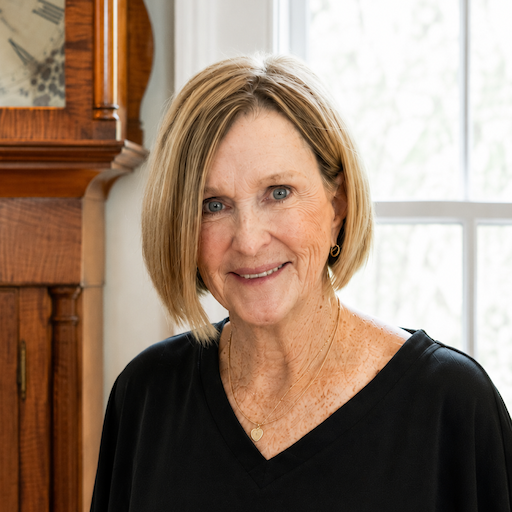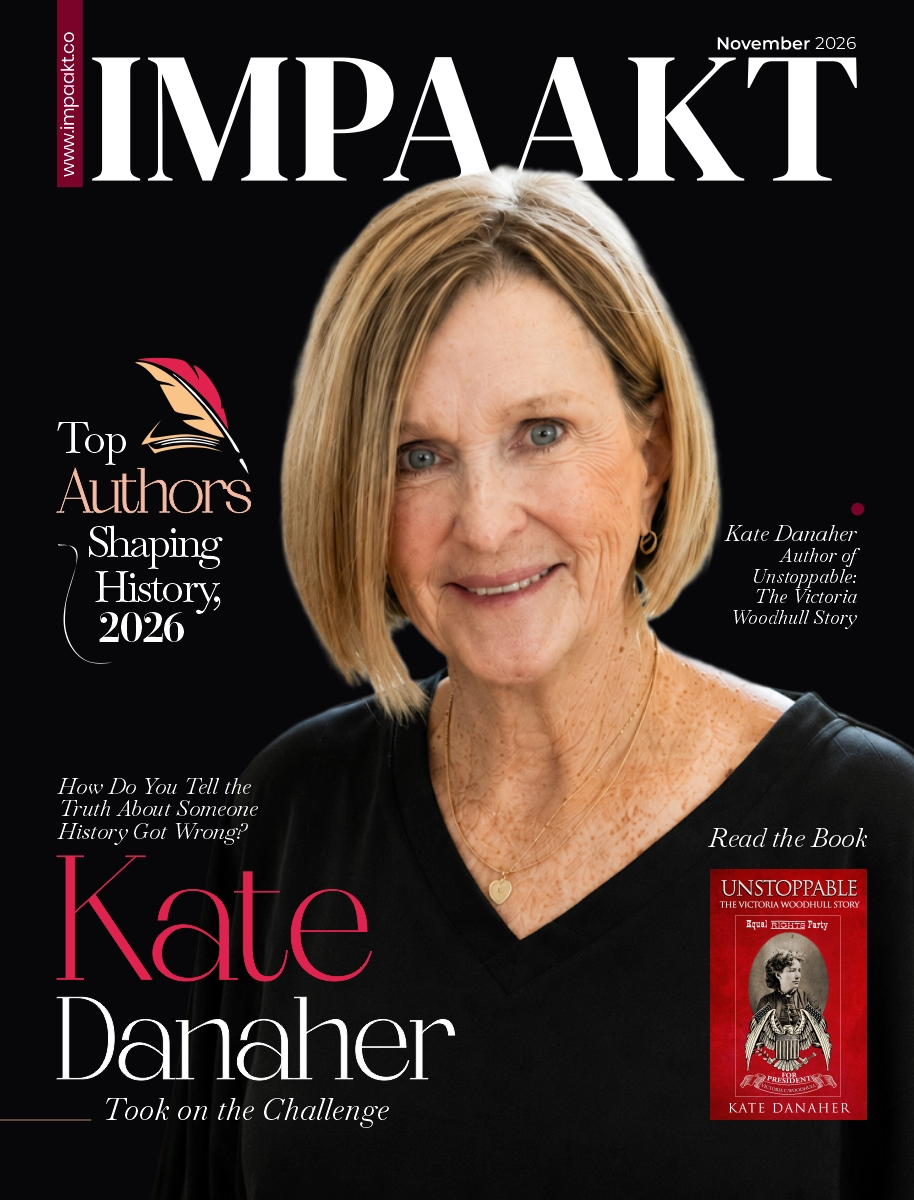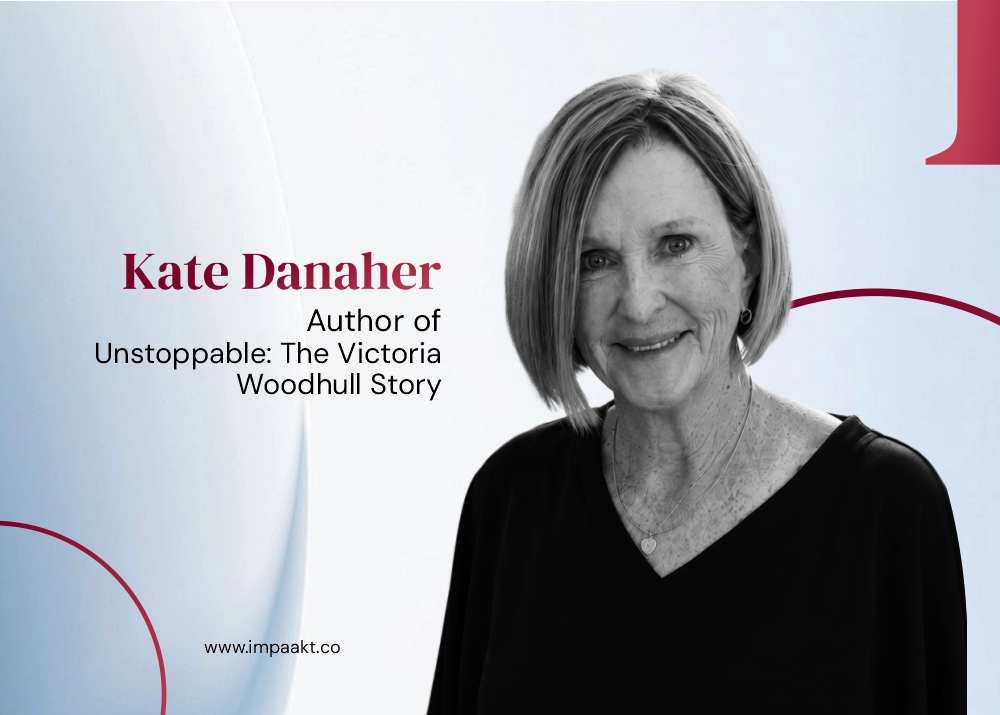
History has a curious way of remembering women who refuse to stay in their place. Sometimes, it remembers the controversy before the courage, the scandal before the substance, and the headline long after the person behind it has disappeared.
Victoria Woodhull was one such woman.
In 1872, she announced her candidacy for the U.S. presidency at a time when women could not even vote. She became a Wall Street broker, newspaper publisher and political reformer, spoke publicly about women’s equality and economic independence, and challenged ideas about marriage, labour and women’s place in society. She was also arrested on Election Day. Yet over time, the sensational stories surrounding her began to overshadow the woman herself.
For Kate Danaher, that was the part that refused to make sense. How could someone so remarkable be so forgotten?
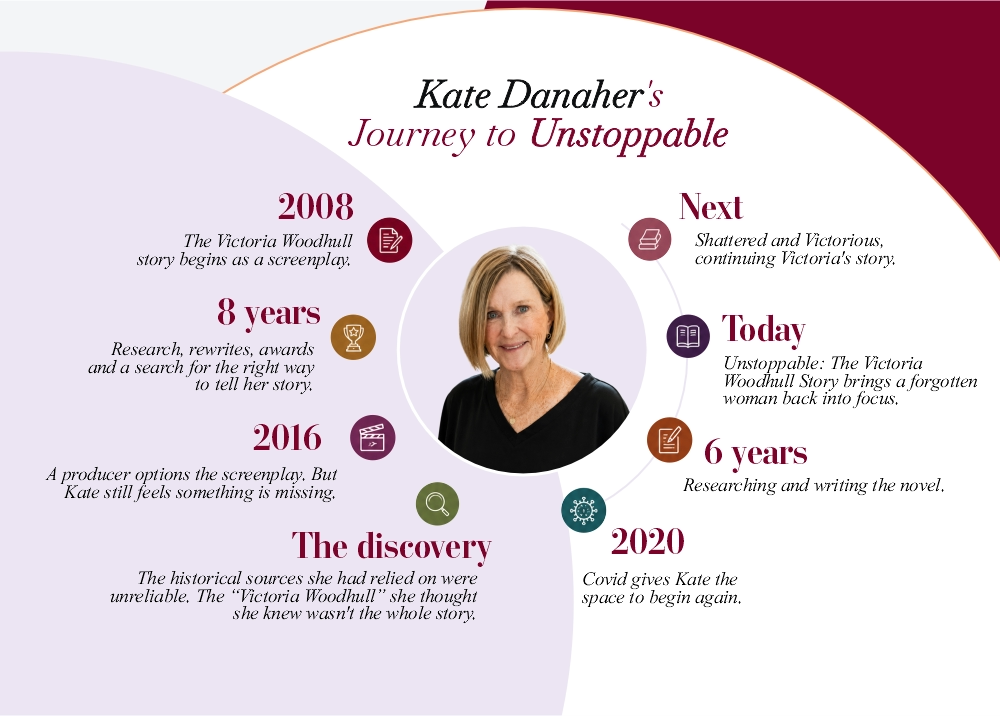
That question first led her to Victoria. What began as a screenplay in 2008 turned into years of research and, eventually, a startling discovery: much of the story Kate thought she knew about Victoria was built on unreliable accounts. The woman she found in the historical record was far more complex, ambitious and fascinating.
So Kate went back to the beginning. After years of teaching literature, writing screenplays and performing as an Irish storyteller, she wrote Unstoppable: The Victoria Woodhull Story, her first novel later in life. The book became her way of looking beyond the headlines and giving Victoria the space to be understood on her own terms.
There is a striking parallel between the two women. Victoria spent her life asking, “Why not?” Kate found herself asking the same question of her own creative journey. Inspired by her determination to uncover the woman behind the myth, we got into conversation with Kate Danaher to explore Victoria’s story, the making of Unstoppable, and why some stories deserve to be told again.
Here are the excerpts from the interview:
Kate, you spent years teaching English literature, studying storytelling, writing screenplays and performing as an Irish storyteller before publishing your first novel. What was it about Victoria Woodhull’s story that finally made you want to become a novelist?
I think I was drawn to Victoria Woodhull because, at first, I couldn’t understand how I had never heard of her.
Here was a woman who, in 1872, announced her candidacy as the first woman to run for U.S. President at a time when she couldn’t vote for herself. Then, she was jailed on Election Day. She had a difficult childhood yet became a Wall Street broker, newspaper publisher, and a political reformer. She spoke publicly about women’s equality, marriage, labor and women’s right to control their own lives. She dared to imagine herself at the center of American political life when almost no one believed a woman belonged there. She seemed so very modern. Yet she remains, generally, our forgotten first.
My screenwriting partner and I delved right in. That was in 2008. We won many screenwriting awards, but did not find a producer. Someone in Hollywood told me no one would do a period drama—it just wouldn’t pay. My partner finally moved on to other projects, but I wanted to keep at it—I knew people loved period stories. Two years later Downton Abbey became a smash hit.
The problem was that with each version of the screenplay I wrote, I never felt I had captured
Victoria’s essence, even though I was then winning awards like Best Period Drama and Outstanding Drama. Nevertheless, in 2016, eight years after I first put pen to paper, a producer called and asked to option the script. I said no, I still didn’t like it. But we worked together, revised it, became Sundance finalists, and had even begun turning it into a series. We both had concluded that Victoria’s story was too vast and complex to compress into a two-hour movie.
But then we learned the most shocking thing: what we had written was all wrong. I had found an independent Woodhull historian, Mary L. Shearer. She agreed to read our script because we assured her that we wanted to be true to the spirit of Victoria Woodhull. We waited anxiously to hear from her, only to learn that the “historical” sources we had relied on were, in fact, unreliable. We had believed the sensational story about Victoria Woodhull and had missed the true one.
The producer and I resolved to start over, but then she was in a bad car accident, moved out of LA, and the project was put on hold. But I, of course, could not get Victoria out of my mind. Eight years of work lost—or was it? Was there something to be salvaged from having travelled so long on that wrong road? I was determined to find out where those myths originated and why I had believed them. I spent years reading, researching, and talking to Mary. And then, when Covid hit in 2020, I decided to write a novel.
I knew a novel would give me the room to do what needed to be done. I could remain faithful to the historical record while exploring the emotional spaces between the documented moments— the choices, fears, hopes and private conversations that might have shaped a woman who lived such an extraordinary public life.
Victoria did not wait until the world was ready for her. She simply stepped forward. That idea resonated with me, as I began writing my first novel later in life. Victoria had spent her life asking, why not? It took me six years to finish, but writing Unstoppable became my own way of asking the same question.
What did you discover about Victoria during your research that made you think, this woman needs to be remembered differently?
I learned Victoria Woodhull was not born into poverty, her family fell into it, and that distinction matters. I learned her father was not the con man he was made out to be; she was not an “amazing child clairvoyant,” starved and forced to work. She was not “the prostitute who ran for president,” and she was not a scandalous “free lover.” These descriptions, some of which come from generally respected texts, have shaped the way generations of readers have understood her, but they bear little resemblance to the woman I found in the historical record.
The woman I finally found was far more complicated—and far more interesting—than the caricature I first met in my reading. I learned she cared deeply about the condition of women, particularly about their lack of economic independence. She grew up in Ohio equal to her brothers in ways that shaped her profoundly. She could chop wood, plant a garden, and do the hard physical work expected of boys. She saw no reason why the rules should suddenly be different when she entered the larger world. The sense of her own capability stayed with her, as she moved from one world to another and made herself heard.
I also learned that she exposed hypocrisy and sexual misconduct in her newspaper and was arrested on the technicality of obscenity, just before Election Day. She did not simply, as one scholar put it, “write obscene literature about her critics.” And she wasn’t afraid—she was determined to right the wrongs, whatever the price. She was ambitious, intellectually curious, and remarkably resilient.
What particularly struck me was the seriousness of her political thinking. In January 1871,
Victoria became the first woman to address the House Judiciary Committee, arguing that the Fourteenth and Fifteenth Amendments already protected women’s right to vote. The committee rejected her interpretation, but her argument was serious enough to encourage women—Black and white—and even Susan B. Anthony, to try to vote. Four years later, her same argument was presented to the Supreme Court in Minor vs. Happersett.
Before she was a scandal, she was a political radical. And what she demanded in her time is what we take for granted today. That, to me, is the Victoria Woodhull who deserves to be remembered.
For readers meeting Victoria for the first time through your book, how would you describe the woman behind the historical headline?
I would describe Victoria Woodhull as a woman of enormous vitality who refused to live quietly. She was charismatic, provocative, and extraordinarily self-confident. She could be charming and persuasive, but she could also be uncompromising. She had an instinct for finding the door that was supposed to be closed to her—and then walking through it.
What makes Victoria so fascinating to me is that she was never simply one thing. She was a businesswoman and a political radical, a spiritualist and a newspaper publisher, a devoted mother and a woman who challenged conventional ideas about marriage and relationships. She could move from Wall Street to a political rally, and from the world of spiritualism to the halls of Congress.
She was a woman who had experienced enormous hardship and had spent years learning of the hardships of others. She worked as a medical clairvoyant. That can sound like a fortune teller to us today, but that wasn’t really the role. People went to her for guidance about their health and lives, somewhat as people might consult a life coach today. She counseled both men and women, with particular concern that both should marry only for love, and not for money.
Ultimately, I think Victoria’s greatest quality was her refusal to accept that other people had the right to define the boundaries of her life. That is the Victoria I hope readers meet in Unstoppable: not the scandalous figure who has too often dominated the literature, but a complicated, passionate, fiercely determined woman who believed that the future could be different—and had the audacity to try to make it so.
Victoria was both admired and fiercely criticized. Do you think she was misunderstood because she was ahead of her time, or because she challenged too many conventions at once?
I think it was both—but challenging too many conventions at once made Victoria particularly threatening, especially as she was a woman who refused to be quiet and who claimed not just equality, but authority. She didn’t ask men to speak on her behalf. She spoke for herself, expected to be heard, and intended to change the rules.
Victoria not only challenged the behavior of individuals, but also the entire political, economic, and religious system of her day. While many reformers picked one issue to focus on, Victoria found that virtually impossible. In her mind all the systems intersected, and change was a complex movement, with progress in one system affecting the others.
Had Victoria confined herself to one acceptable cause, perhaps she would have been an easier person for her contemporaries to embrace. But she crossed boundaries everywhere she went. For some people, that combination was exhilarating. For others, it was intolerable. Victoria was not rejected simply because she was “ahead of her time.” She was challenging the rules while the people who benefited from those rules were still writing them.
Was there a moment in your research when you found yourself thinking, cannot believe she actually did this?
In February 1876, Victoria delivered a lecture in Memphis, Tennessee, entitled “The Human Body, the Temple of God,” in which she stated: “We are looking forward to the Amalgamation of the Races. The time is rapidly approaching when the Saxon, Latin, Teuton and Slav will be represented in one grand American people.” She delivered this lecture, the newspaper reported, to a crowded house, which greeted her with respectful attention, breathless interest, and, at the close, with prolonged and thundering applause.
More than 150 years later, women have run for President many times, but the barriers around women and political power continue to be debated. What makes Victoria’s story feel surprisingly contemporary?
What makes Victoria’s story feel so contemporary is that the questions she raised and the reservations about female political figures have not entirely disappeared. And something else remains true today: women who step outside accepted roles are often judged differently from men who do exactly the same thing.
An ambitious man can be called visionary. But a woman displaying the same ambition is more often called aggressive, difficult, or presumptuous. Victoria Woodhull and Hillary Clinton both encountered that double standard in its most extreme form. Both were called nasty. And both spoke of men’s determination to bring them down. Also, both Victoria’s and Hillary’s actions in their marriages caused people to complain: Hillary should have divorced her husband, and Victoria should not have done so!
Another interesting comparison with Victoria is Elizabeth Dole, who was often described as having an “iron hand in a velvet glove.” In public, Elizabeth was charming and empathetic, but when it came to her work, she was intense and demanding. I think Victoria may have been like that, too. She often started her speeches in a quiet, ladylike manner. Then, when she knew she had captured her audience by first being what they expected her to be, she became more forceful and passionate.
In 1872, Victoria put herself forward as a candidate for president even though women could not vote. She wasn’t waiting for the political system to invite her in. She was challenging the system to explain why she did not belong there. She thought women were entirely unaware of their power, that they submitted to their marital slavery. A woman, she wrote, is “like an elephant led by a string…. I am sometimes out of patience at the servility with which women fawn upon their masters, when they might lead them by the nose wherever they please.”
Yet I don’t think the lesson of Victoria’s life is simply that women still face barriers, whether imposed by others or accepted by themselves. It is also that barriers can be challenged long before they disappear. Victoria was living in a country that had not yet accepted the idea of a woman as a political leader, but she behaved as though that future was already possible. She didn’t need permission from her time period to imagine herself there. That makes her story feel surprisingly modern.
Do you believe the United States will elect a woman president, and do you think the significance of that moment will be different from what people imagine today?
Yes, I believe the United States will elect a woman president. The more interesting question, to me, is not whether it will happen, but what we will think about it when it does. I suspect that the moment will be both enormously significant and surprisingly ordinary. There will be celebrations, of course, and rightly so. Generations of women will recognize the significance of seeing a woman occupy the highest political office in the country. But I also hope that, by then, it will no longer seem astonishing that a woman is capable of doing the job. And I think Victoria would appreciate that distinction.
When you’re writing about a real person, where do you draw the line between historical fact and imagining what might have happened behind the scenes?
For me, the historical record is the foundation. I never want imagination to contradict what we know to be true.
Researching Victoria Woodhull meant working with newspapers, speeches, legal and political records, biographies, correspondence and accounts of people who knew her. But historical records rarely tell us everything we want to know. They give us the public moments—the speeches, campaigns, arrests and newspaper battles—but they don’t always tell us what happened in the private spaces between those moments. That is where the novelist has to step in.
I think of it as a conversation between fact and imagination. The facts establish the boundaries.
Within those boundaries, I can ask: What might she have felt? What might she have feared? What might two people have said when no reporter was present? Those are questions a historian cannot always answer definitively. A novelist can explore them—but only if the exploration remains faithful to the character, the period, and the documented circumstances.
I was also conscious of not imposing twenty-first-century attitudes on a nineteenth-century woman. I wanted to understand the world in which she actually lived, including the assumptions and limitations that shaped her choices. The facts tell us what happened. Imagination allows us to explore what it might have meant to be there, and what it felt like to be Victoria Woodhull.
This is your first novel after an already rich creative career. Did becoming a novelist later in life change how you approached the blank page?
When you’re young, there can be enormous pressure to prove yourself—to establish a career, to be successful, to make the right choices. I had spent much of my life teaching English literature, writing screenplays and performing as an actor and an Irish storyteller. Each experience taught me something about language, character, structure and the power of a well-told story.
But none of them prepared me completely for sitting down and writing a novel.
A novel requires a different kind of patience. You write scenes that don’t work. You change direction. You question yourself. And then you get up the next morning and go back to the page. I think age gave me a certain freedom to do that. By the time I began writing Unstoppable, I understood that I didn’t need to prove everything in a single sentence or a single day. I had lived long enough to understand that the first version of something is rarely the final version—and that persistence is often more important than confidence.
After spending so much time with Victoria Woodhull, has she changed the way you think about ambition, courage or the women who come after her?
She has made me think differently about all three. Victoria first needed to establish herself as a “lady,” not as the “Mrs. Satan” people made her out to be. But once she established that, she emerged fully as Victoria —passionate, smart, ambitious.
Sometimes the people who seem unreasonable in their own time are the people who make the next generation’s possibilities seem reasonable. We may be nearing the time when women don’t have to hold back any more. I think she would say to the women of today: Let your freak flag fly!
What has publishing Unstoppable taught you about yourself that writing it could not?
Writing Unstoppable taught me that I could tell Victoria Woodhull’s story. Publishing it taught me that telling the story is only the beginning.
There is a strange vulnerability that comes with putting a book into the world. While I was writing, Victoria was my responsibility. I could research her, question her, argue with her, and spend years trying to understand her. Once the book was published, it no longer belonged entirely to me. It belonged to readers. That has required a different kind of courage. I’ve had to learn to put myself out there—to talk about the book, approach bookstores and organizations, give interviews, meet readers, and ask people to take a chance on a story about a woman who is still far less known than she should be.
I’ve also learned that publishing a book requires persistence in a way that writing one does not. There are disappointments, unanswered emails, doors that don’t open, and opportunities that don’t materialize. I’ve had to remind myself that those things are not a measure of the worth of the book. In some ways, that has brought me even closer to Victoria. She knew what it was like to have people dismiss her before they understood what she was trying to accomplish. She kept going anyway.
Publishing Unstoppable has taught me something I didn’t fully understand while I was writing it:
sometimes you have to become your own advocate for the story you believe deserves to be heard. But it has also taught me that, once the book is published, I have to let it go. There is always the temptation to wish you had added something else, or written some part differently, or not made some mistake. But I’ve had to learn that I can’t expect my writing to be perfect. I can only tell the story as honestly and fully as I can, and then let the readers make of it what they will.
 What is next for Kate Danaher? Is there another historical figure, untold story or creative form already calling your name?
There are two more chapters of Victoria Woodhull’s story that are already calling me. In fact, I am writing that next chapter now. To be called Shattered: The Victoria Woodhull Story, Volume II, it will cover the years just after her presidential campaign, when the forces she had challenged began closing in on her with relentless ferocity. A third volume, Victorious, will follow and cover the rest of her life.
Shattered will tell the story of how Victoria faced continued arrests, public attacks and devastating personal and financial losses. Most significantly, Volume II will take readers through the Beecher-Tilton trial, in which Victoria found herself at the center of a national battle over sex, marriage, morality and the double standard applied to men and women. The scandal erupted publicly after Victoria published her accusations against Henry Ward Beecher in 1872; the sensational civil trial followed in 1875.
What interests me most is what happened to Victoria after she had become famous—and then infamous. It would be easy to tell her story as a rise-and-fall narrative: an impoverished girl becomes a Wall Street entrepreneur, runs for president, captures the nation’s attention, and then sees everything collapse. But that isn’t the story I see.
Victoria was repeatedly knocked down, but she was remarkably difficult to extinguish. Shattered is about what happens when a woman who has spent her life refusing to accept other people’s definitions of her suddenly finds herself with almost everything at stake. I am finding that writing the second volume is different from writing the first. I already know Victoria intimately, but I also know how much she is going to lose. That makes the writing both more difficult and, in some ways, more compelling.
I don’t know whether Victoria will be the last historical woman whose story I tell. I suspect she won’t be. But for now, I’m not ready to leave her. There is still too much of her story that needs to be heard.
If Victoria Woodhull could read Unstoppable today, what do you imagine she would say to you?
I suspect Victoria would have opinions! She was not a woman who hesitated to tell people what she thought, so I can imagine her reading Unstoppable with a critical eye and probably finding a few things she would argue with me about.
But I know that, after any objections, she would say, “Thank you, Kate.” She would be glad that someone was finally trying to understand her. For more than a century, so much of the attention surrounding Victoria has focused on the scandal and controversy of her life. I wanted to look beyond the headlines and see the woman who kept getting back up.
Victoria Woodhull spent her life refusing to accept the limits placed on her. What is one limit, expectation or convention that you hope today’s women will feel empowered to question?
I hope women will question the expectation that they have to be finished becoming who they are. We are often given invisible timetables for our lives: when we should establish a career, when we should settle down, when we should accomplish something significant, and even when we are supposed to stop trying new things. Victoria Woodhull certainly didn’t. She reinvented herself again and again, often under circumstances that would have caused most people to give up. She refused to believe that one chapter had to determine the rest of her story. That is something I have taken personally from knowing her.
I published my first novel later in life, after years of teaching, storytelling, writing screenplays, and performing. If I had believed that certain opportunities belonged only to younger people, Unstoppable would never have been written. So, I would tell women: don’t let someone else’s timetable become the timetable for your life.
You may not be able to control every circumstance that comes your way. Neither could Victoria. But you can decide whether those circumstances get to define what is possible for you. As I mentioned earlier, sometimes the most important words in a woman’s life are simply “Why not?” Victoria asked it more boldly than most. I hope women today will keep asking it.