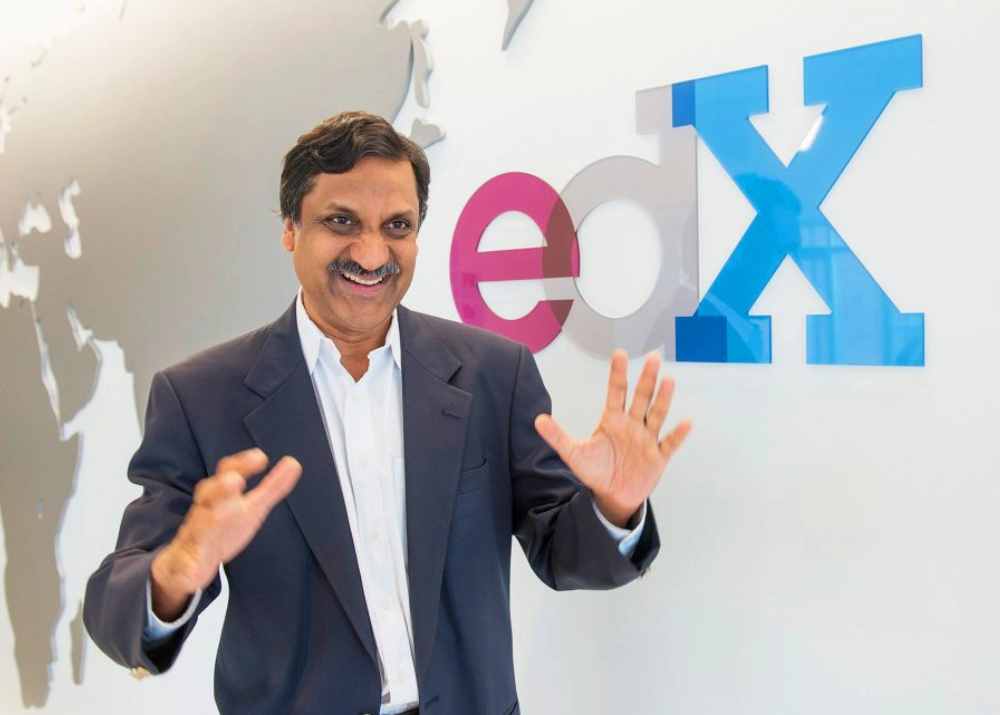
Some leaders build a product. Anant built a pipeline — one that let a teenager anywhere in the world sit, virtually, in a classroom at one of the most selective universities on the planet. And he did it not as a marketing stunt, but as a professor who simply refused to accept that a great education should be geographically rationed.
An engineer’s education, an engineer’s obsession
Anant trained as an electrical engineer, earning his undergraduate degree from IIT Madras before heading to Stanford for his master’s and PhD. He joined MIT’s faculty in 1988 and stayed there — building a reputation not just as a teacher, but as a serious researcher in computer architecture, eventually directing MIT’s Computer Science and Artificial Intelligence Laboratory (CSAIL). He also co-founded Tilera Corporation, a company built around multicore processor technology, proving early on that he wasn’t just a lab-and-lecture academic. He understood how to build things that shipped.
That combination — rigorous researcher and hands-on builder — is exactly what made his next move work.
The course that changed the model
In 2012, Anant taught MIT’s circuits and electronics course, 6.002, as one of the first offerings on what would become edX — a nonprofit online learning platform he founded in partnership between MIT and Harvard. The course pulled in students from across 162 countries. Not because it was easy or dumbed down, but because it was the real thing: MIT-calibre rigor, delivered without the price tag or the passport requirements.
That single course became proof of concept for an entirely new model of higher education — one where the credential mattered less than the actual mastery, and where geography stopped being the deciding factor in who got access to elite instruction.
Building the infrastructure, not just the moment
Plenty of educators have one viral course. Anant used his to build permanent infrastructure. Under his leadership, edX grew into a serious platform for free and low-cost online courses from top global universities, eventually merging into 2U, where Anant continued as Chief Academic Officer and later Chief Open Education Officer, shaping strategy for the broader online education ecosystem well beyond his own course material.
He never fully left MIT either. He remained on faculty even as he built and scaled edX, running both worlds simultaneously — a detail that says a lot about how seriously he takes the “professor” half of his identity, even after becoming a recognised entrepreneur.
What sets Anant apart
Anant’s throughline is stubbornly simple: access shouldn’t depend on privilege, and rigor shouldn’t be sacrificed for reach. He proved you could have both — free and elite, accessible and demanding — in the same course, the same platform, the same movement.
His work has been recognised widely: the Yidan Prize for Education Development, the Harold W. McGraw, Jr. Prize for Higher Education, the Padma Shri, and membership in the National Academy of Engineering. But the honour that probably matters most to him is a quieter one — the fact that a student with no connections, no capital, and no access to an Ivy League campus could still sit in his virtual classroom and walk away having genuinely learned something from MIT.
In an era where “scale” often becomes a euphemism for “diluted,” Anant built something that scaled without diluting. That’s the harder version of the job. He did it anyway.