Boardrooms across the world were filled with the same conversation. Strategic plans covered whiteboards. Market analyses sat in thick binders. Quarterly targets dominated every meeting. Yet something fundamental was missing. Leaders could articulate what their companies did and how they did it, but when asked why they existed beyond making money, the room went quiet.
This wasn’t a crisis of competence. These were brilliant executives running successful operations. But success without meaning creates a particular kind of exhaustion. Employees showed up but weren’t inspired. Customers bought products but weren’t loyal. Leaders achieved goals but couldn’t shake the feeling that something essential was absent.
The traditional leadership coaching model wasn’t designed to address this void. It focused on improving skills, refining strategies, and optimizing performance. All valuable, but all secondary to a more fundamental question: What purpose drives this organization, and does that purpose resonate with the people who give their lives to it?
Two leadership coaches recognized this gap and built their entire philosophies around filling it. They came from vastly different backgrounds and used completely different methodologies, but they shared a conviction that purpose wasn’t a luxury reserved for mission statements—it was the foundation upon which sustainable leadership must be built.
The Anthropologist Who Questioned Everything
Simon Sinek didn’t start his career intending to revolutionize leadership thinking. Born in Wimbledon, London in 1973, he studied cultural anthropology at Brandeis University—an academic path that taught him to look beneath surface behaviors to understand deeper human patterns. After graduation, he entered the advertising world, working at prestigious agencies like Euro RSCG and Ogilvy & Mather in New York.
But the corporate world left him disillusioned. He watched companies pour resources into marketing campaigns that focused obsessively on product features and competitive advantages. What they did, how they did it better than competitors—these questions consumed every strategy session. Yet the campaigns that truly moved people, that created genuine loyalty, operated on a different frequency entirely.
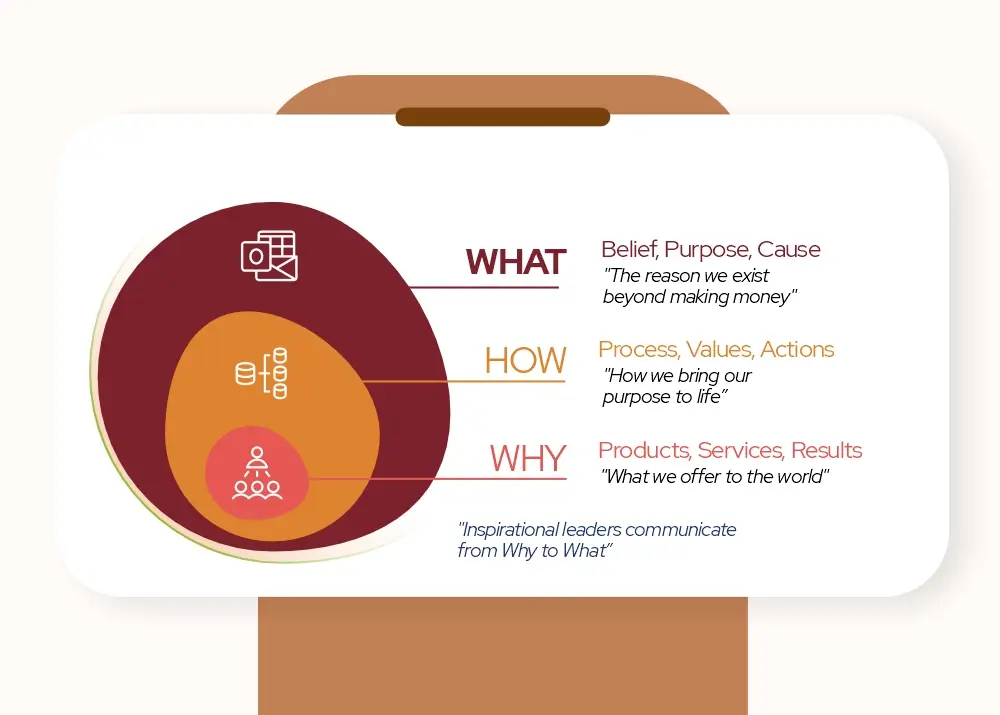
Sinek’s breakthrough came from observing a pattern that seemed obvious once seen but had remained invisible to most leadership thinkers. Every organization knew what it did. Most could explain how they did it. But very few could articulate why they existed beyond making profit. And here was the insight that would define his career: the most inspiring leaders and organizations thought, acted, and communicated from the inside out, starting with why.
In 2009, he published “Start With Why: How Great Leaders Inspire Everyone to Take Action.” The book introduced what he called the Golden Circle—three concentric circles with Why at the center, surrounded by How, then What. The concept was elegantly simple: people don’t buy what you do, they buy why you do it. Employees don’t commit to tasks, they commit to causes.
His TED Talk explaining these ideas became one of the most-watched presentations in TED history, resonating with millions of viewers who recognized the truth in his message. But Sinek wasn’t interested in just delivering inspiring speeches. He wanted to fundamentally change how leaders approached their roles.
Through Sinek Partners, the consultancy he founded, he began working with organizations to help them discover and articulate their why. This wasn’t about crafting clever mission statements. It was archaeological work—digging through an organization’s history, its founding moments, its proudest achievements to uncover the core belief that had always driven it, even when that belief had never been named.
His subsequent books deepened this philosophy. “Leaders Eat Last” explored how purpose-driven cultures create psychological safety where people can thrive. “The Infinite Game” challenged the prevalent obsession with winning and losing, arguing that the most resilient organizations play for a cause bigger than themselves. “Find Your Why” provided practical tools for individuals and organizations to conduct this discovery process.
Sinek’s impact extended beyond private sector consulting. He became an adjunct staff member of the RAND Corporation, bringing his purpose-driven approach to policy and defense strategy. His work demonstrated that whether leading a startup or advising on national security, the fundamental question remains the same: why does this matter?
The Transformer Who Demanded Total Change
Tony Robbins took a radically different path to the same destination. Born Anthony J. Mahavoric on February 29, 1960, in North Hollywood, California, his early life was marked by financial hardship and family instability. These circumstances could have limited him. Instead, they became the crucible that forged his philosophy: that human beings possess far more power to shape their lives than they realize, but first they must connect to a compelling reason for using that power.
Robbins began his career in the early 1980s promoting seminars for motivational speaker Jim Rohn. But he quickly recognized that inspiration without transformation was entertainment, not coaching. In 1983, he founded Robbins Research International and began developing an approach that combined Neuro-Linguistic Programming techniques with his own insights about human psychology and peak performance.
His early books, “Unlimited Power” published in 1986 and “Awaken the Giant Within” in 1991, established his core premise: before you can achieve anything meaningful, you must discover what drives you at the deepest level. Not surface desires for wealth or status, but the fundamental human needs that, when met, create lasting fulfillment.
Robbins identified six core human needs that drive all behavior: certainty, variety, significance, connection, growth, and contribution. His coaching methodology centered on helping leaders understand which needs dominated their decision-making and whether those needs aligned with their stated purposes. A leader driven primarily by significance and certainty would build a very different organization than one driven by growth and contribution.
His intervention events became legendary. “Date with Destiny,” his signature program, immersed participants in intensive multi-day experiences designed to strip away surface explanations and get to core motivations. The firewalking exercise that became his trademark wasn’t about conquering fire—it was a metaphor for confronting the fears that prevent people from pursuing their true purpose.
What separated Robbins from conventional motivational speakers was his willingness to work with elite performers. Bill Clinton sought his counsel. Serena Williams credited him with helping her reconnect to her love of tennis beyond just winning. Marc Benioff, the founder of Salesforce, consulted with him while building one of the world’s most purpose-driven companies. These weren’t people who needed basic motivation. They needed someone who could help them clarify the why beneath their extraordinary what.
In 2002, Robbins partnered with psychotherapist Cloe Madanes to create the Robbins-Madanes Training Center, developing Strategic Intervention coaching. This methodology synthesized psychology, strategic planning, and purpose discovery into a framework that could be taught to other coaches. The goal wasn’t to create Tony Robbins clones but to spread the philosophy that transformational leadership begins with internal clarity about purpose.
The 2016 Netflix documentary “Tony Robbins: I Am Not Your Guru” gave the world an unfiltered look at his methods. What emerged wasn’t slick corporate training but raw, emotionally intense work that forced participants to confront the gap between their daily actions and their deeper purpose. Critics called it manipulative. Participants called it life-changing. What was undeniable was that Robbins refused to let leaders hide behind professional personas or strategic jargon. If you couldn’t name your why, you weren’t ready to lead.
Two Philosophies, One Truth
Sinek and Robbins approach purpose from opposite directions. Sinek comes from anthropology and observation, building his methodology by studying patterns in successful organizations. Robbins comes from personal transformation and intervention, building his methodology by directly confronting individual psychology. Sinek asks leaders to discover their organizational why through historical analysis and cultural examination. Robbins demands they confront their personal why through intensive emotional and psychological work.
Yet both arrive at the same destination: sustainable leadership cannot be built on strategy and tactics alone. Before you optimize how you execute or what you deliver, you must be absolutely clear on why you exist. This clarity isn’t philosophical luxury—it’s practical necessity.
When organizations operate from a clear why, decision-making becomes simpler because every choice is filtered through that purpose. When leaders connect to their authentic why, they stop performing leadership and start embodying it. When employees understand the why, they don’t need to be managed; they manage themselves in service of something they believe in.
The traditional leadership model asked coaches to make leaders more effective at achieving predetermined goals. The purpose-driven model asks a more fundamental question: are those goals worth achieving? And if they are, can the leader articulate why in a way that inspires others to join the mission?
Both Sinek and Robbins have been criticized. Sinek’s critics argue his framework is too simple, reducing complex organizational dynamics to a single question. Robbins’ critics question whether his intensive intervention methods create lasting change or temporary emotional highs. These critiques miss the point. Neither coach claims to have invented purpose. They simply recognized that in an era where knowledge work dominates, where talented people can choose where to invest their energy, leaders who cannot articulate a compelling why will lose the war for hearts and minds—regardless of how sophisticated their strategy or how generous their compensation.
The Leadership Coaching Revolution
The impact of purpose-driven coaching extends far beyond individual leaders. It represents a fundamental shift in how we think about organizational life. For decades, the dominant paradigm treated work as a transaction: employees traded time and effort for compensation. Purpose-driven coaching rejects this transactional model entirely.
When Sinek works with a company to discover its why, he’s not improving the transaction—he’s transforming it into a covenant. When Robbins guides a leader to connect with their deepest motivations, he’s not enhancing their productivity—he’s unleashing their capacity for significance. Both understand that human beings are meaning-making creatures who will always ask why, whether their leaders answer that question or not.
The organizations that thrive in the coming decades won’t be the ones with the best strategies or the most resources. They’ll be the ones that can answer the why question with such clarity and authenticity that talented people line up to join them, customers become advocates, and leaders find meaning rather than just achievement in their work.
This is the revolution that purpose-driven leadership coaching has sparked. It’s not about doing leadership differently. It’s about being a different kind of leader—one who understands that people follow those who know where they’re going and, more importantly, why the destination matters.