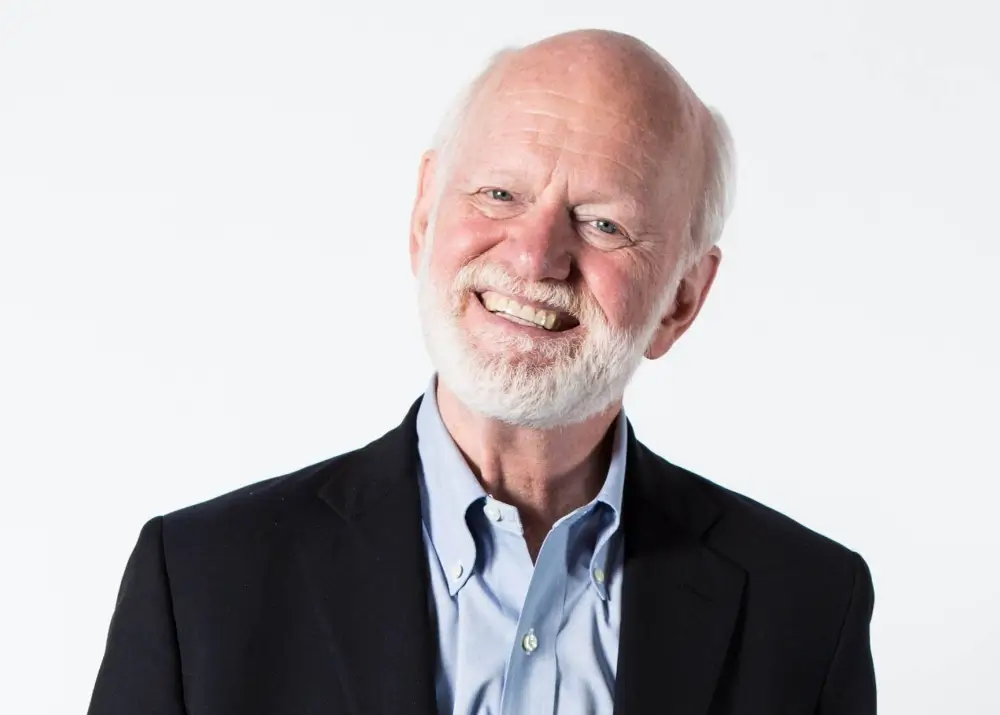
There’s an uncomfortable truth about success: the very habits that get you to the top are often the ones that keep you from going further. While most leadership coaches focus on what executives need to learn, Marshall Goldsmith built his reputation on something far more difficult—teaching them what they need to stop doing.
For over four decades, this Kentucky-born leadership thinker has been the quiet force behind some of the world’s most visible transformations. When Ford needed Alan Mulally to turn around an ailing giant, they brought in Goldsmith. When executives at Coca-Cola, GE, and over 150 other Fortune 500 companies hit their ceiling, his phone rang. Today, at 76, he remains the only person to be named the world’s most influential leadership thinker twice by Thinkers50, and has held the title of the world’s top executive coach for over a decade.
From Mathematical Economics to Human Behavior
Goldsmith’s journey began in Valley Station, Kentucky in 1949, in a world far removed from corner offices and boardrooms. He earned his degree in mathematical economics from Rose-Hulman Institute of Technology in 1970, followed by an MBA from Indiana University’s Kelley School of Business. But it was his 1977 PhD in organizational behavior from UCLA that set the foundation for what would become a revolutionary approach to executive development.
The academic credentials opened doors, but Goldsmith’s real education came from a more practical source. After a brief stint as an associate dean at Loyola Marymount University’s College of Business, he made a decision that would define his career: he walked away from the security of academia to work directly with leaders who needed to change. Not leaders who were failing, but leaders who were succeeding—yet knew they could be better.
The Stakeholder Revolution
In 1987, Goldsmith did something that seemed counterintuitive. Instead of positioning himself as the expert who fixes broken executives, he created Stakeholder Centered Coaching—a methodology that essentially fired the coach from the center of the process. The radical idea: a leader’s progress shouldn’t be measured by the coach’s assessment, but by the people who work with that leader every single day.
The methodology was deceptively simple. Through anonymous feedback from colleagues, direct reports, and board members, leaders identify one or two behaviors holding them back. Then comes the hard part—they tell their stakeholders exactly what they’re working on, ask for suggestions, and check in regularly on their progress. The coach becomes an orchestrator, not a savior. The stakeholders become the real coaches.
It was a philosophy shaped by his early mentor, Paul Hershey, who instilled in Goldsmith a principle that seems obvious now but was revolutionary then: coaching effectiveness can’t be judged by the coach alone. What matters is whether the people around the leader see real change.
The approach worked. Goldsmith built a guarantee into his process that few in the industry dared to offer: measurable improvement or no fee. Over 30 years, this process has been refined with more than 250,000 individuals from the world’s top organizations. The Marshall Goldsmith Group, founded around 2009, now sits at the center of the world’s largest network of executive coaches, with over 4,000 certified practitioners.
Words That Changed Conversations
Walk into any executive suite today and you’ll likely hear phrases that Goldsmith popularized. “What got you here won’t get you there”—the title of his 2007 bestseller that won the Harold Longman Award as Best Business Book of the Year. The book identified 20 workplace habits that sabotage success, from the need to win every argument to the compulsion to add too much value. It became a Wall Street Journal and New York Times number one bestseller, selling millions of copies in over 36 languages.
But Goldsmith didn’t stop there. His 2015 book “Triggers” explored why brilliant people with the best intentions still fail to change, offering a daily question process that forces honest self-assessment. His most recent work, “The Earned Life,” published in 2022, pushed leaders to question the Great Western Disease: “I’ll be happy when…” Instead, he argued for finding fulfillment in the process, not just the outcome.
Amazon recognized two of his books among the Top 100 Leadership and Success Books ever written. He’s the only living author with two titles on that list.
Legacy Beyond the Client List
In 2016, Goldsmith launched what might be his most enduring contribution: 100 Coaches. This pay-it-forward initiative brings together the world’s most accomplished leadership thinkers and practitioners to mentor the next generation. Unlike traditional consulting, there’s no fee. The only requirement: that participants pay it forward to others.
The initiative reflects Goldsmith’s fundamental belief that success isn’t about accumulation—it’s about impact. His volunteer work spans the Peter Drucker Foundation, World Bank, Mayo Clinic, and the U.S. military. He established scholarships at the University of Central Florida for executive coaching and leadership development. He teaches at Dartmouth’s Tuck School of Business, not because he needs to, but because he believes in shaping the next generation of leaders.
Today, Goldsmith lives in Nashville with his wife Lyda, maintaining the same disciplined approach he teaches. He writes prolifically, sharing insights across social media where he ranks 58th among all content creators on LinkedIn out of 250 million users. His work has been featured in major publications from Forbes to The Wall Street Journal.
The Paradox at the Core
What makes Goldsmith’s impact so profound is the paradox at its center. He became the world’s most successful leadership coach by insisting that he shouldn’t be at the center of the transformation. He built a fortune helping executives see that their success isn’t about them—it’s about how they make others better. And he earned global recognition by teaching that titles, money, and possessions aren’t the measure of success. The measure is simpler: are you becoming the best version of yourself?
In an industry often criticized for vague promises and unmeasurable results, Goldsmith offers something rare: a methodology with four decades of proof, a guarantee of results, and a philosophy that challenges everything executives thought they knew about what makes them successful. The leaders he coaches don’t just perform better. They fundamentally change how they show up, how they listen, and how they lead.
That’s not coaching. That’s transformation. And that’s why, at 76, Marshall Goldsmith remains the standard by which all executive coaches are measured.