How Women CEOs Are Leading Bold Technology Transformations
In the corner offices of global corporations, there’s a recurring tension between protecting what exists and investing in what could be. Most CEOs opt for the former—incremental improvements, safe bets, quarterly wins. It’s understandable. Shareholders demand predictability. Boards want proven strategies. Wall Street rewards consistency.
But some leaders refuse that calculus entirely. They look at industries on the verge of seismic shifts and make a different choice: bet everything on the future, even when the present is uncertain. What’s remarkable isn’t just that these leaders exist—it’s that when you examine the boldest technology transformations of the past decade, women CEOs are disproportionately leading them.
This case study examines two such leaders: Lisa Su at AMD and Ginni Rometty at IBM. Both inherited companies at crossroads. Both made billion-dollar bets on emerging technologies before market consensus emerged. Both faced skepticism, resistance, and risk. And both fundamentally reshaped their industries by refusing to accept the status quo as inevitable.
The Courage to Scrap Everything and Start Over
When Lisa Su became CEO of AMD in 2014, the company was hemorrhaging money and relevance. Intel dominated the processor market with an iron grip. AMD’s products were viewed as budget alternatives—cheaper, yes, but slower and less efficient. The company had spent years trying to compete on Intel’s terms, and it was losing badly. Debt was mounting. Market share was shrinking. The existential question wasn’t whether AMD could beat Intel. It was whether AMD could survive at all.
Su’s response was radical: stop trying to beat Intel at their own game and change the game entirely.
She made a decision that stunned the industry. AMD would abandon its existing processor roadmap—products that had consumed years of development and millions in investment—and build something completely new from scratch. The project was called Zen, a chiplet-based architecture that would fundamentally reimagine how processors were designed and manufactured.
The risk was extraordinary. Zen would take years to develop. During that time, AMD would have to compete with outdated products while investing heavily in R&D it could barely afford. If Zen failed, AMD would likely be acquired or dismantled. But Su had conviction. She believed the future of computing wasn’t just about raw speed—it was about efficiency, scalability, and adaptability. Chiplets could deliver all three.
Su also did something counterintuitive: she drastically narrowed AMD’s focus. The company had been trying to compete in too many markets with too few resources. Su cut underperforming product lines, exited unprofitable businesses, and concentrated everything on high-performance computing, data centers, and gaming—markets where AMD could differentiate itself. It was a ruthless prioritization exercise, but it freed up resources and organizational energy for the Zen bet.
Critically, Su didn’t just invest in technology. She invested in relationships. She brought customers like Hewlett-Packard into the development process early, understanding their needs and constraints. She built partnerships with companies like Microsoft and Sony for gaming consoles, ensuring AMD chips would power the next generation of PlayStation and Xbox. These partnerships weren’t just revenue streams—they were validation that AMD’s technology mattered.
The Zen architecture launched in 2017, and it changed everything. Suddenly, AMD processors were competitive with Intel’s best chips—and in many cases, superior. Data centers started switching to AMD. Gamers embraced the performance. The company that had been written off was back, and this time, it was leading.
What Su demonstrated wasn’t just technical vision. It was the courage to make a bet so large that failure meant the end of the company, and the discipline to execute it flawlessly over years. She showed that transformation isn’t about incremental improvements—it’s about having the conviction to blow up what isn’t working and build something better.
Redefining What a Legacy Company Can Become
If Lisa Su’s story is about focused reinvention, Ginni Rometty’s journey at IBM is about portfolio transformation at scale. When Rometty became CEO in 2012, IBM was still known primarily as a hardware and services company. The problem wasn’t that IBM was failing—it was that the market was moving to a place where IBM’s traditional strengths were becoming irrelevant.
Cloud computing was emerging as the future of enterprise IT. Companies like Amazon Web Services and Microsoft Azure were building public cloud platforms that fundamentally changed how businesses bought and deployed technology. IBM had legacy relationships with nearly every Fortune 500 company, but those relationships were based on selling hardware and consulting services. The cloud threatened to make both obsolete.
Rometty made a choice that would define her tenure: IBM wouldn’t try to beat Amazon and Microsoft at public cloud. Instead, it would bet on hybrid cloud—the idea that most enterprises would need to manage workloads across multiple clouds and on-premise systems. It was a contrarian position. The tech industry was convinced public cloud would dominate everything. But Rometty believed enterprises needed flexibility, security, and the ability to keep sensitive data on-premise while still leveraging cloud benefits.
To execute this vision, Rometty orchestrated the largest acquisition in IBM’s history: the purchase of Red Hat for $34 billion. It was an audacious move. Red Hat was a successful, fast-growing company with a strong culture. Integrating it into IBM—a company known for bureaucracy and slow decision-making—risked destroying what made Red Hat valuable. But Rometty understood that IBM needed Red Hat’s open-source credibility and its Kubernetes-based platform to make hybrid cloud work. She committed to keeping Red Hat operationally independent, preserving its culture while leveraging IBM’s enterprise relationships.
The Red Hat acquisition was only part of Rometty’s portfolio transformation. She divested billions in legacy businesses—selling IBM’s x86 server business to Lenovo, spinning off the managed infrastructure services division into a separate company called Kyndryl. These weren’t peripheral assets. They were businesses that had defined IBM for decades. But Rometty recognized they were anchors, not engines. Cutting them free allowed IBM to focus resources on cloud, AI, and emerging technologies like quantum computing.
Rometty also placed an early, massive bet on artificial intelligence through Watson. Years before AI became a mainstream business priority, IBM was investing billions in cognitive computing. Watson competed on Jeopardy! in 2011, demonstrating AI’s potential in a public, dramatic way. Rometty then tried to commercialize Watson across industries—healthcare, finance, customer service. The results were mixed. Some Watson initiatives succeeded; others failed to gain traction. But the investment positioned IBM as an AI leader and built capabilities that would become critical as generative AI emerged.
What Rometty demonstrated was a different kind of courage: the willingness to dismantle a legacy business model while building a new one, all while managing Wall Street’s expectations and navigating IBM’s complex internal culture. She showed that betting on the future doesn’t always mean building something from scratch—sometimes it means knowing what to keep, what to acquire, and what to let go.
What This Means for Business Leadership
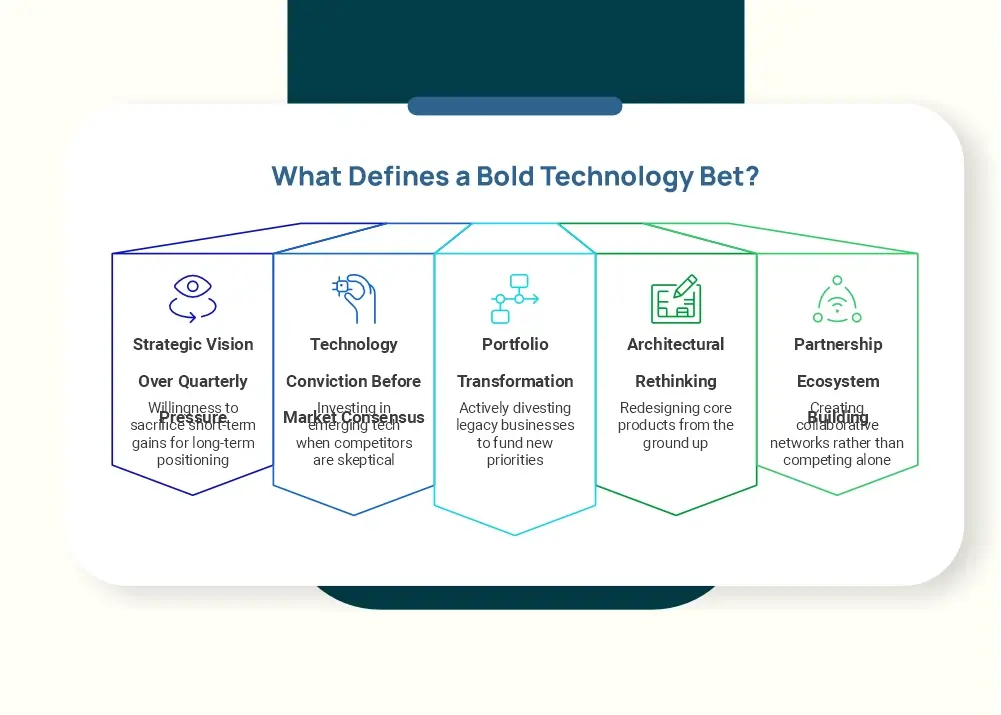
The transformations led by Lisa Su and Ginni Rometty offer a framework for how CEOs can lead through technological disruption. Several patterns emerge.
First, bold bets require abandoning attachment to legacy approaches. Su stopped trying to compete with Intel on Intel’s terms. Rometty accepted that IBM’s traditional hardware and services model was becoming obsolete. Both leaders recognized that defending the past prevents building the future.
Second, transformation demands focus. Su narrowed AMD’s scope dramatically, exiting markets where the company couldn’t win. Rometty divested businesses that consumed resources without driving strategic priorities. Neither leader tried to be everything to everyone.
Third, execution matters as much as vision. Su spent years developing Zen with meticulous attention to technical detail and customer needs. Rometty carefully structured the Red Hat acquisition to preserve what made it valuable while integrating it into IBM’s ecosystem. Vision without execution is fantasy.
Fourth, partnerships accelerate transformation. Su brought customers and partners into AMD’s development process. Rometty positioned IBM as the “Switzerland” of hybrid cloud—a neutral partner rather than a competitor. Both recognized that winning alone is harder than winning together.
Finally, these transformations required patience. Zen took years to develop. Hybrid cloud took years to validate. The leaders had to withstand skepticism, criticism, and pressure to pursue safer strategies. They needed boards and investors who would support long-term bets even when short-term results were uncertain.
The Lasting Impact
What Lisa Su and Ginni Rometty accomplished goes beyond saving or transforming their companies. They demonstrated that legacy technology companies aren’t doomed to irrelevance. With bold strategic vision, disciplined execution, and willingness to make uncomfortable decisions, even century-old companies can reinvent themselves for new technological eras.
They also proved something more fundamental about leadership: the best time to bet on the future is before everyone else sees it clearly. Su invested in chiplet architecture and AI-focused processors before AI became the defining technology trend of the decade. Rometty invested in hybrid cloud and AI before enterprises fully understood why they needed either.
That’s what separates bold bets from reckless gambles. Bold bets are grounded in deep understanding of where technology and markets are heading. They’re informed by customer needs and competitive dynamics. They’re executed with discipline and adjusted based on feedback. But they’re made before the path is obvious—because by the time everyone sees the opportunity, the window has closed.
For business leaders navigating their own transformations, the lesson is clear: waiting for certainty means waiting too long. The future belongs to those willing to bet on it while it’s still uncertain.