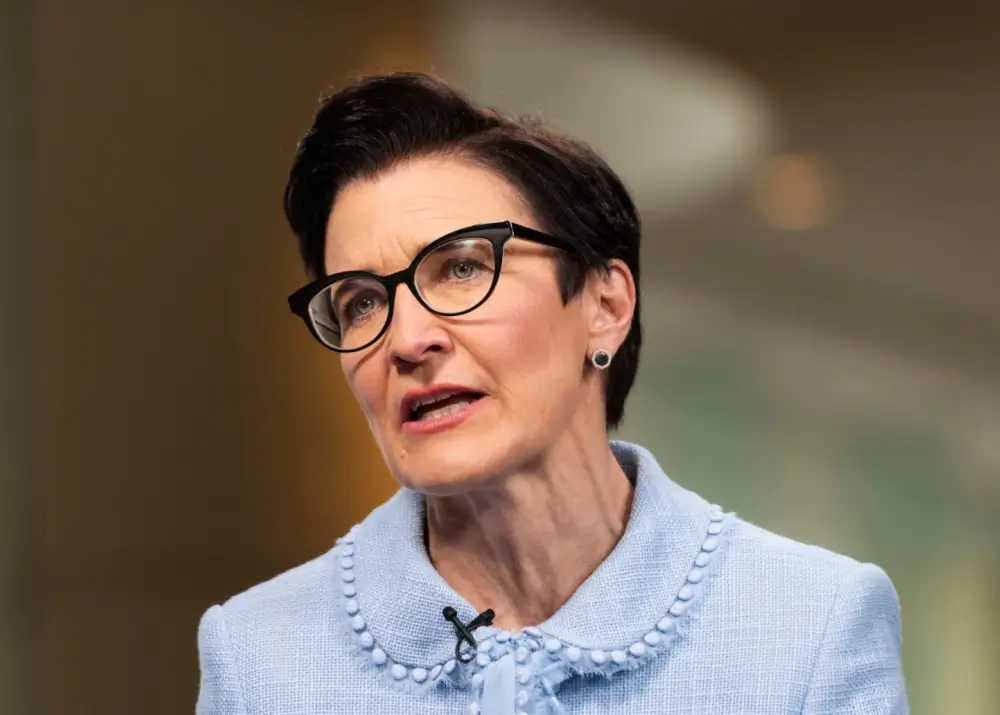
There’s a particular kind of pressure that comes with being first. It’s not just about doing the job well—it’s about redefining what the job can be. In March 2021, when Jane Fraser became CEO of Citigroup, she inherited more than a major Wall Street bank. She inherited 200 years of history, decades of structural complexity, regulatory scrutiny, and the weight of being the first woman ever to lead a major U.S. financial institution. The question wasn’t whether Fraser could handle the pressure. Her 20-year track record at Citi had already answered that. The question was whether she could do what nobody else had managed: make Citi live up to its potential.
Four years later, the answer is emerging. Under Fraser’s leadership, Citi posted net profits of $12.7 billion in 2024—a 37% increase from the previous year—and achieved its highest total revenues since 2010 at $81 billion. The bank’s stock became one of the best performers among U.S. and global banks in late 2024 and early 2025. More important than the numbers is what they represent: evidence that Fraser’s bold restructuring is working.
The Builder Who Learned to Break Things Down
Fraser’s path to Citi’s corner office was anything but conventional. Born in St. Andrews, Scotland, she spent her childhood caddying at the famous Old Course to earn pocket money. She studied economics at Cambridge University’s Girton College, then earned her MBA from Harvard Business School.
She started her career at Goldman Sachs in London, working in mergers and acquisitions. Then came a stint in Spain at a consulting firm where she learned Spanish—a skill that would prove critical years later. She joined McKinsey & Company and rose to partner, co-authoring a book about corporate globalization that cited Citigroup as an exemplar of how to build a truly global firm. That book caught the attention of Citi executives, and after years of recruitment efforts, Fraser joined the bank in 2004.
What followed was a masterclass in how to build credibility across a complex organization. Fraser led client strategy in investment banking, then became Global Head of Strategy and Mergers & Acquisitions during the 2008 financial crisis—a baptism by fire that involved restructuring the group, leading re-engineering efforts, and raising new capital. She turned around Citi Private Bank, taking it from a $250 million annual deficit to profitability. She ran CitiMortgage and U.S. Consumer and Commercial Banking.
Then came the role that set her apart: CEO of Citigroup Latin America. She was both the first woman and the first non-Latin American to lead the division. Her fluency in Spanish proved valuable as she managed operations across the region, including overseeing the troubled Banamex operation in Mexico. In 2019, she returned to New York as President of Citi and CEO of Global Consumer Banking, positions that made her the clear successor to CEO Michael Corbat.
The Transformation Nobody Thought Was Possible
When Fraser became CEO, she inherited a bank that analysts openly described as a “mishmash”—an institution caught in endless restructuring with a return on tangible common equity of just 7.3%, compared to JPMorgan’s 21%. Shareholders were exhausted. The bank’s regulatory challenges were well-documented. The structure was byzantine.
Fraser did what others had been unwilling to do: she blew it up and started over.
In September 2023, she announced the most consequential organizational changes to Citi in two decades. She eliminated layers of management, created five core businesses with direct accountability, and made the leaders of those businesses part of her executive team. It was a radical simplification—replacing a complex matrix structure with clear lines of authority and direct accountability for results.
But organizational charts don’t transform banks. Systems do. Fraser launched what she calls “the Transformation”—a multi-year effort to modernize Citi’s infrastructure, consolidate systems, retire legacy technology, and strengthen risk and controls. It’s unglamorous work, and it’s expensive. In 2024 alone, Citi continued investing billions in technology while simultaneously pursuing positive operating leverage across all five businesses.
The results are starting to show. Services, Wealth, and the U.S. Personal Bank all posted record revenues in 2024. Every business delivered solid earnings and positive operating leverage. The bank returned nearly $7 billion to common shareholders through dividends and share repurchases, and announced a $20 billion buyback program. In the first quarter of 2025, expenses declined 5% year-over-year while returns grew across all five businesses.
The Leader Who Refused to Play by Wall Street’s Rules
Fraser’s leadership style stands in stark contrast to the typical Wall Street archetype. While many major bank CEOs demanded staff return to offices full-time post-pandemic, Fraser maintained Citi’s hybrid work policy. She’s defended it consistently, citing the need to differentiate Citi during recruiting and acknowledging the realities of working mothers—a demographic she understands personally as a mother of two sons.
Her approach has been described as methodical and collaborative rather than showy. Colleagues note her emphasis on clarity, accountability, and detailed planning—traits reflecting her McKinsey background. She builds consensus and focuses on execution over visibility. In an industry that rewards loud confidence, Fraser leads with disciplined conviction.
First Woman, But Not the Last
Fraser was named Chair of Citi’s Board of Directors in October 2025, adding to her CEO title. She serves on the boards of the Business Roundtable, the Council on Foreign Relations, and the Partnership for New York City. She chairs the Financial Services Forum and sits on Harvard Business School’s Board of Dean’s Advisors and the Stanford Global Advisory Board.
But what Fraser represents transcends board positions and titles. She’s proving that a female CEO can lead a major Wall Street bank through a fundamental transformation. She’s showing that methodical, collaborative leadership can work in an industry that has historically rewarded aggressive, combative styles. And she’s demonstrating that you can restructure a global bank while maintaining flexibility for working parents and acknowledging the complexities of modern work life.
Four years in, Fraser’s transformation of Citi is far from complete. She’s targeting a return on tangible common equity of 10% to 11% by 2026—a waypoint, not a destination. But the foundations are in place: a simpler structure, stronger controls, modernized technology, and clear strategic priorities.
For an industry that has long struggled with change, Fraser offers something rare: proof that it’s possible. And for women across corporate America, she offers something even more valuable: evidence that the corner office isn’t just accessible; it’s conquerable.